ilkka_nissila wrote:
The authors of the Nature nanotechnology paper do not mention photography as a potential application for the metalens.
It still isn't suitable for normal photography (the latest metalens technology can work with light in the visible spectrum, but basically it's for a few discrete wavelengths only which means at best some shots of static studio subjects where color has to be "reconstructed"). But we might get there some day; progress in this area is pretty fast lately.
ilkka_nissila wrote:
The authors of the Nature nanotechnology paper do not mention photography as a potential application for the metalens.
So what? It is just one example of technological R&D taking place around the world. Neither you nor I, nor anyone else knows how different lenses may be in the future compared to what they are now.
Do you think 100 years ago that photographers had any concept of what modern DSLR’s would be capable of today?
arbitrage wrote:
The phrase "I only shoot FX" doesn't tell us much in Nikon land these days. For bird and wildlife I envision people either have the D850 or the D5.....those are two different types pixel density and therefore I think the focal length required differs between them. That assumes one is okay with cropping down to DX or further with a D850 file.
I agree that I usually need 850mm on 20MP FX. But on 46MP FX I can take into account the 1.5x "pixel crop factor" and then 500-600mm can be enough.
That said, I've recently been using 850mm on DX and D850 to get enough reach for songbirds and warblers so sometimes there never is enough
To Whayne's point, I'm not sure if a 600PF will be smaller than a 200-500? Also not sure if it will be lighter? The 400DOII is about the same weight as the 200-500 but I think the 600/5.6 will need to be longer than the 400DOII and will have a slightly bigger front element. But even if it is getting close to the 200-500 that would be a deadly weapon for sure.
Here is a survey for all interested in these type of lenses....if you had the choice between a 400 f/4 PF and a 600 f/5.6 PF at the exact same price, the 600 being a little longer (yet no longer once a 1.4 is added to the 400) and just slightly heavier (but probably fairly close), what would you prefer??...Show more →
You need to put the 600 PF in terms of a 300 f/2.8. A regular 600 f/5.6 would be longer naturally than a 300 f/2.8, but have same front element. If a 300 f/2.8 weighs 2.3-2.5kg, then I’d suspect a similarly built 600 f/5.6 woiuld weigh a few hundred grams more for the extra material in the lens body at best. Now a 600 f/5.6 PF would come in at least 30% smaller and lighter than a refractive 600 f/5.6. I’d say a 600 f/5.6 PF should be under 300mm in length and thus also come in closer to 2kg. Can’t really see how it can be otherwise. Look at the 300 f/4 PF its tiny compared to its refractive counterparts and 40% lighter.
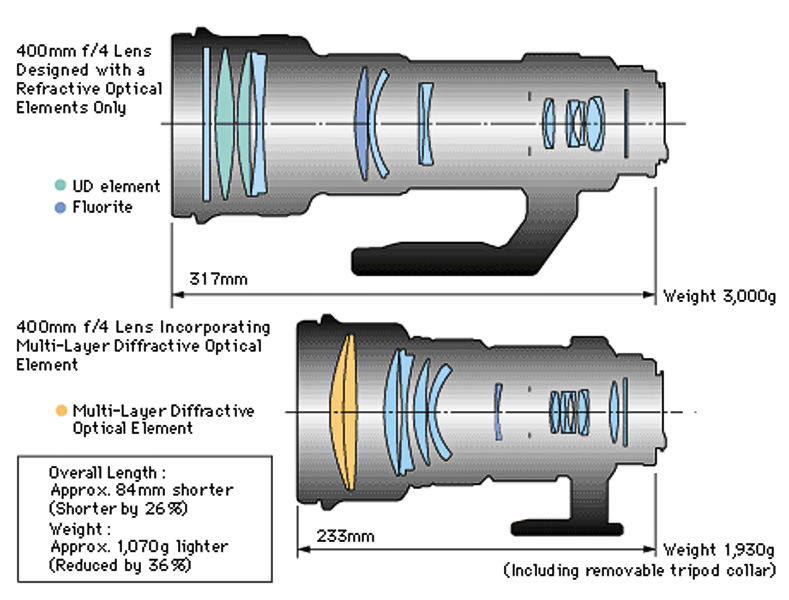
Hard to compare the Canon 400 DO to anything as there’s never been a 400 f/4 refractive design, but Canon claimed way back when the v1 was released it was over 30% lighter and shorter than their prototype 400 f/4 refractive lens.
Imagemaster wrote:
So what? It is just one example of technological R&D taking place around the world. Neither you nor I, nor anyone else knows how different lenses may be in the future compared to what they are now.
Usually researchers have far-fetching ideas of their invention's applications in the future. They have to think about these things to get funding.
You could make a camera that uses a metalens but a conventional lens produces a better quality image and transmits more light.
Do you think 100 years ago that photographers had any concept of what modern DSLR’s would be capable of today?
You must be very young and healthy. I don't have such expectations of long life myself.
Pixel Perfect wrote:
You need to put the 600 PF in terms of a 300 f/2.8. A regular 600 f/5.6 would be longer naturally than a 300 f/2.8, but have same front element. If a 300 f/2.8 weighs 2.3-2.5kg, then I’d suspect a similarly built 600 f/5.6 woiuld weigh a few hundred grams more for the extra material in the lens body at best. Now a 600 f/5.6 PF would come in at least 30% smaller and lighter than a refractive 600 f/5.6. I’d say a 600 f/5.6 PF should be under 300mm in length and thus also come in closer to 2kg. Can’t really see how it can be otherwise. Look at the 300 f/4 PF its tiny compared to its refractive counterparts and 40% lighter.
Hard to compare the Canon 400 DO to anything as there’s never been a 400 f/4 refractive design, but Canon claimed way back when the v1 was released it was over 30% lighter and shorter than their prototype 400 f/4 refractive lens. ...Show more →
You could also then compare the 400DOII to the 300/2.8II as the 400DOII has a slightly smaller front element in its favour and the weight savings aren't as substantial as your numbers above. The weight savings between those two designs is only 11%.
Canon's original 400/4 comparison posted below for those interested...
Personally I'd like to see a 500/4 PF and 600/4 PF more so than any of these f/5.6 ones...maybe Canon will release the 600 DO they say they are developing and drive me back to that camp
The original 400mm f/4 DO was lighter but wasn't as well received for its image quality.
I guess the main advantage in the 400mm DO IS II version is the shorter physical length (compared to a conventional 400mm f/4) rather than weight savings. This could also be why Nikon seem focused on smaller-aperture lenses for their PF series, to gain more weight savings.
The original 400mm f/4 DO was lighter but wasn't as well received for its image quality as the new version is. I guess the main advantage in the 400mm DO IS II (compared to a conventional 400mm f/4) is the shorter physical length rather than weight savings. This could also be why Nikon are working on smaller-aperture PF lenses: to gain greater weight savings.
ilkka_nissila wrote:
Usually researchers have far-fetching ideas of their invention's applications in the future. They have to think about these things to get funding.
You could make a camera that uses a metalens but a conventional lens produces a better quality image and transmits more light.
I would not be surprised to see such technology being used in photography within 10 years or so. But there will be compromises, just like with recent super-resolution microscopy techniques that seem to violate the laws of optics/physics. In reality they mostly strike different compromises than traditional microscopy which can work in very specific conditions but not for more general use where progress has been relatively minor over the last 100 years or so. More specifically, action shots in uncontrolled outside conditions like in nature photography are a very unlikely subject for implementing current metalens technologies.
---------------------------------------------
arbitrage wrote:
You could also then compare the 400DOII to the 300/2.8II as the 400DOII has a slightly smaller front element in its favour and the weight savings aren't as substantial as your numbers above. The weight savings between those two designs is only 11%.
Canon's original 400/4 comparison posted below for those interested...
That's a good analysis.
One of the problems is that while the DO/PF element itself can be very light/thin compared to a traditional lens, it needs structural support from a traditional lens element which gets increasingly costly (in weight and price) as the diameter of the lens elements increases. Because of this one can expect that the weight savings are less percentage-wise with bigger lenses, so the 40% weight loss in the 300PF is unlikely to be repeated in longer lenses. Also, this 40% savings is compared to the relatively heavy non-PF version, the old Canon 4/300 IS was already a bit lighter and a non-DO f/4 300mm with current lightweight construction materials might already come close to 1 kg.
It also means that there could be better weight savings when using less bright lenses, which could be a reason that Nikon goes for f/5.6 in the longer lenses. Of course there are other factors involved in the decision, like the different PF/DO technology that is used and probably has a bit different limitations than the one from Canon, and marketing factors.
technic wrote:
I would not be surprised to see such technology being used in photography within 10 years or so. But there will be compromises, just like with recent super-resolution microscopy techniques that seem to violate the laws of optics/physics. In reality they mostly strike different compromises than traditional microscopy which can work in very specific conditions but not for more general use where progress has been relatively minor over the last 100 years or so. More specifically, action shots in uncontrolled outside conditions like in nature photography are a very unlikely subject for implementing current metalens technologies.
---------------------------------------------
That's a good analysis.
One of the problems is that while the DO/PF element itself can be very light/thin compared to a traditional lens, it needs structural support from a traditional lens element which gets increasingly costly (in weight and price) as the diameter of the lens elements increases. Because of this one can expect that the weight savings are less percentage-wise with bigger lenses, so the 40% weight loss in the 300PF is unlikely to be repeated in longer lenses. Also, this 40% savings is compared to the relatively heavy non-PF version, the old Canon 4/300 IS was already a bit lighter and a non-DO f/4 300mm with current lightweight construction materials might already come close to 1 kg.
It also means that there could be better weight savings when using less bright lenses, which could be a reason that Nikon goes for f/5.6 in the longer lenses. Of course there are other factors involved in the decision, like the different PF/DO technology that is used and probably has a bit different limitations than the one from Canon, and marketing factors....Show more →
Canon wouldn't use it's premium magnesium alloy in a 300 f/4 class lens and the weight savings in a 300mm lens are much smaller than a 400mm+ which is why the 300 f/2.8L II was only 200g lighter than the mk I, whilst the 500mm was 600g lighter and the 400/600mm were more like 1.4kg lighter. A 300 f/4 would only benefit less than a 100g, so we might go from 1.2kg to 1.1kg.
Nikon's PF lens will probably be polycarbonate anyway giving it a bit of an edge in weight compared to a regular supertele.
Pixel Perfect wrote:
Canon wouldn't use it's premium magnesium alloy in a 300 f/4 class lens and the weight savings in a 300mm lens are much smaller than a 400mm+ which is why the 300 f/2.8L II was only 200g lighter than the mk I, whilst the 500mm was 600g lighter and the 400/600mm were more like 1.4kg lighter. A 300 f/4 would only benefit less than a 100g, so we might go from 1.2kg to 1.1kg.
Nikon's PF lens will probably be polycarbonate anyway giving it a bit of an edge in weight compared to a regular supertele.
If Canon doesn't want to use magnesium that's a marketing decision, not a cost decision (real materials cost is very little).
Yes, a 4/300mm could probably save more weight by using polycarbonate on the outer shell instead of Al or Mg alloys. I understand some pros need rock solid construction but I'm perfectly fine with a bit less if that saves significant weight. The 300PF looks plenty solid to me, and my cheap 55-250STM makes a sturdy impression and the polycarbonate handles very well in different conditions.
Well I guess my high-3s was even a bit optimistic . I think that confirms to me that if they do a 600PF next it will match the 400DOII price in the 7s...
The length seems about right and would be a nice size....hoping the weight will leak next....
As per the NR post some other lengths to compare to:
300PF: 14.7cm
500FL: 38.7cm
I just measured the 200-500 unextended and it is 26.7cm. Extended is 34.3cm, almost as long as the 500FL..which is why I sometimes just go out with 500FL without hood and am almost as inconspicuous as with my 200-500 at 500mm(I hate attention from people out at parks, preserves etc). Actually less conspicuous if I have no hood on the 500FL and a hood on the 200-500. So having this 500/5.6 be a tiny bit shorter than the 200-500 non-extended and with what we assume will be substantial weight savings over the 200-500 could still make this lens tempting....however, as I noted a few days ago, I am also more interested in a 600/5.6 but I have to be realistic of the price being $7K USD.
arbitrage wrote:
Well I guess my high-3s was even a bit optimistic . I think that confirms to me that if they do a 600PF next it will match the 400DOII price in the 7s...
The length seems about right and would be a nice size....hoping the weight will leak next....
My prediction over at DPR of the 600 PF at about $6-7,000 looks to be on the money if the 500 is $4,300.
bs kite wrote:
Very anxious to see this 600 f 5.6!
And how about if we let Nikon make one supertele at a time?
It's coming.
I would prefer every option on the table at once if I had my preference so I could make an informed choice and not have to take a loss selling and buying what I really want a year later.
Just like my current dilemma of buying the Sony 400/2.8 GM....will Sony have a 500/4 GM next year with crazy weight reduction also??...because I'd rather have that then the 400/2.8 in the end but because the 400/2.8 is already lighter than my 500/4 FL, I can see a reason to get the 400/2.8GM now also....so hard to decide....
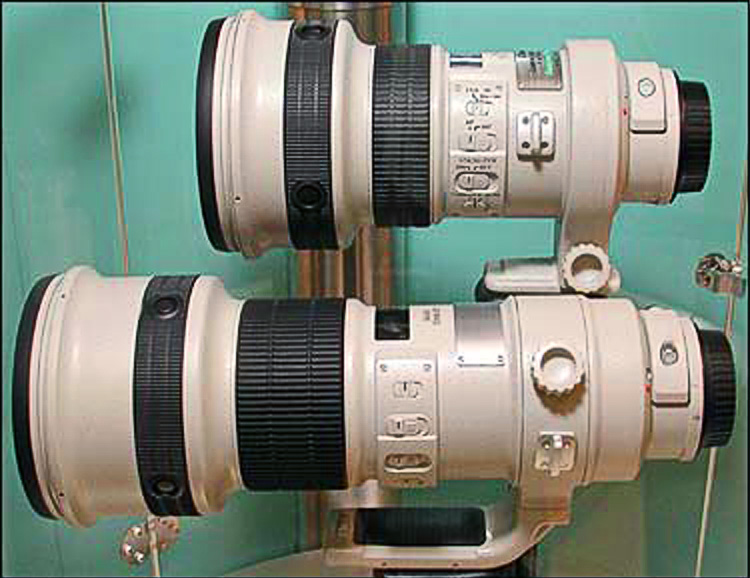
Another interesting thing I just went and measured....the Canon 400DOII is 23.4cm at 400/4...but it is only 26cm when the 1.4TC is added making it a 560/5.6...ie almost a 600/5.6 like what Nikon might give us.
We know from the 400/500/600PF patents that the 600 will be 5cm longer than the 500 so about 29cm (assuming this rumour is correct).


 . I think that confirms to me that if they do a 600PF next it will match the 400DOII price in the 7s...