philip_pj
Offline
• • • • • •
Upload & Sell: On
|
 p.92 #2 · Voigtlander 50mm f/2 APO-Lanthar Review p.92 #2 · Voigtlander 50mm f/2 APO-Lanthar Review | |
There are now many reviews of the two APO 50mm lenses from Cosina (VM) and Leica, quite a number in video form.
The two CV 50s shown above in MTF are obviously rather different lenses in: glass formulations, element spacing and as a result, performance. Of course, always check what version each reviewer is using - the M-mount lens will give you a decent approximation of the E/Z lens for smaller than f2 images, but wide open IQ is fundamental to all such lenses.
They are similar as they share the basic design. The best place to start with analysing MTF charts is the axis - the very centre of each lens and the centre of all images it produces. Axial performance is shown at the far left for each line pair. The top line pair relates to broad strong edges (say, the edge of a face), the lower line pair relates to us the detail performance (finely drawn, down to tiny motifs in our images, think: varigation in leaves, grain in statues, fine texture in all materials.
Small variations in the journey across the frame are shown as we follow all six lines to the right side, which shows the far corners at 21mm. For reasons known only to themselves, Cosina reduced the overall performance of the M-mount lens where it matters most to many M photographers - wide open at f2. This is the major difference here, rather than the shape of the line pairs, which decline gradually in the E/Z lenses past the wide edge at 18mm.
But make no mistake, the E/Z lens delivers a significant (and very probably noticeable) advantage for all line pairs at f2. A table of key points with numbers would show the gain more readily than this chart method, but it's easy enough to see the scales on the left-side axis. For the important bottom line pairs, it looks like around 72% for the top chart (Leica vsn) and approx 77% for the E/Z lens. 5% sounds small, but 5/72 equals a 7% boost! This result has led to many seeing the APOs as 'landscape lenses' when they are, in fact, extremely well-rounded optics.
The middle line pairs - which some analysts use as a good 'overall' measure - are also boosted, and indeed even the top line pairs get an advantage. So there are no trade-offs here.
The f4 results of each lens are or or less a carbon copy of the other, showing the effects of stop-down as it evens out the key differences seen wide open. The differences in IQ are inconsequential at f4.
F2 is very important for many reasons and E/Z users are encouraged to use f2 in the CV APOs for many compositions, as an 'aperture bracket' to go along with middle aperture captures. It will surprise you with a gradual fade quality off-plane into the distance, even for focal distances of 5-10 metres. F2 performance matters more for an f2 lens because they compete with faster lenses, so top image quality wide open is key to their success. Leica and Cosina both limit their APOs to f2 maximum apertures.
Very few f1-f1.2-f1.4 lenses will equal these APOs, with each being measured at f2. Show us the results, if any here disagree. Below is one - it's the MTF of Zeiss's last and greatest (full frame stills) lens in their long and storied history, in my opinion of course. They broke with tradition by increasing the complexity to Sigma-Sony-Nikon-Canon levels, commissioning Cosina to make a 100mm f1.4 with a 14/11 design, up from the Otus 85/1.4 at 11/9.
I include this one here to illustrate just how good the E/Z 50/2 is (also true of the 35/2 APO). The finest Otus and Leica's APOs are the company these two Voigtlander APOs keep. (ignore the middle line pairs because Cosina use 30lpmm, Zeiss use the traditional 20lpmm measures, so it's invalid to compare them).
We used to have debates here over whether lenses can 'keep up' with higher resolution cameras. Not any more. As Peter Karbe opines: 80% lens contrast at 40 lpmm (lower line pairs in all MTF charts) equals 50% at an eye-watering 60 lpmm. (50% is a standard lens contrast level in the industry, methods like Imatest use it.)
It's doubtful it will happen soon (if at all), but these levels of lens performance are ready for 100mp cameras, according to Herr Karbe. So these rather inexpensive state-of-the-art APOs are optically future-proofed, beautifully realised mechanically, small and light and affordable for regular photographers.
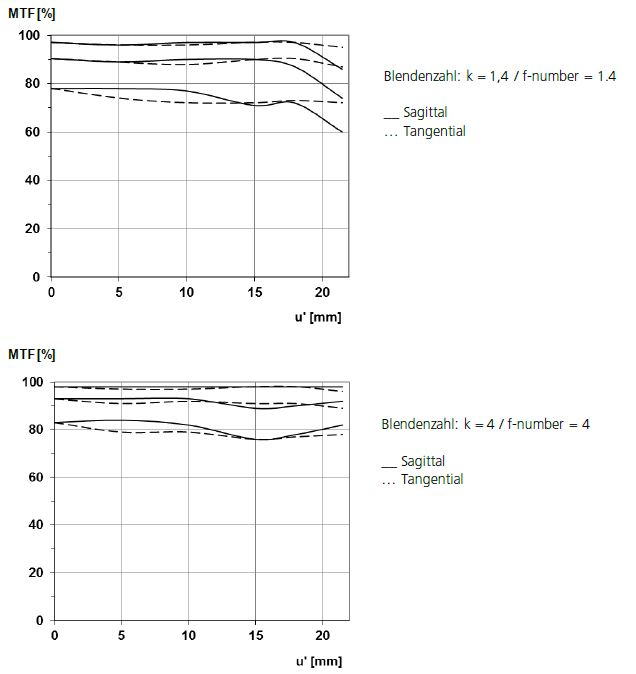
Otus 100mm f1.4 at f1.4 and f4, for comparison to CV APOs
|