Anyway, the reason I linked to that review (and the one with the 35mm f/1.7 Ultron) is that it demonstrates the quite obvious reverse field curvature on the Sony sensor. This makes the lenses unusable (near) wide open in many or most scenarios.
al404 wrote:
in this review the v1 seems almost as sharp as v2
al404 wrote:
now I'm confused in @Juha Kannisto@ the new 28mm on A7C seems to perform great
I do not think that Juha's images have sufficient magnification to demonstrate any issues with the stock A7C camera in the edges and the corners in particular. The Sony body sensor thickness is just too thick to allow for great performance into the edges and the corners of the image when looked at any real amount of magnification until stopping the lens down a fair amount (f5.6 or more). You need to use the lens with an M camera or an ultra thin sensor modified Sony or other maker's mirrorless cameras to perform well for wider apertures; otherwise for the stock sensors you will need to stop the lens down to f5.6 or to about f8 for really good performance into the edges and corners.
naturephoto1 wrote:
I do not think that Juha's images have sufficient magnification to demonstrate any issues with the stock A7C camera in the edges and the corners in particular. The Sony body sensor thickness is just too thick to allow for great performance into the edges and the corners of the image when looked at any real amount of magnification until stopping the lens down a fair amount (f5.6 or more). You need to use the lens with an M camera or an ultra thin sensor modified Sony or other maker's mirrorless cameras to perform well for wider apertures; otherwise for the stock sensors you will need to stop the lens down to f5.6 or to about f8 for really good performance into the edges and corners.
My uploaded shots are original SOOC JPEGs without any resizing, i.e. 6000x4000 (24 MP) and they can be viewed in 100% size, e.g. by downloading the original images and zooming in etc. Google Photos didn't do any resizing or compression to the original images as I'm using "Original quality" settings for Google Photos uploads and I have 2 TB storage capacity there (with Google 1 subscription). I'm not sure what you mean by not having "sufficient magnification" in this case.
I did stop down to f5.6 for the infinity shots as mentioned when I posted the images. I think the lens starts to perform reasonably well corner-to-corner from f5.6 and further on A7C and that's definitely the case with Sigma fp.
Thanks for confirming the aperture used on those images, Juha.
To al404:
I think that if we adjust our expectations to the limitations that the combo (28mm Ultron on a full frame mirrorless camera), including that there will be reverse field curvature, then of course the lens will be usable within those limits. Stop down well for cityscapes and landscapes and expect smearing in the corners, plus when shooting near wide open at shorter focus distances, expect less background blur outside the center.
Will the lens perform as intended or as well as its potential? No. The stellar sharpness outside the center will be lost. If one is fine with that, then go ahead.
To me this doesn't make sense because the compromise in image quality undermines the whole idea buying a full frame camera and fast high quality lenses.
Why not just get the native Sony 28mm f/2 lens and be done with it? It has autofocus and full integration with the camera. Then, when or if you sometime in the future buy a Leica M camera, you can get the 28mm Ultron II. This is just my way of thinking about it. You do what you think is best.
Juha Kannisto wrote:
My uploaded shots are original SOOC JPEGs without any resizing, i.e. 6000x4000 (24 MP) and they can be viewed in 100% size, e.g. by downloading the original images and zooming in etc. Google Photos didn't do any resizing or compression to the original images as I'm using "Original quality" settings for Google Photos uploads and I have 2 TB storage capacity there (with Google 1 subscription). I'm not sure what you mean by not having "sufficient magnification" in this case.
I did stop down to f5.6 for the infinity shots as mentioned when I posted the images. I think the lens starts to perform reasonably well corner-to-corner from f5.6 and further on A7C and that's definitely the case with Sigma fp....Show more →
Hi Juha,
Thank you. I did not realize that the images were were able to be viewed at 100%, I glanced at some of them and just didn't enlarge them enough. But, yes, stopping down to about f5.6 or f8 will/should aid with the lens on stock cameras.
for my style of shooting I use the lens wide open if I want to get this kind of photo isolating the main subject those should be at f2, here I can't see any strange artifact
And if I want to take a landscape or city scape / street I mostly use it between f5.6 and f11, I never really shoot in the dark unless I'm visiting some church or museum, form me corners seems pretty good
- Sony 28mm doesn't really seem the best lens of Sony
- I also have a Fuji APS-C and Canon R6 and I could adapt the lens on both
- I'm considering to try a Leica M digital ( M240 ) not sure if I would like rangefinder but if it is the case I may sell A7C to get M240
- Voiglander images seems to have a 3D effect and pop out of the screen, the only lens it gives me the same effect is Sony Zeiss 55mm f1.8
philip_pj wrote:
'starts to perform reasonably well corner-to-corner from f5.6' does not sound promising in an f2 lens.
I usually use f5.6 for infinity shots with most of my native lenses as well and in this case "reasonably well" meant that I'm happy with the infinity results at f5.6. I use wider apertures for different type of shots, e.g. close-ups with some bokeh etc. and usually there's too much vignetting for infinity shots at wide apertures anyway to my taste.
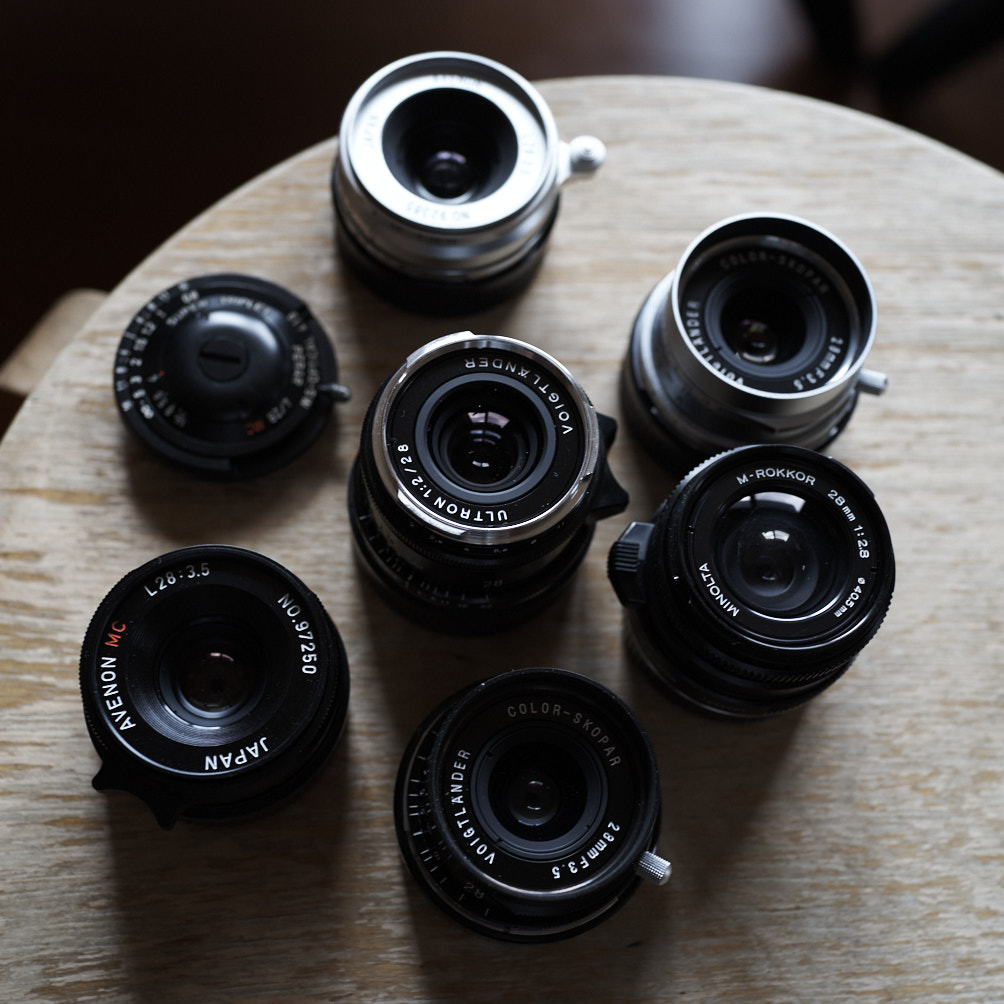
The photo shows my 28mm rangefinder lens collection and from the group the new Ultron works best at f5.6 for inifinity type shots on Sony E-mount cameras, for all others I use f8 (CV 28/2 II, CV 28/3.5 x 2, Avenon 28/3.5 x 2, Minolta M-Rokkor 28/2.8, MS-Optical Perar 28/4). I also had CV 28/2 v1 and CV 28/1.9 LTM before and they were not as good.
I'm still eager for getting a native 28mm E-mount lens from CV at some point in the future of course but in the meanwhile this VM Ultron works well enough for me on both A7C and especially on Sigma fp. I have some native zooms that start at 28mm so I can always use those as well.
From this thread and the one you started on DPReview you have now been informed about the behavior of the lens/sensor combo. It seems you have settled that the 28mm Ultron II will be fine for your needs. Go ahead and buy it then. Nobody is trying to prevent you from buying it.
Juha Kannisto wrote:
I usually use f5.6 for infinity shots with most of my native lenses as well and in this case "reasonably well" meant that I'm happy with the infinity results at f5.6. I use wider apertures for different type of shots, e.g. close-ups with some bokeh etc. and usually there's too much vignetting for infinity shots at wide apertures anyway to my taste.
The photo shows my 28mm rangefinder lens collection and from the group the new Ultron works best at f5.6 for inifinity type shots on Sony E-mount cameras, for all others I use f8 (CV 28/2 II, CV 28/3.5 x 2, Avenon 28/3.5 x 2, Minolta M-Rokkor 28/2.8, MS-Optical Perar 28/4). I also had CV 28/2 v1 and CV 28/1.9 LTM before and they were not as good.
I'm still eager for getting a native 28mm E-mount lens from CV at some point in the future of course but in the meanwhile this VM Ultron works well enough for me on both A7C and especially on Sigma fp. I have some native zooms that start at 28mm so I can always use those as well. ...Show more →
I have all three 28mm Ultrons now and used the LTM f/1.9 regularly on a Sony. The field curvature penalty wasn't overly obnoxious and for distant shots, where the intent is to have edge to edge sharpness, the lens behaved well when focused more towards the midfield than the infinity hard stop when stopped down to f/8. For distant shots with a Small Format (35mm) lens, an aperture of f/5.6 - f/11 was and still is a fairly traditional and sensible approach.
These traditional fast lenses are intended to be used wide open in the two to three meter range (extended to 2 - 5) for subject distance. In this range it's usually possible to get edge to edge sharpness wide open. Hoping to get something with edge to edge sharpness wide open with a traditional manual focus lens at the infinity hard stop is a somewhat naive assumption. Lens variation alone makes the behavior of the lens at the infinity hard stop something of a variable for legacy types of manual focus lenses, the Sony field curvature penalty only exacerbates this... If the lens focuses even slightly beyond infinity the edges go south quickly. This is hard to spot on 24mp and when observed is sometimes incorrectly interpreted (from what I've seen).
Where the Sony penalty really comes into play with these types of lenses, wide open, is when focused on a subject at something like four to five meters where the background is somewhat distant. One gets a subject in focus and on the edges, the distant objects which should be out of focus are sharp. On a native M this does not happen - the sensor cover glass penalty on the Sony accentuates the lens' inherent field curvature where the M sensor array is designed to reduce the effect. It still shows up on Ms with some lenses, it's just harder to see it on 24mp.
So, bottom line, any of the three 28mm Ultrons are quite capable - depending on usage and expectations based on the particular usage... Used out of it's intended range, any traditional manual focus lens is going to disappoint, especially older designs. (IMHO ; - )
I should perhaps add, that I originally intended to use my Z6 unmodded with carefully selected M mount lenses, including the Voigtländer 15mm f/4.5 III, 21mm f/1.8, 50mm f/1.2 and Leica 90mm lenses that all work fine with mirrorless cameras.
The specific reason I ended up getting the Ultra Thin conversion on my Z6 is the available M mount lenses in 28mm focal length. I wasn't happy with the 7Artisans 28mm f/1.4 and the Summicron-M Asph II underperformed severely.
I consider the price of the UT mod low to the improvement it provides. It's about two thirds of the price of the 28mm Ultron II and all my lenses benefit from the mod, including the F mount lenses (except one). With the UT mod, I don't need two cameras, one for M and one for F mount lenses. I get IBIS as well as AF and correct f-stop in EXIF with my Megadap MTZ11 which an M camera won't provide. In short, the mod is a no brainer to me.
@LarsHP I also asked on Voiglander FB group, this is an all new topic form me that come out of the blue
A guy said that sensor thickness should be:
Sony A7 series - 1.9mm
Panasonic S series - 1.45mm
Nikon Z series - 1.1mm
It seems that Z6 is the best against this kind of issue
Did you try the lens without modification?
Aug 07, 2021 at 07:43 AM
Steve Spencer Offline • • • • • • • Upload & Sell: On
al404 wrote:
@LarsHP@ I also asked on Voiglander FB group, this is an all new topic form me that come out of the blue
A guy said that sensor thickness should be:
Sony A7 series - 1.9mm
Panasonic S series - 1.45mm
Nikon Z series - 1.1mm
It seems that Z6 is the best against this kind of issue
Did you try the lens without modification?
I believe whoever told you that is wrong. Those numbers do not include the cover glass that is epoxied onto the sensor for at least the Sony and the Nikon Z cameras. I know the Nikon Z7 that I have is nothing like a Leica M camera in terms of performance and it is much closer to a Sony camera. I think the numbers are much closer to 2.5mm for Sony and 2.1mm for Nikon Z when you add the cover glass that is attached to the sensor.
If I get a chance in a couple of weeks (I am at the airport as I write this and won't be back for a couple of weeks) I could compare the new Voigtlander 28 f/2 II on the Leica M10, Sony A7r II, and Nikon Z7. I have all three cameras and I could do side by side testing, but I can tell you from actual use the the Sony A7r II and Z7 are not very different from each other and very different from a Leica M10.
I haven't tried the 28mm Ultron II on any other camera than my UT modded Z6.
Regarding the thickness of sensor glass, I jumped on the Z6 at first for the very reason that it was reported to be significantly thinner than on Sony and only marginally thicker than those on Leica M sensors, but later it became clear that the difference is not as big in practice since the measurement is only for the removable glass. There is a glass layer glued to the sensor which adds to the total thickness, and this evens out the difference between Nikon and Sony sensor glass stack quite a bit.
I had Sony a7II when I got my Nikon Z6, and the difference with M mount wide angle lenses was minor, with advantage for the Z6, but this might at least partly be caused by the difference in sensor technology: the Z6 is a newer model with BSI sensor design which means the pixel wells are more open (larger). If we should compare on an even playing field, it should have been the a7III and Z6 (or Z6II). However, I haven't seen such a comparison (with M mount wide angle lenses).
al404 wrote:
@LarsHP@@@ I also asked on Voiglander FB group, this is an all new topic form me that come out of the blue
A guy said that sensor thickness should be:
Sony A7 series - 1.9mm
Panasonic S series - 1.45mm
Nikon Z series - 1.1mm
It seems that Z6 is the best against this kind of issue
al404 wrote:
@LarsHP@ I also asked on Voiglander FB group, this is an all new topic form me that come out of the blue
A guy said that sensor thickness should be:
Sony A7 series - 1.9mm
Panasonic S series - 1.45mm
Nikon Z series - 1.1mm
It seems that Z6 is the best against this kind of issue
Did you try the lens without modification?
Aside from using a M body, the best mirrorless camera to adapt M lenses is the Leica SL series because it has the thinnest packaging in front of the sensor. Furthermore these sensors are equipped with 'off-set' microlenses in front of every pixel used to direct light coming from a very steep incident angle. This avoids astigmatism and induced field curvature which is the typical result when using camera sensors with a thicker sensor stack, and that includes the Nikon Z series.
I think that's for the SL2, not the SL if I recall correctly. Something along the lines of the SL being more like the Panny S1.
I got the Z7 for the Nikkor Z lenses however I found that the 7 performed exactly the same as the M for a range of lenses, from the above mentioned 28 Ultron LTM to a ZM 35 Biogon. Actually, they performed remarkably close to the M on my Sony, with the exception of the accentuated field curvature. ...First fast M lens I tried on the 7 was the 40 Nokton. An unexpected surprise. Different usage and expectations I guess... ; - )
I feel confident that astigmatism and induced field curvature is caused by the thicker sensor glass layer. The microlenses in the M sensors seems to primarily help reducing vignetting. This is my conclusion based on comparing the M 240 to my Z6UT (and indirectly the unmodded Z6). However, as mentioned, the Z6 is a BSI sensor while the M 240 is not.
Fred Miranda wrote:
Aside from using a M body, the best mirrorless camera to adapt M lenses is the Leica SL series because it has the thinnest packaging in front of the sensor. Furthermore these sensors are equipped with 'off-set' microlenses in front of every pixel used to direct light coming from a very steep incident angle. This avoids astigmatism and induced field curvature which is the typical result when using camera sensors with a thicker sensor stack, and that includes the Nikon Z series.
mapgraphs wrote:
I have all three 28mm Ultrons now and used the LTM f/1.9 regularly on a Sony. The field curvature penalty wasn't overly obnoxious and for distant shots, where the intent is to have edge to edge sharpness, the lens behaved well when focused more towards the midfield than the infinity hard stop when stopped down to f/8. For distant shots with a Small Format (35mm) lens, an aperture of f/5.6 - f/11 was and still is a fairly traditional and sensible approach.
These traditional fast lenses are intended to be used wide open in the two to three meter range (extended to 2 - 5) for subject distance. In this range it's usually possible to get edge to edge sharpness wide open. Hoping to get something with edge to edge sharpness wide open with a traditional manual focus lens at the infinity hard stop is a somewhat naive assumption. Lens variation alone makes the behavior of the lens at the infinity hard stop something of a variable for legacy types of manual focus lenses, the Sony field curvature penalty only exacerbates this... If the lens focuses even slightly beyond infinity the edges go south quickly. This is hard to spot on 24mp and when observed is sometimes incorrectly interpreted (from what I've seen).
Where the Sony penalty really comes into play with these types of lenses, wide open, is when focused on a subject at something like four to five meters where the background is somewhat distant. One gets a subject in focus and on the edges, the distant objects which should be out of focus are sharp. On a native M this does not happen - the sensor cover glass penalty on the Sony accentuates the lens' inherent field curvature where the M sensor array is designed to reduce the effect. It still shows up on Ms with some lenses, it's just harder to see it on 24mp.
So, bottom line, any of the three 28mm Ultrons are quite capable - depending on usage and expectations based on the particular usage... Used out of it's intended range, any traditional manual focus lens is going to disappoint, especially older designs. (IMHO ; - ) ...Show more →
Yeah, I pretty much agree with your comments. I never use hard stop for focusing for infinity shots myself unless it seems to give the best results, I always check the focus by peaking and/or magnification and figure out what generally works with the lens and camera and adapter combo. E.g. I check peaking across the whole frame for infinity shots or I check a specific area by magnification (usually somewhere in the midframe). Some of my 28mm rangefinder lenses do give the best results at hard infinity with some of my cameras & adapters, but for example the new Ultron 28/2 II does not and I need to focus at around the starting point of the infinity symbol instead with my Rayqual adapters. Some of the lenses (both Avenon 28/3.5 LTM lenses) need a slightly thinner-than-spec adapter and hard infinity focusing for the best "infinity" results across the frame. With a spec-accurate adapter the corners never get there with those lenses. I mostly use Rayqual adapters (for both M-E and M-L) that are made very precisely to correct thickness and are very light and well built but for the Avenons I use my CV VM-E close focus adapter on Sony cameras and a Shoten close-focus adapter on Sigma fp.
With 28mm lenses I usually shoot "infinity" type shots quite often at f5.6 or f8, e.g. some street views, buildings, cityscapes etc. and some closer focus shots at wider apertures usually at 0.5m to 3m range, usually focusing on some objects, flowers etc. I don't shoot that much of anything between 3m and 10m subject distance.
Speaking of the older 28mm Ultrons, the 28/1.9 LTM was one of my first MF lenses and I used it a lot with my NEX-6 (with the APS-C crop) but later when I got an A7R I couldn't quite get as nice infinity shot results with lens as I would have liked even at f8 so I sold it at some point. I did like the lens a lot for closer range shooting though. With the 28/2 VM v1 I didn't like the focus shift. I sometimes miss the 28/1.9 LTM and might add it back to my collection some day if a good copy comes by at a decent price.
Anyway, I find these small rangefinder lenses very nice and enjoyable to shoot with overall and 28mm is one of my favorite focal lengths.
Fred Miranda wrote:
Aside from using a M body, the best mirrorless camera to adapt M lenses is the Leica SL series because it has the thinnest packaging in front of the sensor. Furthermore these sensors are equipped with 'off-set' microlenses in front of every pixel used to direct light coming from a very steep incident angle. This avoids astigmatism and induced field curvature which is the typical result when using camera sensors with a thicker sensor stack, and that includes the Nikon Z series.
They should make a lot smaller SL body though as the >900g bodies are not really a good match with the small rangefinder lenses I think especially if one wants a smallish camera/lens combo. Sigma fp is 422g with a battery and SD card but it needs an external EVF and a small add-on grip to be really nice for manual focusing use e.g. with rangefinder lenses. fp ends up somewhat bigger and heavier than A7C with those add-ons but at least the viewfinder has a bigger view. If somebody made a nice compact L-mount body in the 500-600g range with an in-built EVF and the same level of optimization for M lenses as the SL series it could be a really nice option.