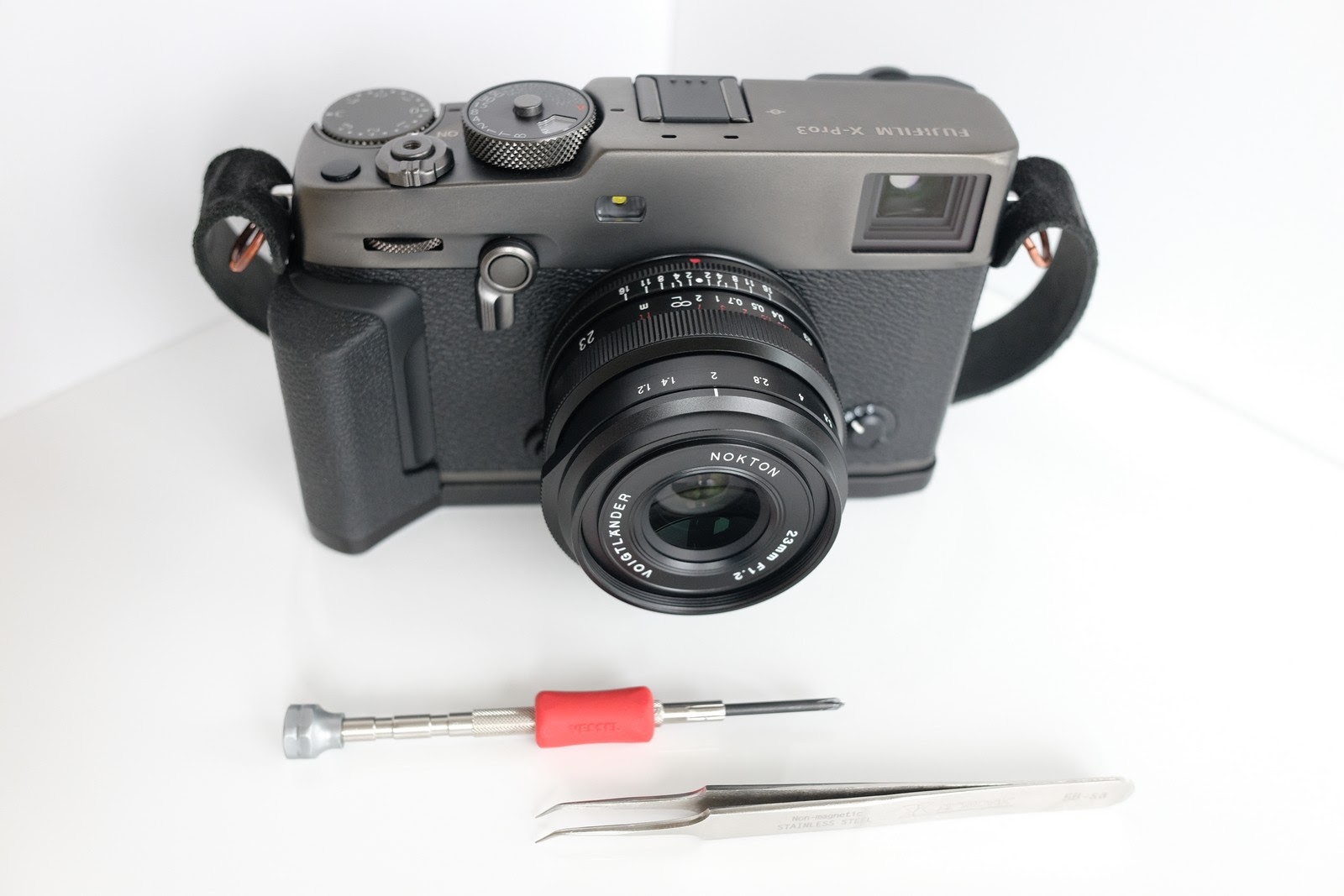
@yukosteel has published a teardown of the Voigtlander 23mm F1.2 Nokton lens designed for the Fuji X mount. As an owner of this lens myself, I am thoroughly impressed with its rendering capabilities and believe it to be a valuable addition to the Fuji X-mount range. One notable excerpt from the article is as follows:
"I'm very impressed by the mechanics and reliable design of electronics in this Voigtlander 23mm F1.2 Nokton lens. The precise way focusing distance information is collected is one of huge benefits of true manual focusing Voigtlander lens comparing to focus-by-wire most Fujinon lens. All parts are made from metal and precisely machined up to highest Cosina quality standards similar to Leica M mount lenses. For sure this lens can outlast any Fujinon lens with intense use, because it can be effectively operating fully mechanically even if its electronics breaks, while Fujinons are completely dead lens if electronics fails there.
Regarding the optical rendering of Voigtlander 23mm F1.2 - it's a area of discussion for another articles, and there are tons of them already. I can only add that personally it's a great experience shooting with this lens and the IQ is high enough to often grabbing this lens for shooting with X-Pro3 instead of using X100V camera."
A very interesting article, and interesting to see the comments about distance information, as there have been comments that the focusing scale on the lens is not accurate, so is not useful for scale or hyperfocal focusing use. It would be interesting to know if that is the case, as you have the lens @Fred Miranda I would appreciate a comment on both focus scale and Depth of Field marking on this (and the 35mm) as you are well used to meticulous testing!
You are absolutely right, the physical DOF scale on Voigtlander 23mm shell is not precise enough for hyperfocal estimation. However the focusing distance scale is precisely correct on this lens.
There is one important influencing thing - Depth-Of-Field Scale Format.
Fuji X-Pro3 has this menu item with two values: "Pixel" and "Film Format Basis".
"Pixel" - is very precise format, for F8 and focus to 1m it will show DOF as 0.8 - 1.5m, and picture is actually all sharp in that range.
"Film Format Basis" - is based on much larger "circle of confusion", leading for F8 and focus to 1m to show DOF as 0.5m to infinity, which is far from what is observed on picture zoomed to 100%, but closer to truth if picture remains very small, e.g. like it's observed on LCD.
Looks like Cosina based external DOF scale on that "Film Format Basis", which works precisely same as DOF digitally shown in manual focus scale line in OVF/EVF if you set in menu DOF Scale > "Film Format Basis" and rotate focus ring. I think if they try to engrave "pixel" based DOF, it will all collapse to unusably tight scale.
My recommendation is to set DOF Scale to "Pixel" and use OVF/EVF with manual focus scale enabled to set desired hyperfocal range.
yukosteel wrote:
That's a very good question Gerry.
You are absolutely right, the physical DOF scale on Voigtlander 23mm shell is not precise enough for hyperfocal estimation. However the focusing distance scale is precisely correct on this lens.
There is one important influencing thing - Depth-Of-Field Scale Format.
Fuji X-Pro3 has this menu item with two values: "Pixel" and "Film Format Basis".
"Pixel" - is very precise format, for F8 and focus to 1m it will show DOF as 0.8 - 1.5m, and picture is actually all sharp in that range.
"Film Format Basis" - is based on much larger "circle of confusion", leading for F8 and focus to 1m to show DOF as 0.5m to infinity, which is far from what is observed on picture zoomed to 100%, but closer to truth if picture remains very small, e.g. like it's observed on LCD.
Looks like Cosina based external DOF scale on that "Film Format Basis", which works precisely same as DOF digitally shown in manual focus scale line in OVF/EVF if you set in menu DOF Scale > "Film Format Basis" and rotate focus ring. I think if they try to engrave "pixel" based DOF, it will all collapse to unusably tight scale.
My recommendation is to set DOF Scale to "Pixel" and use OVF/EVF with manual focus scale enabled to set desired hyperfocal range. ...Show more →
But using the Pixel based COC defeats the whole premise of DoF, which is for viewing the whole image, at normal viewing distance. Not for staring at a small part of the image from 6 inches away, whether on a monitor or a magnifying glass on a print.
I am reassured that they use the 'film' base for the DoF, thus preserving the 'illusion' that DoF always has been, Always of course used carefully, i.e. I would stop down one more stop than the scales indicated, and get 'acceptable' sharpness when viewing prints.
DOF is subjective and its precision depends on use case. I think Fujifilm decided to give us best possible extreme options to choose from. For many cases Pixel precision is practical, e.g. if you take landscape shot and print it on the wall. Film based precision is probably fine for most small album prints.
yukosteel wrote:
DOF is subjective and its precision depends on use case. I think Fujifilm decided to give us best possible extreme options to choose from. For many cases Pixel precision is practical, e.g. if you take landscape shot and print it on the wall. Film based precision is probably fine for most small album prints.
DoF is a set of compromises, it shouldn't matter what size the print is as long as you look at the whole image from an appropriate distance, the bigger the print the further away. If you inspect more closely then it is easy to see the illusion fall apart. CoC and viewing distance are implicit in the calculation formula. Vary the conditions certainly then make changes about the use of them, but the Pixel version makes no sense as if you look hard enough there is NO DoF.
And I do print landscape (and architecture, mainly A3 but sometimes A2. And professionally did prints many feet wide from various formats
I think it's totally fine if Pixel based DOF doesn't make any practical sense for your personal use, and it's good that Fuji made it configurable in camera to select option that fits better. Though it's technically hard to make it adjustable on lens body (even though it's possible). One workaround I used in the past is custom printed DOF scale that better reflects my personal preference.
One thing commonly directing people to use Pixel based DOF - numerous online calculators and apps which primarily based on very tiny CoC, to satisfy customers that look at 100% magnified picture. E.g. if you pick any random DOF calculator, set 23mm on APS-C, 1m distance and F8 it will show DOF range of 0.77m to 1.42m (which is close to what X-Pro3 shows for CV 23mm at F8). https://www.photopills.com/calculators/dof
Practical use of this Pixel based DOF for many people is to know which picture portion will still look sharp even if 100% crop is made and then printed, which often can be small portion of frame (e.g. flying bird photography). Many cameras, including Fuji X, have single button press to show 100% crop quality, and many people may find disappointed if picture look completely blurred in the area which they planned to crop later. Much narrower DOF helps to solve that problem.
Now if person used to shoot with higher DOF precision try to rely on Film based DOF of CV 23mm, they most likely will be highly disappointed and decide that DOF scale is wrong.
So many do not take the trouble to understand the theory (and fact) behind so much photographic practice. DoF is an attempt to cope with the inadequacies of human vision. Th at there is only one point of focus, at any aperture, each side of it is increasingly blurred, the conventions of DoF explain what the eye 'sees' in normal use, the harder you look the more the illusion falls apart. If you crop then the CoC selected for full frame viewing is no longer relevant, one can either recalculate (but Fujis Pi el based effort covers only one possibility) or make allowances from experience depending how much you have departed from the conditions selected for the normal scales. Better to understand the system than rely on an arbitrarily selected single departure from the normal. DoF is not a exact science.
Edit, just to say that in spite of any differences on DoF, your article is as always very interesting and informative, much appreciated.
Yes, I agree that people often forget to check the theory basics and more often assuming instead of exploring origins. Modern tech direction often moves far from pleasant old good classic way and adding extra layer of confusion by introducing new trends and standards. I'm glad you started this interesting topic on Voigltnader 23mm lens DOF scale precision, that should help many people to get the right answer.
I'm personally quite conservative and prefer to keep old habits until they work well. Being able to use DOF on rangefinder film camera was one of few essential things to learn first. It's great that Fuji has so large sense of respect to classic photography techniques and building cameras highly compatible with polished by decades best practices of taking pictures. X mount Voigtlander lenses are also great examples of following good classic traditions.
From the other hands Fuji have to react to modern market demand, and support numerous new use cases. I appreciate their flexibility as soon as it doesn't hurt the classic path. Though the level of confusion in some areas is significant, and having clarifying conversation should help people to improve their shooting experience.
BTW, speaking of Voigtlander 23mm F1.2 , it's nice that Cosina used unique lens body design for Fuji, and also followed classic Nikon design for Nikon mount lenses. After exploring how focus ring is mounted, it seems that Nikon version of this lens may have same focusing frame. Now I'm wondering if there is a technical possibility to swap the mount and electronics from X mount version to Nikon Z mount version.
Yes, I agree that people often forget to check the theory basics and more often assuming instead of exploring origins. Modern tech direction often moves far from pleasant old good classic way and adding extra layer of confusion by introducing new trends and standards. I'm glad you started this interesting topic on Voigltnader 23mm lens DOF scale precision, that should help many people to get the right answer.
I'm personally quite conservative and prefer to keep old habits until they work well. Being able to use DOF on rangefinder film camera was one of few essential things to learn first. It's great that Fuji has so large sense of respect to classic photography techniques and building cameras highly compatible with polished by decades best practices of taking pictures. X mount Voigtlander lenses are also great examples of following good classic traditions.
From the other hands Fuji have to react to modern market demand, and support numerous new use cases. I appreciate their flexibility as soon as it doesn't hurt the classic path. Though the level of confusion in some areas is significant, and having clarifying conversation should help people to improve their shooting experience.
BTW, speaking of Voigtlander 23mm F1.2 , it's nice that Cosina used unique lens body design for Fuji, and also followed classic Nikon design for Nikon mount lenses. After exploring how focus ring is mounted, it seems that Nikon version of this lens may have same focusing frame. Now I'm wondering if there is a technical possibility to swap the mount and electronics from X mount version to Nikon Z mount version. ...Show more →
I still have my M3 I bought in '68, as well as a III I inherited. Leica Ms were the backbone if my personal photography till digital came along, an M6 bought for retirement got traded for my Xpro2. I cant remember usung the rangefinder ever on those with the 21mm Elmarit asph, or the 15 and 21 Voigtlanders, and the 25 had no coupling!
Its a shame these Voigtlanders for Fuji dont communicate with the Xpro2, I might be tempted, but at the moment I use my 15, 28/1.9 and 75 with the Fuji M adapter, and a 40mm Ultron in Nikon mount, which with the Fringer adapter gives semi auto diaphragm, I might get a 20 or 28 SLII in Nikon mount as its quite convenient to avoid manual stopping down.
I don’t know if anyone else noticed, but I zoomed in on the pic above of the lens to get a better look at the details of the DOF scale set up at the base of the lens, and it a slightly OOF compared aperture markings on the end of the lens. The top front edge of the camera seems to be in Focus also, so the plane of focus probably is anchored by the end of the lens the the front-top edge of the camera.
Just thought that was interesting in light of the conversation, and I didn’t notice it until I zoomed in.
Back in the 35mm film days, an 8x10 enlargement was pretty big- especially with any kind of cropping. And 11x14? Grain city, forget about DOF when you are connecting the grain dots to visualize an image
So, the lens markings, being historical to less magnification/cropping makes sense.
Really interesting conversation and lens. I’m looking forward to the X100Next, but I’m also interested in what I could do with this lens or the 27/2. Does the 27/2 have the same ‘electronic’/pixel accuracy capability when put on an XE4 or Xpro?