p.62 #2 · Nikon Zf as a platform for adapted/native manual focus lenses
Fred Miranda wrote:
Ok, I got this working using the Nikon D850 instructions you provided, not the earlier video.
The interesting part is that it does not work with Voigtlander native Z-mount or E-mount adapted lenses (Even when setting Focus Mode to AF-S). But...it worked perfectly with my setup using the Megadap adapter + Voigtlander dumb adapter + any Leica M lens.
________________
On the Nikon Zf:
* Set Focus Mode to AF-S or AF-C, either one works
* Set AF-S or AF-C priority selection to 'Focus'. (Only 'Focus' works, not 'Focus + Release' or 'Release')
* Set AF Activation to Off (instead of On)
Then:
* Go into 'AF-ON only', press right, and set 'Out-of-focus release' to Disable
________________
That's the key step that makes trap focus behave properly.
With this setup, I can use M lenses with trap focus. Basically, I fully press the shutter, and the camera only takes the shot when the subject hits perfect focus.
I'm pretty confident this should also work with other chipped adapters like TTArtisan 6-bit or SHOTEN.
I didn't see if you found this yet but in the Shooting Menu, you can set AF/MF Subject detection to what ever your subject and and the the menu right below that allows you to set your focus area and you'll have eye and subject detect even in manual mode.
p.62 #3 · Nikon Zf as a platform for adapted/native manual focus lenses
Seabassius wrote:
I didn't see if you found this yet but in the Shooting Menu, you can set AF/MF Subject detection to what ever your subject and and the the menu right below that allows you to set your focus area and you'll have eye and subject detect even in manual mode.
Yes, thank you. I have really been enjoying Nikon's menu system. It's very full featured, but still feels well organized, which made it surprisingly quick to get everything set up in just a day.
Coming from using a Sony as my main mirrorless, I'm realizing how much I had gotten used to relying on peaking and magnification for focus. Going back to that now feels slow and limiting. Focus peaking is still the closest comparison to Nikon's focus confirmation, but since it's based on contrast rather than actual phase detection on the sensor. it is less reliable and usually needs to be combined with magnification to be reliable.
I have to admit, it might be tough to go back to using my Sony with manual focus lenses after this...
Today I'm finally testing something I have been curious about for a long time, how much the Nikon sensor stack thickness really affects the performance of certain M lenses. Over the years, I've read that Nikon's stack is thinner than Sony's, which should allow for better compatibility with these lenses. I want to see how true that actually is.
I will be comparing the Zf to the Leica M10-P, both at 24MP, using a lens that I already know performs poorly on Sony. It should be a good way to see how much of a difference the sensor stack really makes in real use. So far, from all the mirrorless cameras I have tested, only the Leica SL series has consistently performed well with M lenses.
p.62 #4 · Nikon Zf as a platform for adapted/native manual focus lenses
Something I've noticed with Nikon's focus confirmation for manual lenses is that it tends to be most reliable with well corrected optics.
On the Nikon Zf, focus confirmation is based on on-sensor PDAF. In simple terms, it works best when the lens produces a clean, well defined focus plane. With modern, well corrected designs, especially APO lenses, the transition into focus is very clear, so the confirmation tends to be very accurate.
Where it gets a bit less predictable is with lenses that have residual spherical aberration. SA reduces micro contrast at the focus plane, which makes fine detail harder for the phase detect system to 'see'. Focus detection still works (turns green), but the precision drops. So, the more SA a lens has, the less reliable the green confirmation becomes for critical focus.
p.62 #5 · Nikon Zf as a platform for adapted/native manual focus lenses
Try out the TechArt M to Z adapter. Gives you pretty darn reliable AF with M glass, including subject recognition and all that good stuff, but you can also set the camera to manual focus mode, and then you still get the green box confirmation and correct stabilization focal length, plus, given the adapter moves the entire lens forward and backwards, it also can greatly reduce the minimum focus distance by a good amount.
Probably the best $400 I’ve ever spent on any photographic accessory, and revolutionizes the ZF with M glass
p.62 #6 · Nikon Zf as a platform for adapted/native manual focus lenses
millsart wrote:
Try out the TechArt M to Z adapter. Gives you pretty darn reliable AF with M glass, including subject recognition and all that good stuff, but you can also set the camera to manual focus mode, and then you still get the green box confirmation and correct stabilization focal length, plus, given the adapter moves the entire lens forward and backwards, it also can greatly reduce the minimum focus distance by a good amount.
Probably the best $400 I’ve ever spent on any photographic accessory, and revolutionizes the ZF with M glass
That's exactly how the Techart M to E adapter works, but it's good to know the Z version also gives you green focus confirmation in manual focus. My only complaint about the Techart AF adapter is that it's wider and heavier than a regular close-focus adapter.
I did try something a bit ridiculous, stacking my Techart M to E onto the Megadap (ETZ21) just to see what would happen. For anyone wondering, it doesn't work, AF is completely non-functional.
p.62 #7 · Nikon Zf as a platform for adapted/native manual focus lenses
millsart wrote:
Try out the TechArt M to Z adapter. Gives you pretty darn reliable AF with M glass, including subject recognition and all that good stuff, but you can also set the camera to manual focus mode, and then you still get the green box confirmation and correct stabilization focal length, plus, given the adapter moves the entire lens forward and backwards, it also can greatly reduce the minimum focus distance by a good amount.
Probably the best $400 I’ve ever spent on any photographic accessory, and revolutionizes the ZF with M glass
I tried the TechArt on my Zf but I was disappointed with the AF in less than ideal light, combined with the weight, I decided to return it and stick to manual focusing my MF lenses. If I want AF on the Zf, I have a few Z mount AF lenses plus my Sony mount AF lenses combined with the Megadap adapter works for me.
p.62 #8 · Nikon Zf as a platform for adapted/native manual focus lenses
Fred Miranda wrote:
That's exactly how the Techart M to E adapter works, but it's good to know the Z version also gives you green focus confirmation in manual focus. My only complaint about the Techart AF adapter is that it's wider and heavier than a regular close-focus adapter.
I did try something a bit ridiculous, stacking my Techart M to E onto the Megadap (ETZ21) just to see what would happen. For anyone wondering, it doesn't work, AF is completely non-functional.
I did that too and then couldn't get them apart! Had to send them to B&H Allstate warranty and they just sent me the money back because they couldn't do it either.
p.62 #9 · Nikon Zf as a platform for adapted/native manual focus lenses
Seabassius wrote:
I did that too and then couldn't get them apart! Had to send them to B&H Allstate warranty and they just sent me the money back because they couldn't do it either..
The Techart's build tolerances aren't very consistent. Some adapters are too tight, while others have a bit of play, so yours was likely on the tighter side. I was able to mount and unmount mine onto the Megadap, but there's no AF (at all), so for anyone wondering about this combo, it's not worth trying. I still think the Techart is a great idea and it works fairly well, but in practice I rarely use it since it's a bit heavy and bulky and also because I prefer MF M lenses.
p.62 #11 · Nikon Zf as a platform for adapted/native manual focus lenses
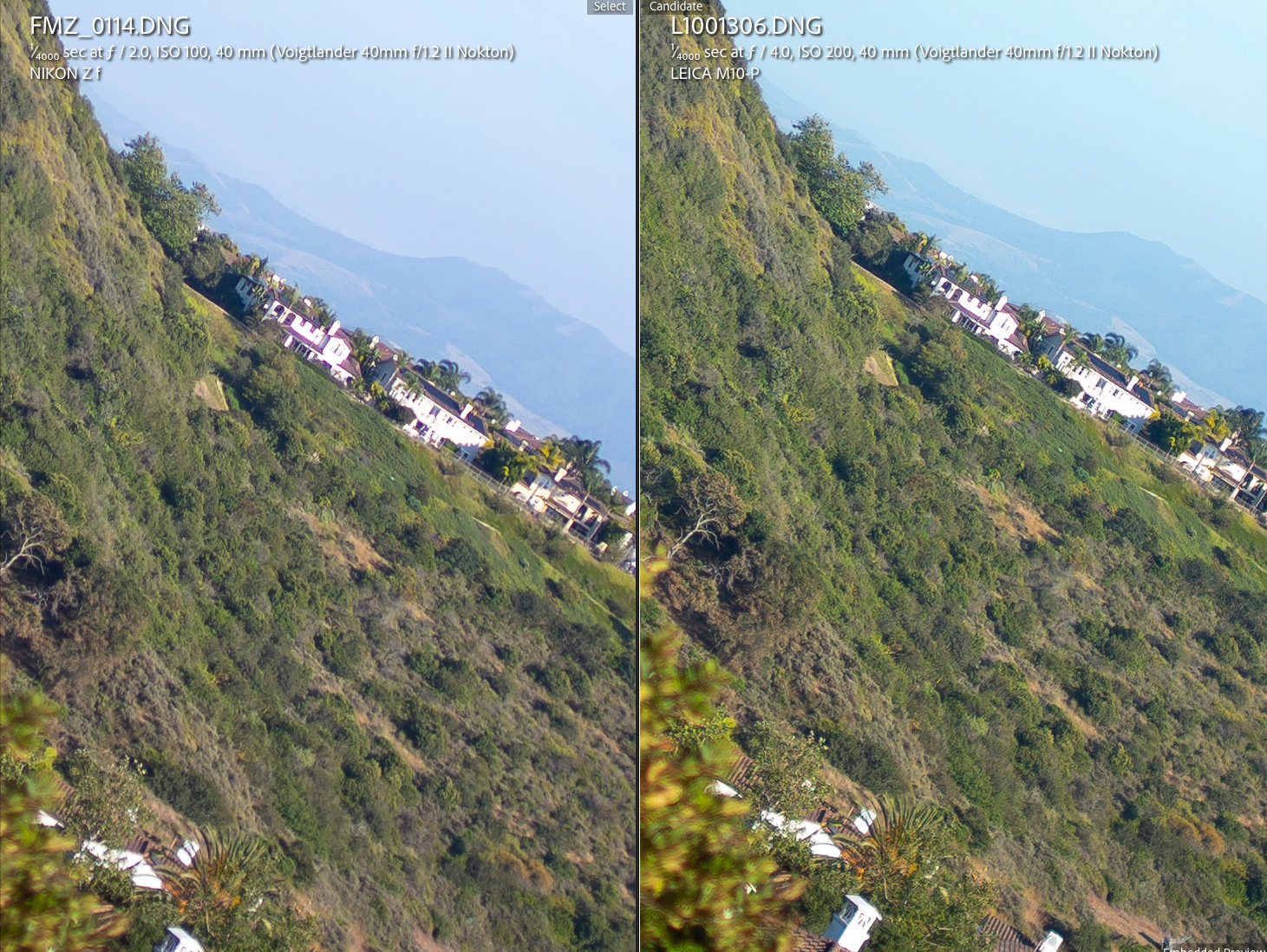
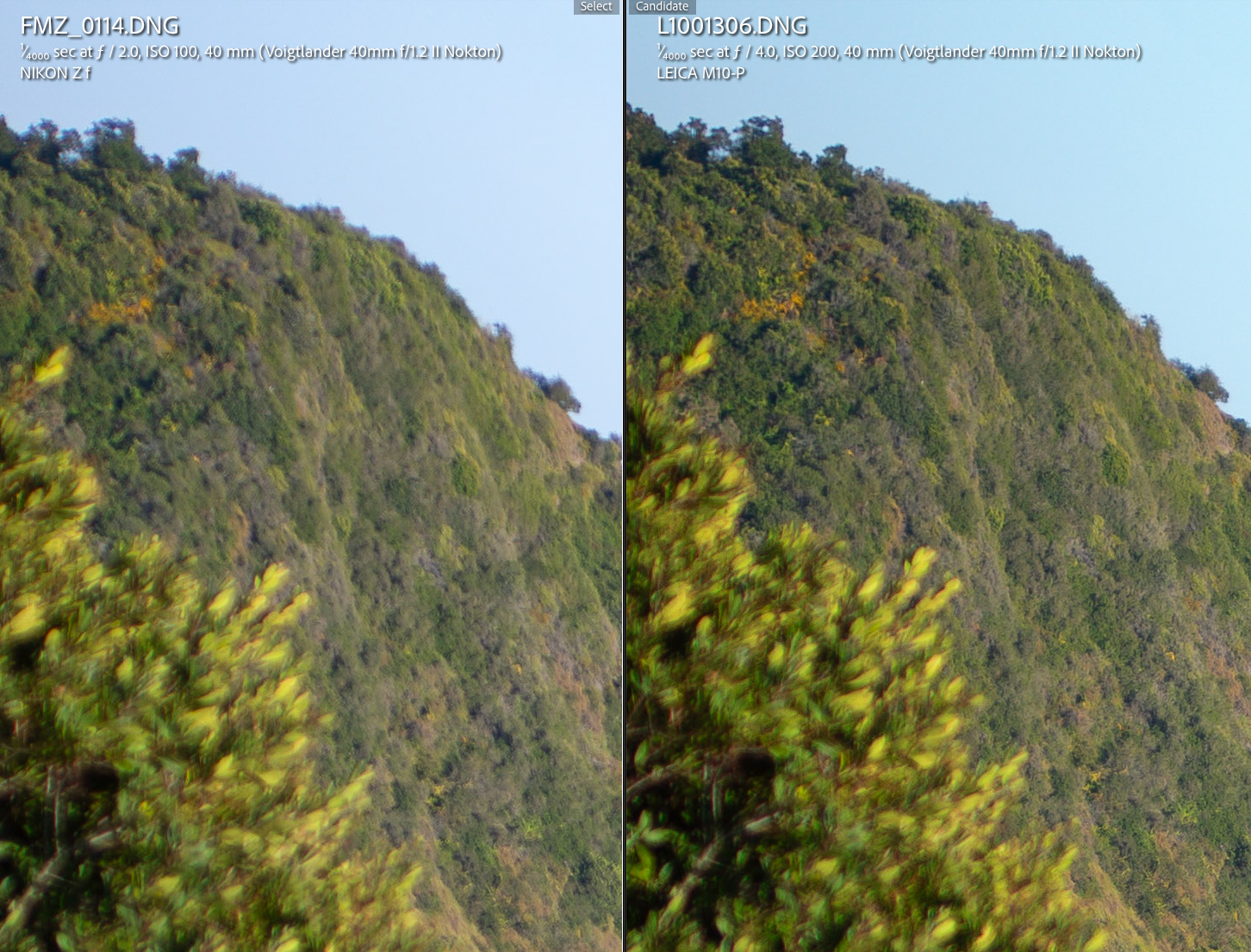
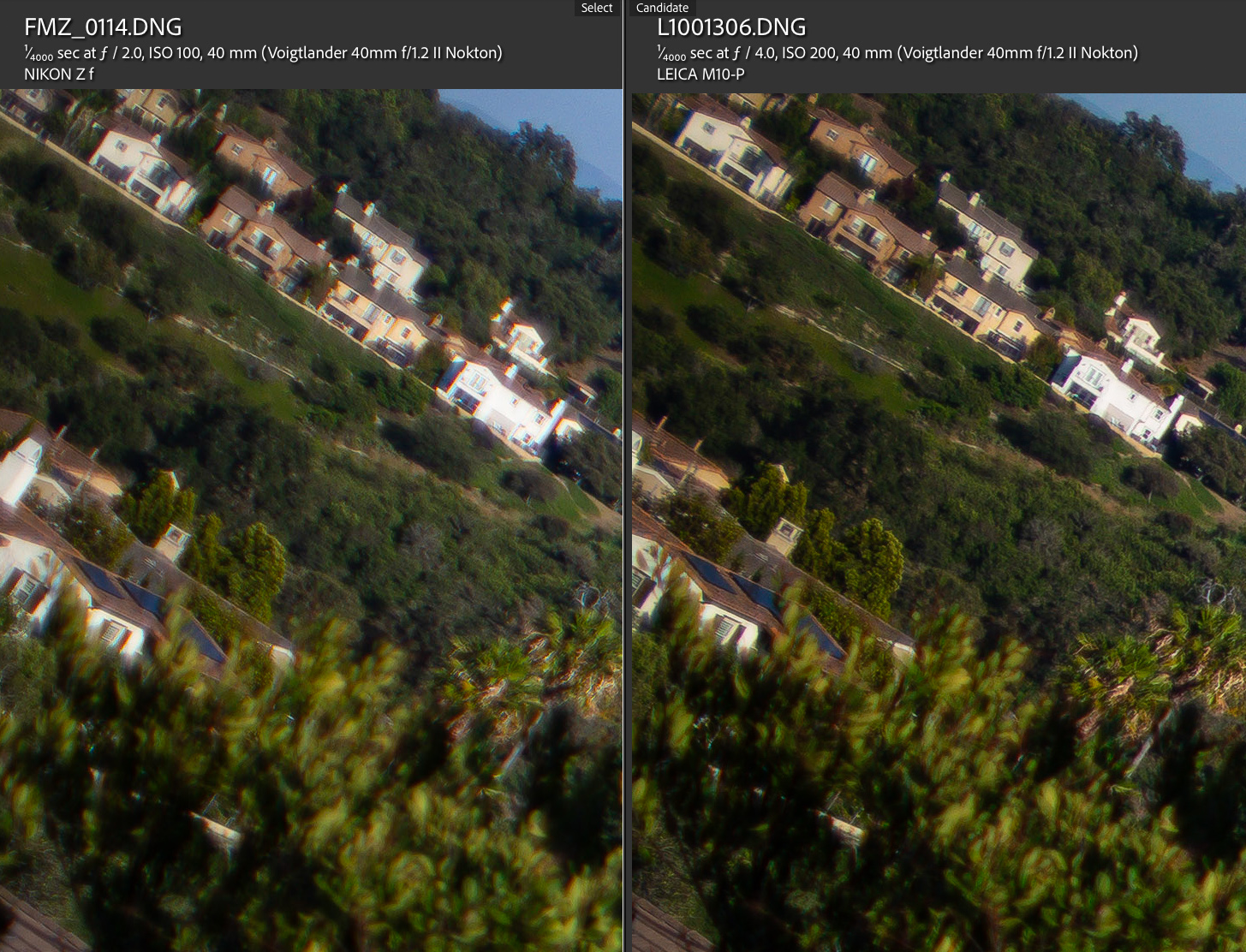
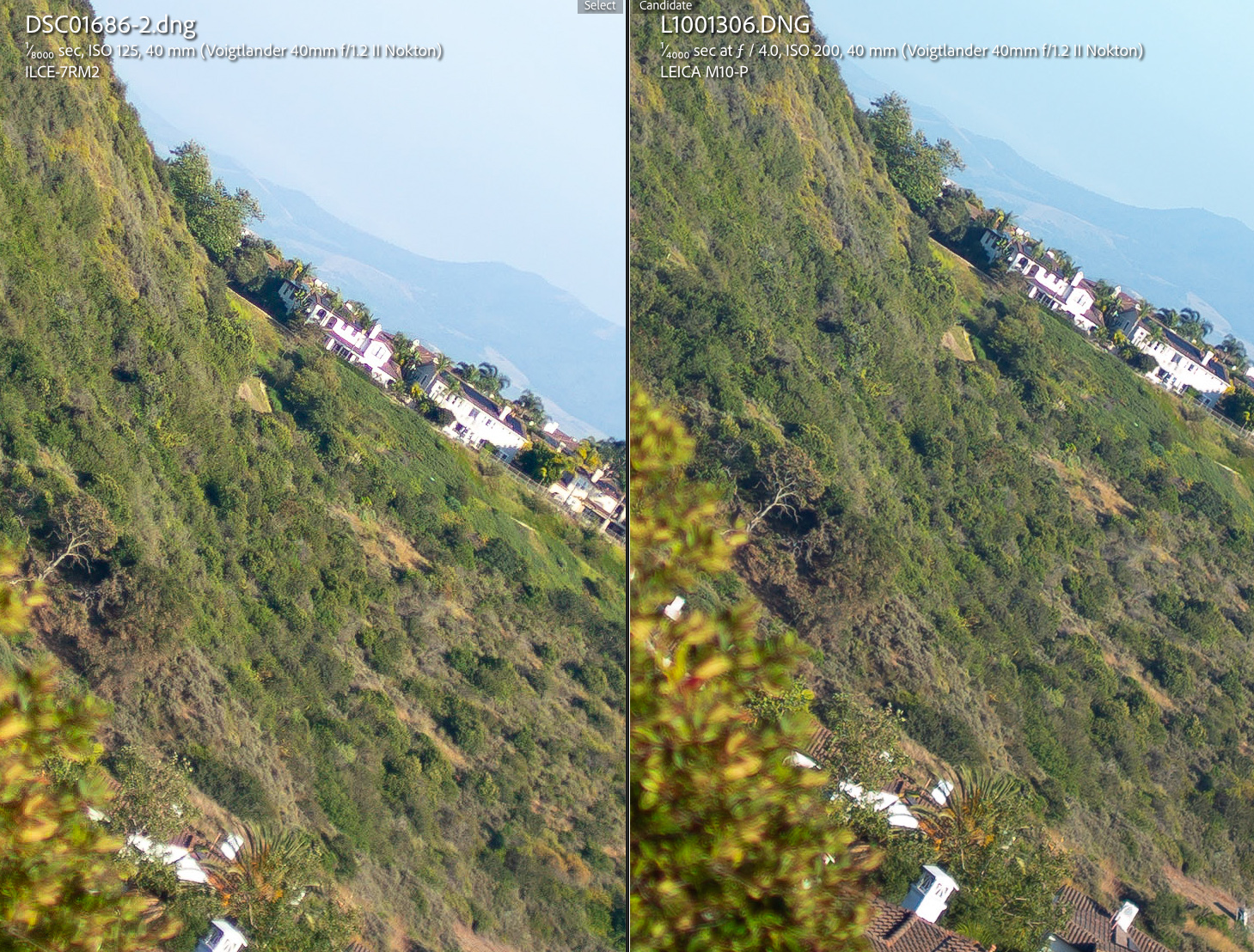
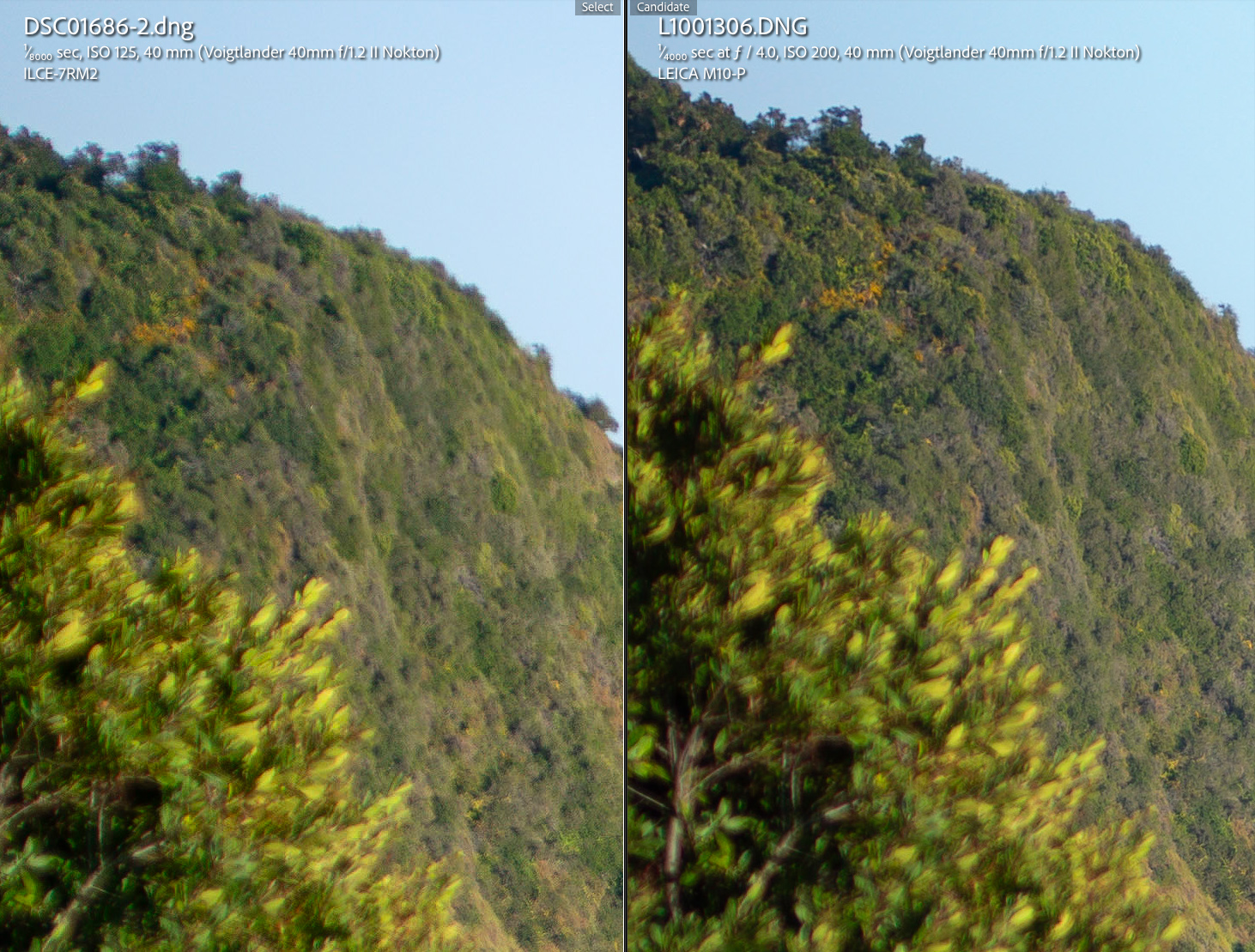
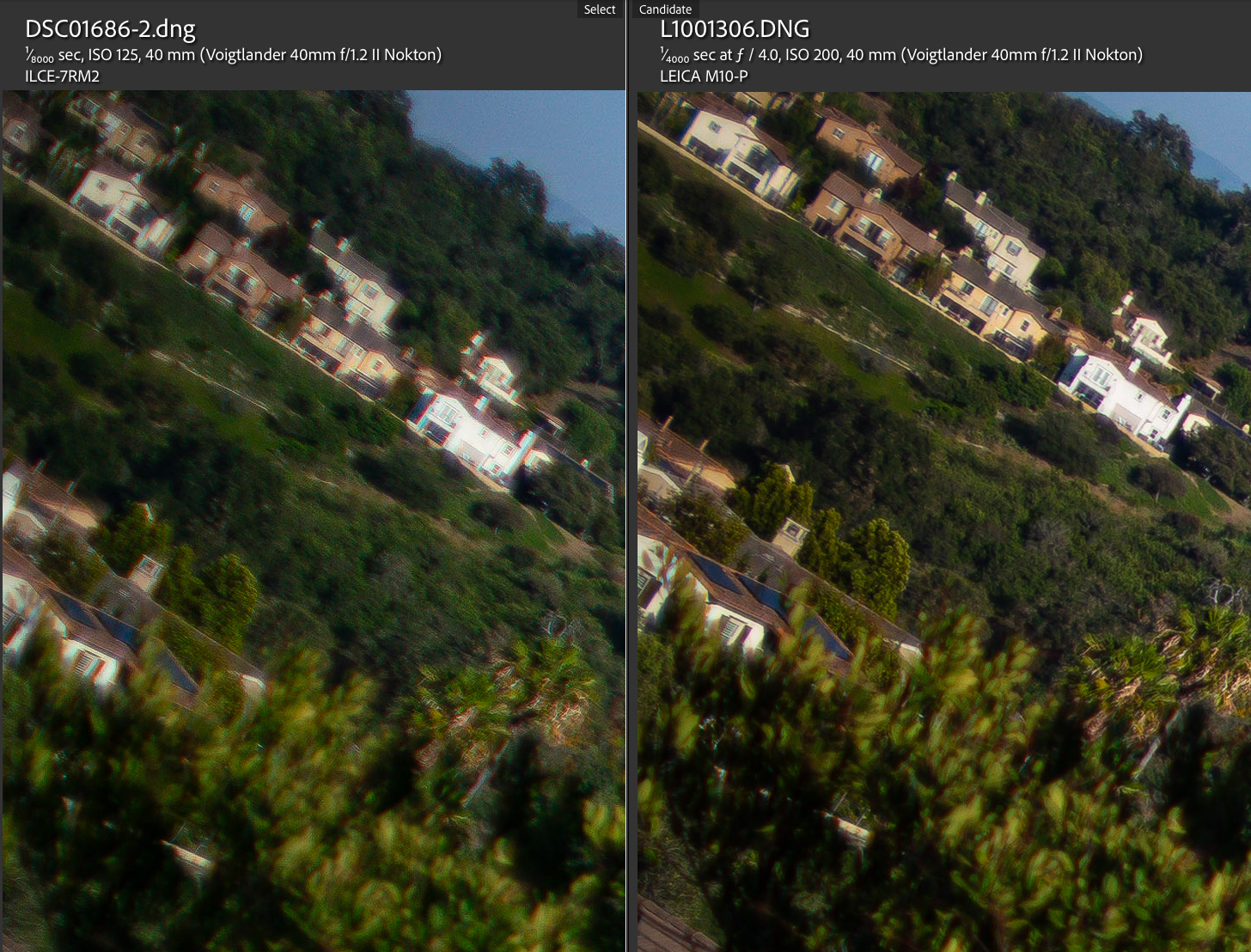
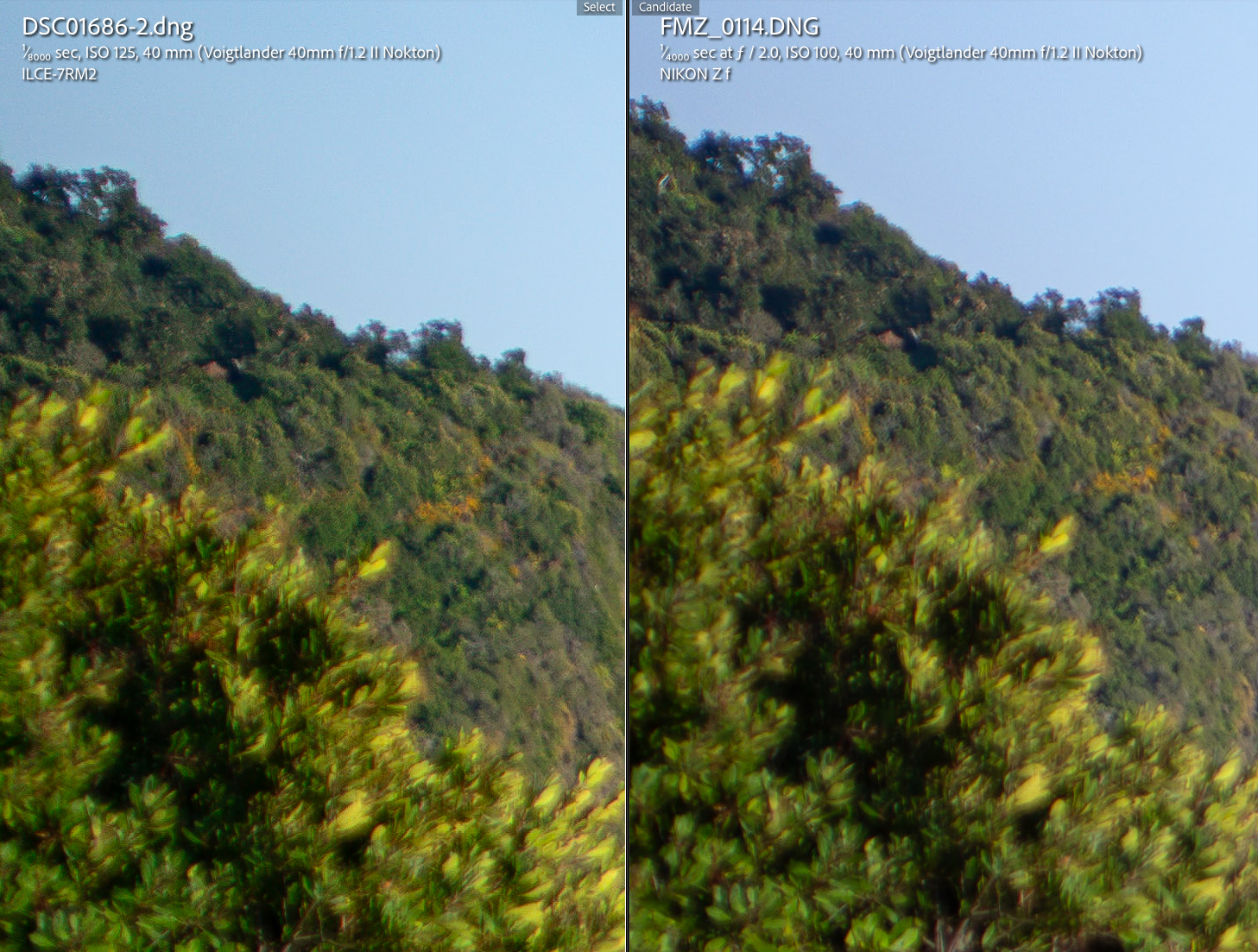
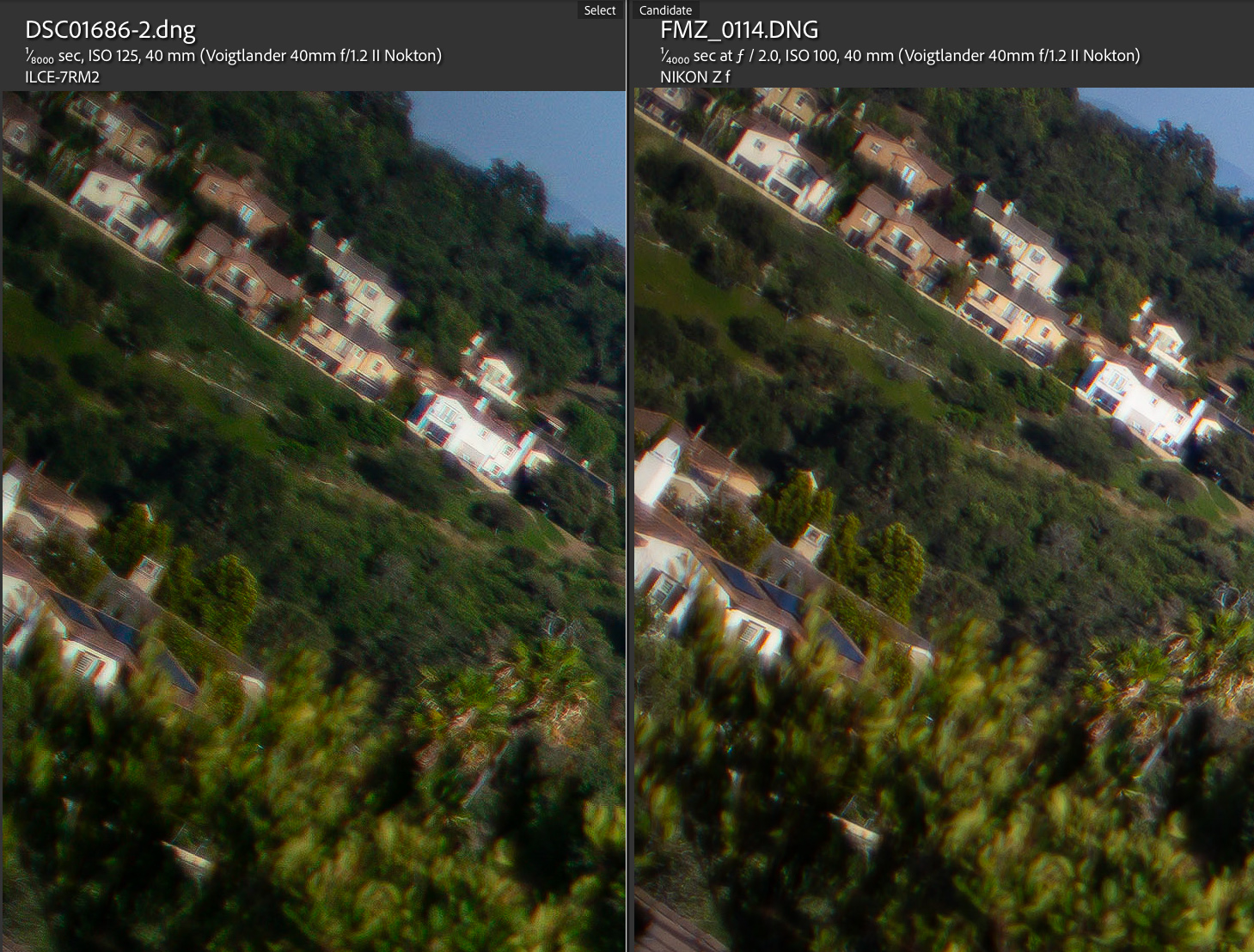
I did a quick test today comparing Nikon, Sony, and Leica sensors using the Voigtlander 40mm f/1.2 Nokton VM, a lens that tends to show degradation when adapted to mirrorless bodies. As I've mentioned before, the Leica SL series is the only mirrorless that really lets this lens perform at a high and consistent level similar to how it does on a Leica M body. On the Sony side, you can clearly see off-axis image quality issues, mainly stronger field curvature and some astigmatism.
This time I added the Nikon Zf to the comparison. Since it has a 24MP sensor, I matched it with the Leica M10-P at 24MP, and resized the Sony A7R II files from 42MP down to 24MP before applying any sharpening. That way, all three files are on equal footing.
All images were focused at the center, so this comparison is really about how the mid-frame and corners hold up relative to the Leica.
There's a lot of talk online claiming the Nikon sensor performs much better than Sony with M-lenses, often attributed to a thinner sensor stack. In practice, the Nikon does show improvement over the Sony results but with certain M lenses like this one, it still doesn’t reach the level of performance you get from the Leica.
Below are 100% crops from the center, mid-field, and corners for reference. All images were shot wide open at f/1.2, focused at the center, and processed in the same way.
The last two sets show direct comparisons between the Nikon Zf and Sony in the mid-zone and corners. To my eyes, the Nikon crops look slightly better in the extreme corners, while performance in the mid-field appears very similar, which is where this lens tends to struggle compared to the Leica M10-P.
This may not be the ideal lens to highlight the differences, so I'll be testing more lenses soon.
p.62 #12 · Nikon Zf as a platform for adapted/native manual focus lenses
You probably noticed that CV 40mm f/1.2 Nokton VM isn't a strong performer away from the center when shot at f/1.2 even on the M10-P.
Out of curiosity, I'll also test the CV 28mm f/2 APO-Lanthar VM, which I consider the best 28mm on the market, across these three cameras when I get the chance. That should give a clearer picture of how much it really shines on the Leica M from center to corner at f/2, and how the Sony and Nikon sensors compare.
p.62 #13 · Nikon Zf as a platform for adapted/native manual focus lenses
Fred Miranda wrote:
The interesting part is that it does not work with Voigtlander native Z-mount or E-mount adapted lenses (Even when setting Focus Mode to AF-S). But...it worked perfectly with my setup using the Megadap adapter + Voigtlander dumb adapter + any Leica M lens.
________________
On the Nikon Zf:
* Set Focus Mode to AF-S or AF-C, either one works
* Set AF-S or AF-C priority selection to 'Focus'. (Only 'Focus' works, not 'Focus + Release' or 'Release')
* Set AF Activation to Off (instead of On)
Then:
* Go into 'AF-ON only', press right, and set 'Out-of-focus release' to Disable
I confirm this procedure works with the Z6 and it works with my native Z-mount Viltrox 50 Air. For classic alternative lenses (no contacts) the procedure fails because the camera focus mode is implicitly MF and the "Out-of-focus release' setting is inoperative—shutter will fire regardless of focus attainment.
p.62 #14 · Nikon Zf as a platform for adapted/native manual focus lenses
@Fred Miranda thank you for confirming my own observations. I sold all of my M-to-Z and M-to-E adapters a while ago because I didn't see the point of using M lenses on non-Leica cameras. The image degradation was quite obvious without even doing any instrumented tests.
I kept my F-to-Z, F-to-E, and Z-to-E adapters because those produce images I have no problems with. But again, I haven't bothered with instrumented testing. Perhaps you may want to see whether IQ of an E-lens drops when it's mounted to a Z-body? Keeping fingers crossed! ;-)
p.62 #15 · Nikon Zf as a platform for adapted/native manual focus lenses
Looking forward to your test!
Fred Miranda wrote:
You probably noticed that CV 40mm f/1.2 Nokton VM isn't a strong performer away from the center when shot at f/1.2 even on the M10-P.
Out of curiosity, I'll also test the CV 28mm f/2 APO-Lanthar VM, which I consider the best 28mm on the market, across these three cameras when I get the chance. That should give a clearer picture of how much it really shines on the Leica M from center to corner at f/2, and how the Sony and Nikon sensors compare.
May 03, 2026 at 03:18 AM
Steve Spencer Offline • • • • • • • Upload & Sell: On
p.62 #16 · Nikon Zf as a platform for adapted/native manual focus lenses
old-gregg wrote:
@Fred Miranda@ thank you for confirming my own observations. I sold all of my M-to-Z and M-to-E adapters a while ago because I didn't see the point of using M lenses on non-Leica cameras. The image degradation was quite obvious without even doing any instrumented tests.
I kept my F-to-Z, F-to-E, and Z-to-E adapters because those produce images I have no problems with. But again, I haven't bothered with instrumented testing. Perhaps you may want to see whether IQ of an E-lens drops when it's mounted to a Z-body? Keeping fingers crossed! ;-)
It does depend on the lens, however. Some lenses including the slower Voigtlander 10 f/5.6, 12 f/5.6, 15 f/4.5, 21 f/3.5, 50 f/3.5 APO, 90 f/2.8 APO, and the new 75 f/2.8 APO, show remarkably good performance on mirrorless cameras with close to no effect of the thicker sensor stack.
Other lenses like the 40 f/1.2 as Fred has shown here have markedly worse performance. The two key variables are the max aperture and the exit pupil for the lens. The more narrow the max aperture the more likely it is to work and the longer the exit pupil the more likely it is to work. Generally speaking lenses with an f/2 or faster max aperture will be affected when shot at wider apertures, and even some slow lenses (e.g., the Voigtlander 28 f/2.8 and 35 f/3.5) with really short exit pupils are affected by the cover glass.
My personal experience of E to Z adapting is like yours that adapting E lenses to Z mount doesn't really affect performance. At least not in ways that I could see. Now that Fred has the ability to do these tests, it would be great to see him test a few lenses when he gets around to it. His careful tests might reveal some differences I wasn't able to see.
p.62 #17 · Nikon Zf as a platform for adapted/native manual focus lenses
I don't know if the aperture is strongly related to adaptability. There are many examples of poorly adapting slower CV lenses too, like the older film-era 21/4, 25/4, 28/3.5, 35/2.5, 50/2.5 and some of the faster digital era 35mm lenses adapt better than the slower ones, for example 35/1.2 III/IV and 35/1.5 adapt better than all the slower 35mm CV lenses in my experience. I also find 50/1.5 V1 and V2 Noktons to adapt well, and 50/2.2 Color-Skopar had some challenges. I mainly paid attention to stopped down corner-to-corner performance when using these VM lenses on Sony though and less to possible bokeh impacts at widest apertures.
I think the exit pupil distance and other optical design aspects definitely play a part and if the lenses were designed with consideration for digital M as well as FF mirrorless from the start, Cosina may have chosen designs that are less affected and easier to optimize with small tweaks.
p.62 #18 · Nikon Zf as a platform for adapted/native manual focus lenses
rico wrote:
I confirm this procedure works with the Z6 and it works with my native Z-mount Viltrox 50 Air. For classic alternative lenses (no contacts) the procedure fails because the camera focus mode is implicitly MF and the "Out-of-focus release' setting is inoperative—shutter will fire regardless of focus attainment.
Thanks for confirming. Just keep in mind those settings weren’t intended for a direct M-to-Z non-CPU adapter. I was testing with the Megadap, plus a 'dumb' M-to-E adapter, paired with a Leica M lens.
p.62 #19 · Nikon Zf as a platform for adapted/native manual focus lenses
Steve Spencer wrote:
It does depend on the lens, however. Some lenses including the slower Voigtlander 10 f/5.6, 12 f/5.6, 15 f/4.5, 21 f/3.5, 50 f/3.5 APO, 90 f/2.8 APO, and the new 75 f/2.8 APO, show remarkably good performance on mirrorless cameras with close to no effect of the thicker sensor stack.
Other lenses like the 40 f/1.2 as Fred has shown here have markedly worse performance. The two key variables are the max aperture and the exit pupil for the lens. The more narrow the max aperture the more likely it is to work and the longer the exit pupil the more likely it is to work. Generally speaking lenses with an f/2 or faster max aperture will be affected when shot at wider apertures, and even some slow lenses (e.g., the Voigtlander 28 f/2.8 and 35 f/3.5) with really short exit pupils are affected by the cover glass.
My personal experience of E to Z adapting is like yours that adapting E lenses to Z mount doesn't really affect performance. At least not in ways that I could see. Now that Fred has the ability to do these tests, it would be great to see him test a few lenses when he gets around to it. His careful tests might reveal some differences I wasn't able to see....Show more →
---------------------------------------------
Juha Kannisto wrote:
I don't know if the aperture is strongly related to adaptability. There are many examples of poorly adapting slower CV lenses too, like the older film-era 21/4, 25/4, 28/3.5, 35/2.5, 50/2.5 and some of the faster digital era 35mm lenses adapt better than the slower ones, for example 35/1.2 III/IV and 35/1.5 adapt better than all the slower 35mm CV lenses in my experience. I also find 50/1.5 V1 and V2 Noktons to adapt well, and 50/2.2 Color-Skopar had some challenges. I mainly paid attention to stopped down corner-to-corner performance when using these VM lenses on Sony though and less to possible bokeh impacts at widest apertures.
I think the exit pupil distance and other optical design aspects definitely play a part and if the lenses were designed with consideration for digital M as well as FF mirrorless from the start, Cosina may have chosen designs that are less affected and easier to optimize with small tweaks....Show more →
There are a lot of variables at play. Maximum aperture, exit pupil distance, and overall optical design all matter, especially how the lens sends light toward the sensor at the edges. That is why it's best to test each lens for compatibility with thicker sensor stacks. We can make educated guesses, but you can't be certain without real testing.
What I’ve seen so far is that Nikon and Sony have very similar sensor stack thickness. Sony might be slightly thicker, but in practice their compatibility with M lenses designed for thinner stacks looks about the same to me. What helps the Nikon Zf is its 24MP sensor, it doesn't resolve enough detail for the off-axis degradation to stand out as much. If I were using a higher megapixel Nikon body with M lenses, I’d seriously consider sending it to Kolari.
May 03, 2026 at 09:37 AM
Steve Spencer Offline • • • • • • • Upload & Sell: On
p.62 #20 · Nikon Zf as a platform for adapted/native manual focus lenses
Juha Kannisto wrote:
I don't know if the aperture is strongly related to adaptability. There are many examples of poorly adapting slower CV lenses too, like the older film-era 21/4, 25/4, 28/3.5, 35/2.5, 50/2.5 and some of the faster digital era 35mm lenses adapt better than the slower ones, for example 35/1.2 III/IV and 35/1.5 adapt better than all the slower 35mm CV lenses in my experience. I also find 50/1.5 V1 and V2 Noktons to adapt well, and 50/2.2 Color-Skopar had some challenges. I mainly paid attention to stopped down corner-to-corner performance when using these VM lenses on Sony though and less to possible bokeh impacts at widest apertures.
I think the exit pupil distance and other optical design aspects definitely play a part and if the lenses were designed with consideration for digital M as well as FF mirrorless from the start, Cosina may have chosen designs that are less affected and easier to optimize with small tweaks....Show more →
Juha, those CV lenses (especially the film era lenses) all have really short exit pupils. Brian Caldwell (a lens designer who designed the Coastal Optics 60 f/4 APO macro) explains why both aperture and exit pupil matters as summarized by Roger Cicala here:
Both aperture and exit pupil matter. If the exit pupil is short enough narrowing the aperture simply won't help, but if the exit pupil is long enough lenses with a narrower aperture can work just fine.