highdesertmesa wrote:
That does seem odd. Mine's insanely fast to focus and only misses if I choose field AF and expect it to read my mind. I use single point AF, and I'm quite happy with it. Maybe they improved the firmware since you had yours, IDK. And all Fujifilm cameras are finicky about picking the perfectly-sized single-point AF box size based on the area of the subject/contrast where one wants it to focus. Eye-AF with single point and a single subject is also fast and reliable for me – about a 90% hit rate on the iris of the eye (still behind Canon R5 I had, which was nearly 100% even in continuous/tracking). The 100VI iris hit rate is higher than my Zf with the 40/2 was, which loved to focus on eyelashes all day long. ...Show more →
I think my experience says more about my autofocus expectations than it does about the X100VI. I’d imagine it’s fine for 99%+ of people in regular situations.
So I ended up with the camera and its 10 times better then the X100V ever was in regards to autofocus.
This is almost as accurate as the Leica Q 116 (first gen) in singel AF-S and way better in AFC with eye tracking then the Leica Q (this is with firmware version 1.21 install on the x100VI)
The worst part so far with x100vi is the RAF files in lightroom. (capture one marginally better)
Holy smoke do they ever look completely ass!!
The disappointment looking on a RAF file from x100VI to the DNG from Leica Q, Leica M10, or theM9 or the AWR files from Sony A7III (another 24 megapixel) or the NEF files from the Nikon ZF is HUGE..
Denoising with raw detail, and sharpness set to minimum 60 and detail at 35 is a must for the fuji files to even look in the same ballpark as the other..
I received one about 3 weeks ago because I want to use it as EDC and VI has stabilization. Happy with it so far. Same as you, I am finding I have to apply higher sharpening and radius settings to get something approximating my Sony files in Capture One, but I am still messing around to find what looks good. BTW, I am liking the film simulations and plan to shoot more JPG.
Tor82 wrote:
So I ended up with the camera and its 10 times better then the X100V ever was in regards to autofocus.
This is almost as accurate as the Leica Q 116 (first gen) in singel AF-S and way better in AFC with eye tracking then the Leica Q (this is with firmware version 1.21 install on the x100VI)
The worst part so far with x100vi is the RAF files in lightroom. (capture one marginally better)
Holy smoke do they ever look completely ass!!
The disappointment looking on a RAF file from x100VI to the DNG from Leica Q, Leica M10, or theM9 or the AWR files from Sony A7III (another 24 megapixel) or the NEF files from the Nikon ZF is HUGE..
Denoising with raw detail, and sharpness set to minimum 60 and detail at 35 is a must for the fuji files to even look in the same ballpark as the other.. ...Show more →
Low ISOs look great in C1 from the X100VI. If you're going to shoot high ISO, you can't escape the physics of 40mp shoved into an APS-C sensor. Add film grain and go with it. But unless you're freezing motion, the IBIS should let you keep ISO fairly low even in low light.
If you're not talking about high ISO, then I'd say your experience is not normal for the X100VI RAWs. Make sure you didn't accidentally set it to DR 400, too.
highdesertmesa wrote:
Low ISOs look great in C1 from the X100VI. If you're going to shoot high ISO, you can't escape the physics of 40mp shoved into an APS-C sensor. Add film grain and go with it. But unless you're freezing motion, the IBIS should let you keep ISO fairly low even in low light.
If you're not talking about high ISO, then I'd say your experience is not normal for the X100VI RAWs. Make sure you didn't accidentally set it to DR 400, too.
Isn't DR400 just the dual gain value for these sensors, IE noise should be identical to base?
^ The way I understand DR400 is the camera meters the scene at ISO 400 and then underexposes by 2 stops. The JPEGs are processed to keep the highlights as-is but raise the darks. I think of it as single shot HDR for JPEGs. The RAWs have two stops less light than they normally would compared to shooting natively at ISO 100 (they still appear correctly exposed in LR/C1 because of the 2-stop amplification).
I have read a lot of this thread and impressions/review of the x100vi and figured I would add some of my own. On a whim I pre-ordered one of the silver Made in Japan models when BH announced them. I figured it would be a long wait, but I was surprised to get a shipment notification just 10ish days later. I also shoot with a Nikon Zf and I have a Ricoh GRiii that has been a pocket cam for me for about 7 years now. I thought maybe the x100vi would slide in between them a bit (I also had an x100f in the past that I did really love but the AF was so, so bad). I posted some comparison thoughts on a different x100 vs GR thread here somewhere.
Anyways, I have been really pleasantly surprised with the IQ on the x100vi...I keep almost looking for reasons to sell it/not need it but I keep reaching for it when I go out. The images are very sharp, and I love the colors. I actually use the digital teleconverter way more than I thought I would. Getting the framing right in camera using the EVF has been helpful.
I use the JPEG 95% of the time and I love classic chrome/classic neg/acros with some minor tweaks. I love the ability to add grain at varying levels. For all the bad I read about Fuji's AF, I have been pretty happy with the AF on this thing! The c-AF is not nearly as good as the Zf, I don't even try to use the c-af on the x100vi usually...BUT the eye detect is very good and in s-af it will grab focus very quickly so I feel like my hit rate is reasonable with my kids, despite not having a very helpful c-af option. It does get confused when there are groups of people though.
I took the x100vi with me on a hiking trip recently and it was nice to have something that takes better photos than the GRiii (to me, maybe its just subjective) and has a viewfinder, but much more compact than my Zf. I can hike with the x100 in a chest pack thing easily which is nice.
Anyways, just a bit of rambling. I probably will keep it, I really enjoy using it. I do wonder if I would be better served replacing the x100 and the Zf with like a xpro 3 (or 4 one day?) as more of a middle ground. I love my Zf but it's so big and I have to do mental gymnastics sometimes to convince myself to bring it with me when I already have my hands full with my kids.
I am not a professional, I just like taking photos as a hobby for myself/my family, and with kids now I just really dont want to sit on a backlog of photos to edit. I don't have upload membership yet, but here is a sooc jpeg while hiking that I really like (classic chrome with some minor in camera changes):
Just got the Godox it30 Pro. I have the latest software and so is on my Fuji X100VI. However, I could not get the HSS. There must be a software glitch. Anyway I tried it with Manual and looks good to me. Hope Godox would fix it soon.
highdesertmesa wrote:
I have an X-T5 on order that arrives tomorrow, and I plan to try it with my 27/2.8 pancake that's currently glued to my X-M5.
That said: For me, the X-T5 with the nearest equivalent pancake, the not-yet-released 23/2.8, is not a perfect substitute for the X100VI. I value the X100VI's f/2 aperture, 10cm MFD (half the MFD of the 23/2.8), built-in ND filter, and lighter weight (24% lighter than X-T5 + 23/2.8 combo).
Edit to add: The X100VI with the wide angle conversion lens retains the 10cm MFD and f/2, which bests even the Q3 MFD in macro mode of 17cm and max aperture of f/2.8. Just another something I like about my X100VI....Show more →
Just saw this so I thought I’d reply.
No camera is a “perfect substitute” for any other camera and no camera is perfect in every way. All photographic equipment is a compromise of some sort. The X100vi itself is an obvious compromise in several ways — in exchange for the simplicity of the fixed lens and its smaller size you compromise flexibility, for example. (Also see the exchange about AF performance above.)
These things are not necessarily better/worse choices, they are simply choices.
Because 23mm is not my ideal focal length (though it is great for some things) and because I strongly prefer the flexibility of being able to use more than one focal length, for _me_ the compromise of a slightly less small but still small camera that lets me choose my lens is a better compromise than going slightly smaller and losing that ey .
For another photographer the X100vi might feel like an unacceptably large “compromise” and and they might prefer to give up certain features of that camera for something like one of the little Ricoh bodies… or their smart phone.
In any case, the XT5 with the 27mm f/2.8 (or, when available, the 23mm f/2.8), while not quite as small as the X100vi is still quite small, especially for a camera that has all the features I need including the ability to accommodate more than one lens. If one doesn’t care about that, the X100vi is a fine alternative that is indeed slightly smaller…
Tor82 wrote:
The worst part so far with x100vi is the RAF files in lightroom. (capture one marginally better)
Holy smoke do they ever look completely ass!!
If you are getting “completely ass”image quality in LR from Fujifilm files, you are doing something wrong.
highdesertmesa wrote:
^ The way I understand DR400 is the camera meters the scene at ISO 400 and then underexposes by 2 stops. The JPEGs are processed to keep the highlights as-is but raise the darks. I think of it as single shot HDR for JPEGs. The RAWs have two stops less light than they normally would compared to shooting natively at ISO 100 (they still appear correctly exposed in LR/C1 because of the 2-stop amplification).
That’s my understanding, too. I think it is a decent “quick and dirty” option for those who want more leeway in high dynamic range shots but who don’t want to have to think too much about the details and then deal with it in post. (My preference is just to shoot aV mode, capture raw files, use the EC knob to protect highlights when necessary, and then handle any shadow issues in post. It requires a little more attention and input on my part, but it essentially lets me customize the amount of shadow work I’ll have to do in post. (I use PS/ACR rather than LR, but both have a great AI Denoise feature now that I occasionally employ in images where I do more radical shadow recovery. It really works great on Fujifilm files.)
gdanmitchell wrote:
Just saw this so I thought I’d reply.
No camera is a “perfect substitute” for any other camera and no camera is perfect in every way. All photographic equipment is a compromise of some sort. The X100vi itself is an obvious compromise in several ways — in exchange for the simplicity of the fixed lens and its smaller size you compromise flexibility, for example. (Also see the exchange about AF performance above.)
These things are not necessarily better/worse choices, they are simply choices.
Because 23mm is not my ideal focal length (though it is great for some things) and because I strongly prefer the flexibility of being able to use more than one focal length, for _me_ the compromise of a slightly less small but still small camera that lets me choose my lens is a better compromise than going slightly smaller and losing that ey .
For another photographer the X100vi might feel like an unacceptably large “compromise” and and they might prefer to give up certain features of that camera for something like one of the little Ricoh bodies… or their smart phone.
In any case, the XT5 with the 27mm f/2.8 (or, when available, the 23mm f/2.8), while not quite as small as the X100vi is still quite small, especially for a camera that has all the features I need including the ability to accommodate more than one lens. If one doesn’t care about that, the X100vi is a fine alternative that is indeed slightly smaller…
If you are getting “completely ass”image quality in LR from Fujifilm files, you are doing something wrong.
That’s my understanding, too. I think it is a decent “quick and dirty” option for those who want more leeway in high dynamic range shots but who don’t want to have to think too much about the details and then deal with it in post. (My preference is just to shoot aV mode, capture raw files, use the EC knob to protect highlights when necessary, and then handle any shadow issues in post. It requires a little more attention and input on my part, but it essentially lets me customize the amount of shadow work I’ll have to do in post. (I use PS/ACR rather than LR, but both have a great AI Denoise feature now that I occasionally employ in images where I do more radical shadow recovery. It really works great on Fujifilm files.)...Show more →
I ended up getting rid of the X-T5 almost immediately, instead preferring to stick with the much smaller X-M5 when I need an interchangeable lens X body.
Upgraded DXO PL 8 Elite to 9 Elite. Loving the AI masks and the Fuji denoising. I tried the AI mask (subject and hair) on a couple of underexposed images.
Did some more testing with the wide angle adaptor today:
- F2, a bit glowy sometimes when you zoom into out-of-focus areas, poor resolution close and long, maybe useful for close portraits with a softer look / want the background to blur, but also not bad in low light when the iso is higher and it masks issues (close, not tested longer at f2).
- F2.8 slight reduction in glow (when it shows up), better close but not great, nice for shorter mid distance with filmic edit
- F3.6-F4 decently reduced glow, sharper still for close, better mid/long distance but not peak edge to edge for mid distance, longer distance I can't tell an improvement going higher (f4 vs f5.6) in the samples I took.
- F5.6-6.4 Sharpest close and rather nice, better and decent mid including to edge
It's not impressive for a clean look or detail in low/soft light longer distance.
B&W street with filmic look is probably right up its alley.
Will try some smaller aperture longer distance in hopefully brighter light next. Flat at f5.6 and with depth at f8/11.
All below are with the wide angle adaptor.
f5.6 iso500 1/50, raw details on in lightroom
100% crop:
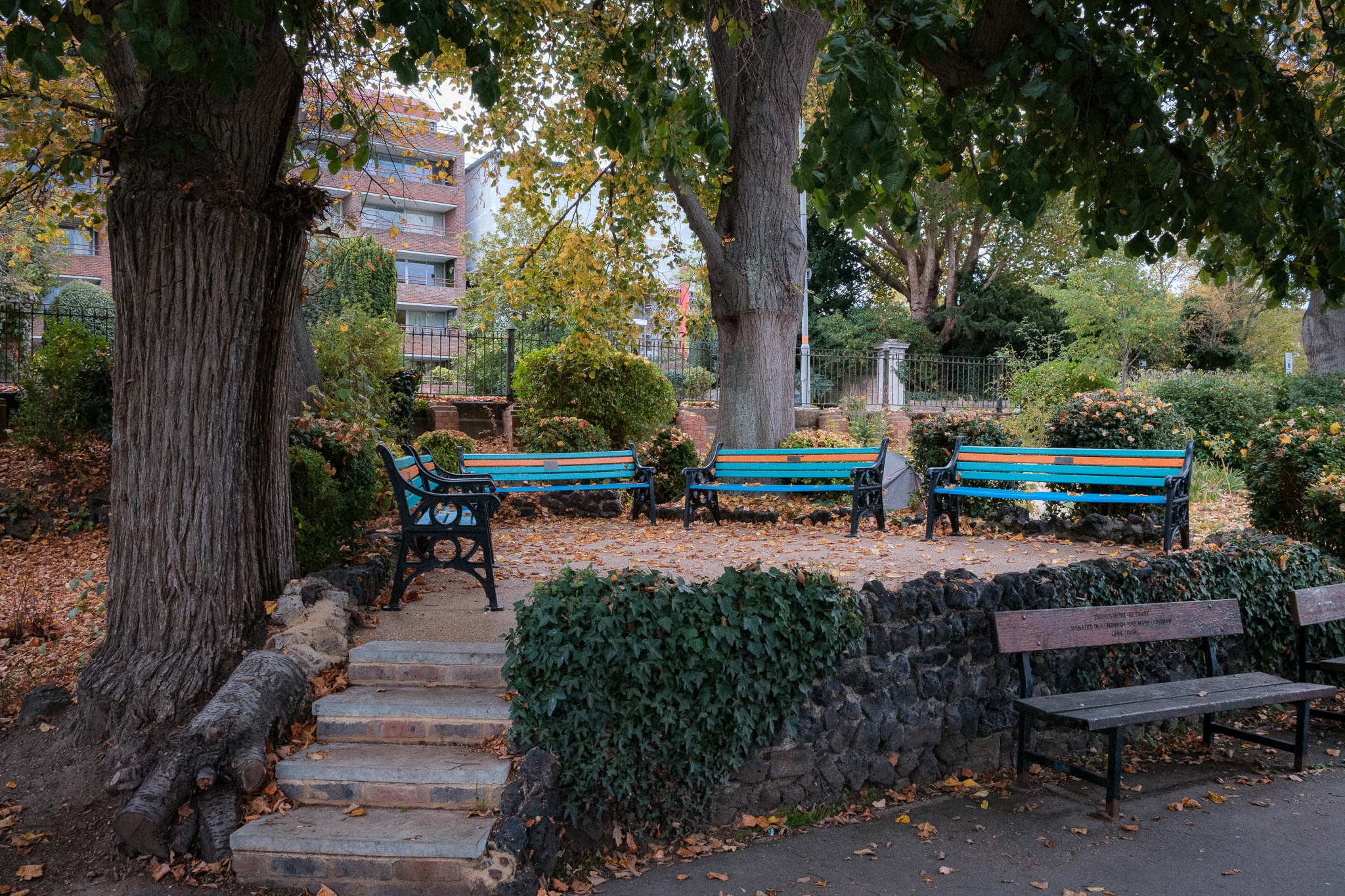
This is iso3200 f8 1/40 with light editing (the blue benches hurt your eyes in person too):
One full-size at F2 just to show what I was mentioning earlier about the glow etc. Iso 250, 1/500, slightly reduced clarity, increased texture and raw details on, can see what i mean about the glow:
Another f2 but iso 3200 1/30 where the high iso and noise mask some of the issues.
I'm actually a little surprised it turned out this well at f2. No raw details on (made no noticeable difference to me), texture +15, clarity -8, grain 27, sharpening 47.
Feel like it's a good camera+adaptor combo for gritty images.
TBH I've done more testing and shooting with the adaptor on than off, mostly because I'm really enjoying 28mm at the moment.
I ordered the nokton f1.5 28mm for sony e-mount though I'm a little worried I won't know how to make good use of it, but I want the option. Don't think it will produce images similar to this at all.
I'm not sure how the Fuji 18mm f2 compares, but I'm curious. The f1.4 is supposed to be excellent but too big for me for this use case as a casual everyday walkabout and probably a different look.
And definitely need to try to make another preset for this weather that's less depressing.
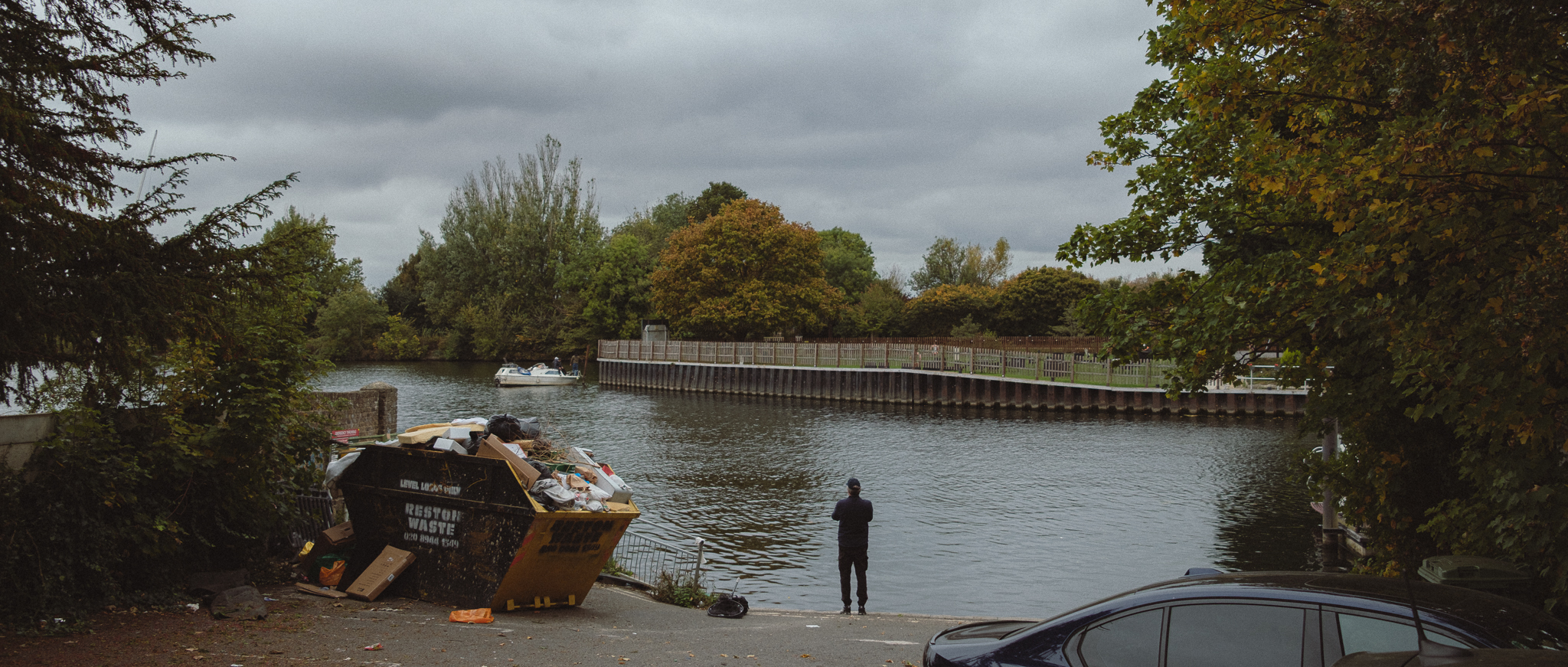
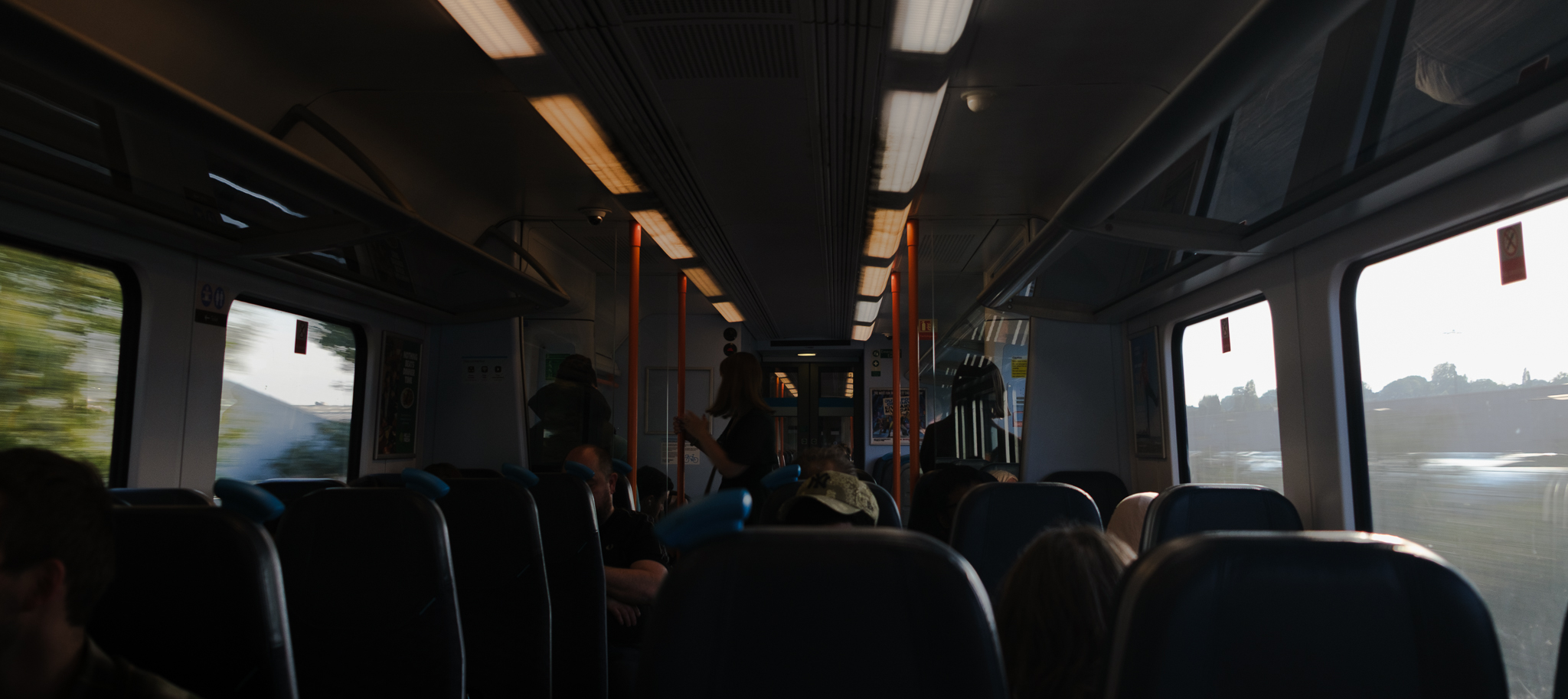
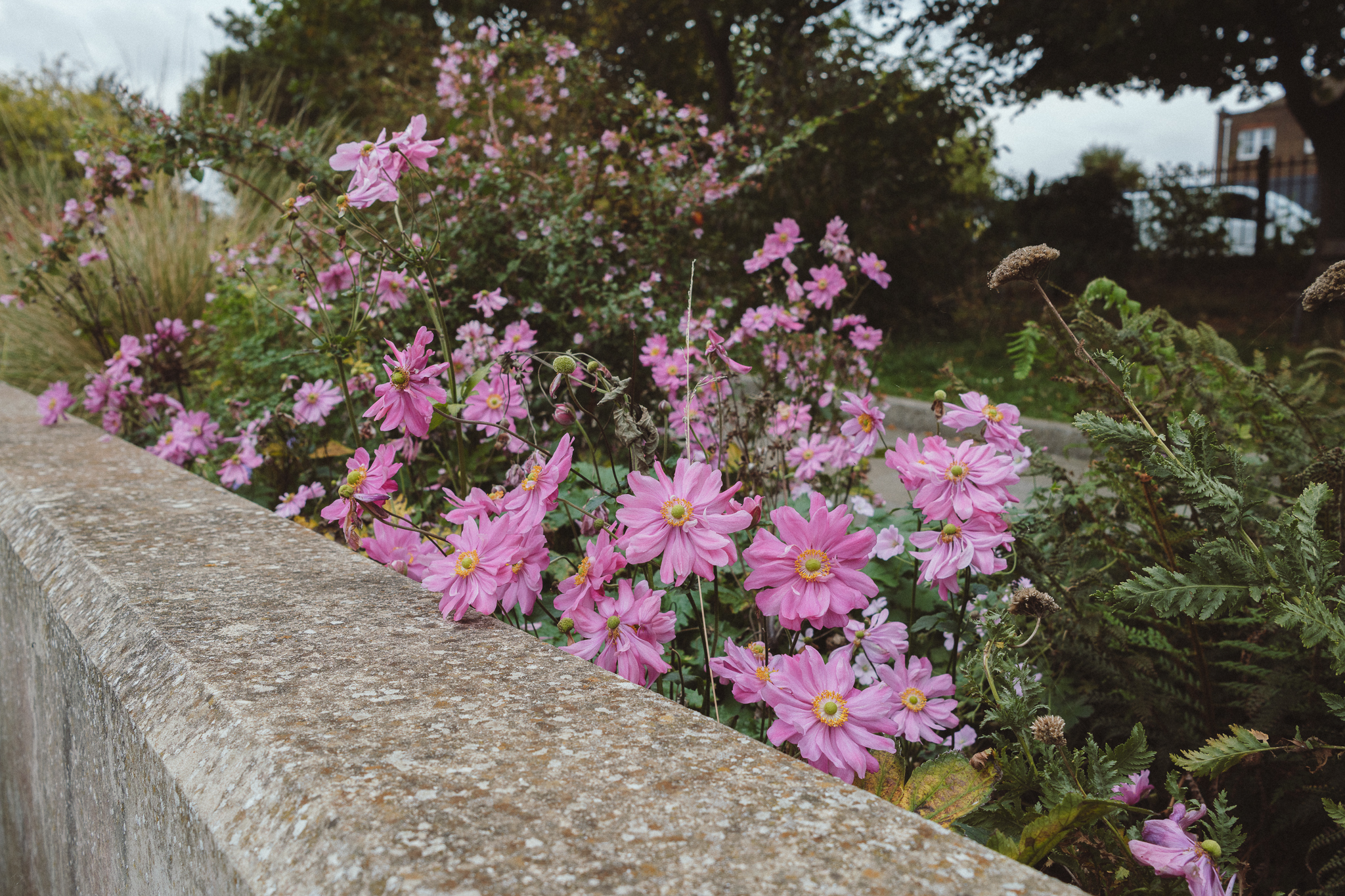
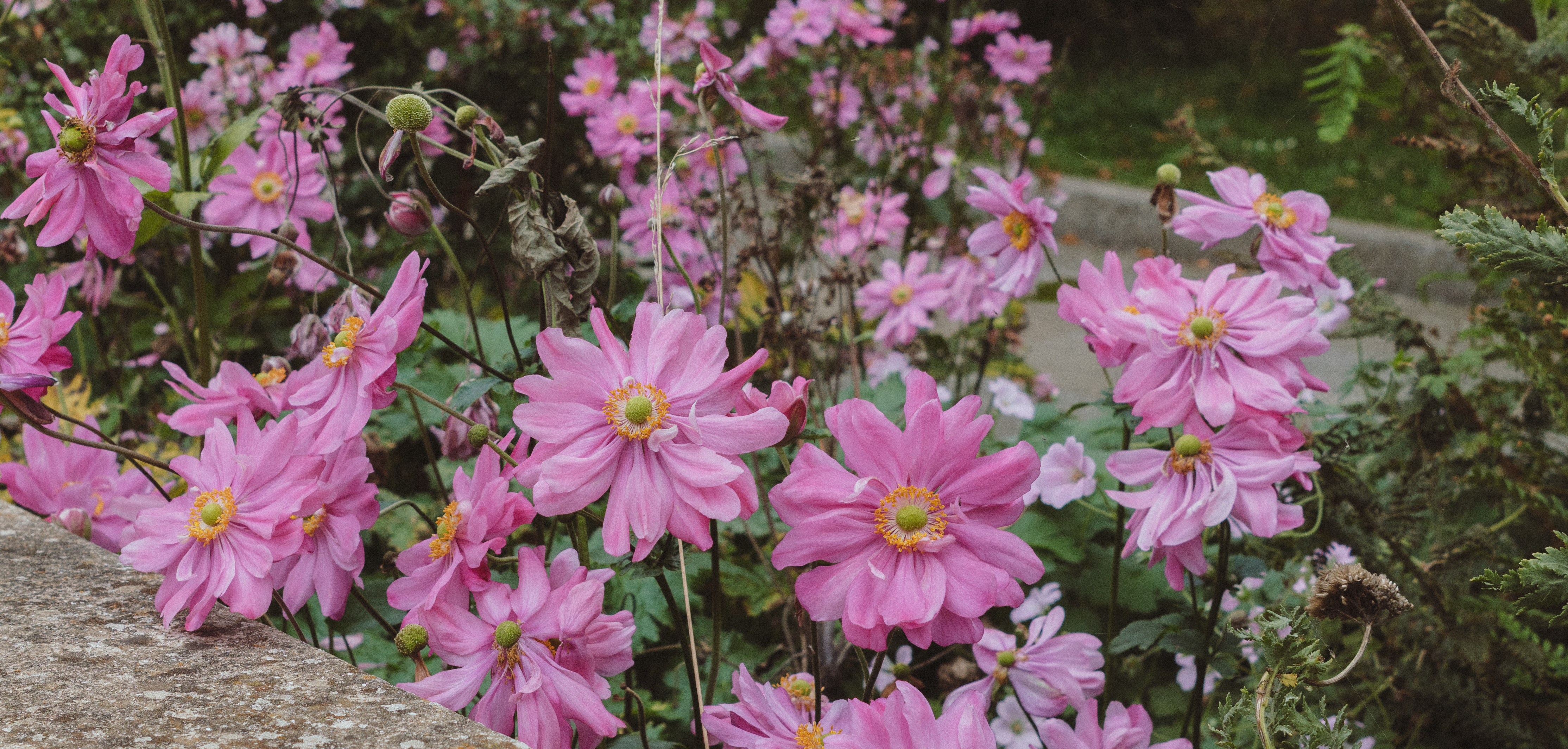
I don't often share my photos as most of them are just of my family but here are a few recent ones traveling with my x100vi that I really enjoy. No editing at all on these which is a huge reason I keep carrying it with me.
highdesertmesa wrote:
^ The way I understand DR400 is the camera meters the scene at ISO 400 and then underexposes by 2 stops. The JPEGs are processed to keep the highlights as-is but raise the darks. I think of it as single shot HDR for JPEGs. The RAWs have two stops less light than they normally would compared to shooting natively at ISO 100 (they still appear correctly exposed in LR/C1 because of the 2-stop amplification).
If you shoot DR400 and 'ISO 500' on the x100vi you actually are shooting at base ISO. DR400 and 'ISO500' meters the scene as if it is ISO500 but when it exposed it underexposes by 2 stops.... by actually running the sensor 2 stops lower, ISO125.
DR400 the camera meters at ISO500 (or higher) but actually runs the sensor 2 stops lower.
DR200 the camera meters at ISO250 (or higher) but actually runs the sensor 1 stop lower.
In other words DR200@ISO250 and DR400@ISO500 are both actually getting the max dynamic range that the sensor is capable of because it is actually running at base ISO.
Really simple test to prove this.
Set the camera to DR100 and ISO 500. Point it at something with fixed consistent illumination (a blank wall is good) and set the shutter/aperture manually to get the proper exposure. Take a shot.
Now, turn on DR400. Take a shot. Your shutter speed/aperture hasn't changed but you will have 2 stops more highlight capture. Because the camera underexposed by 2 stops. There are 3 points in an exposure triangle and you have fixed two of them (shutter/aperture), the third is ISO.