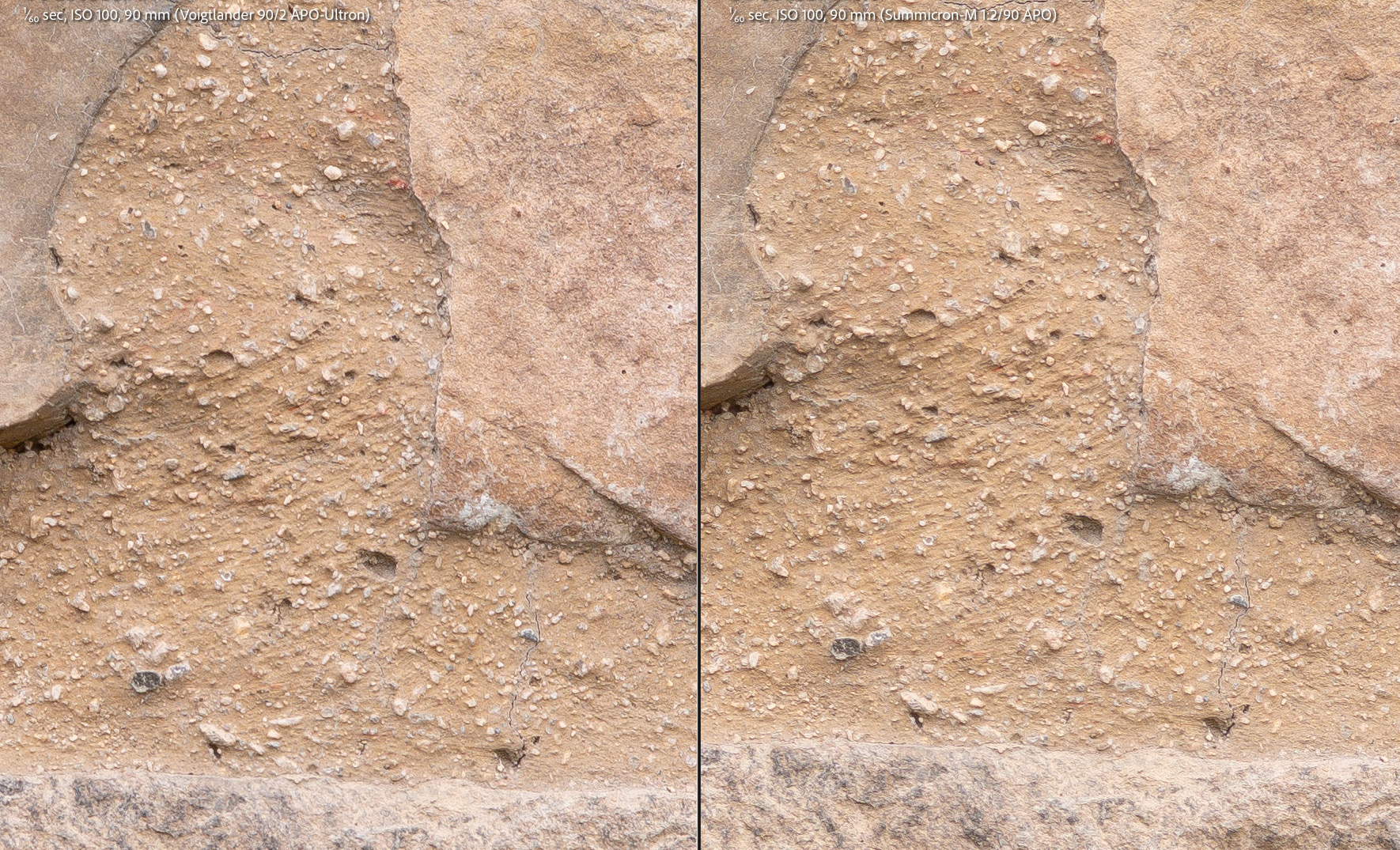
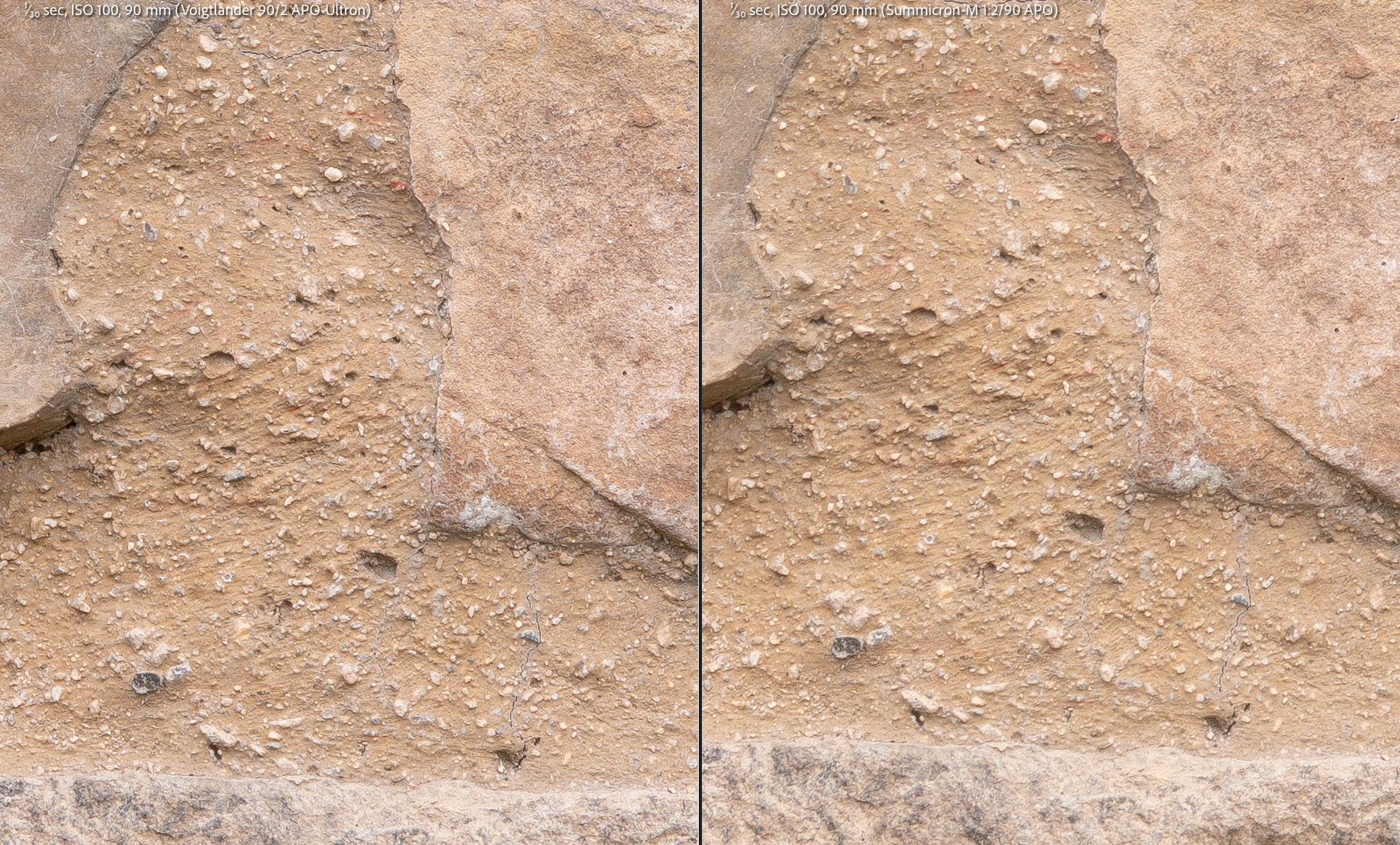
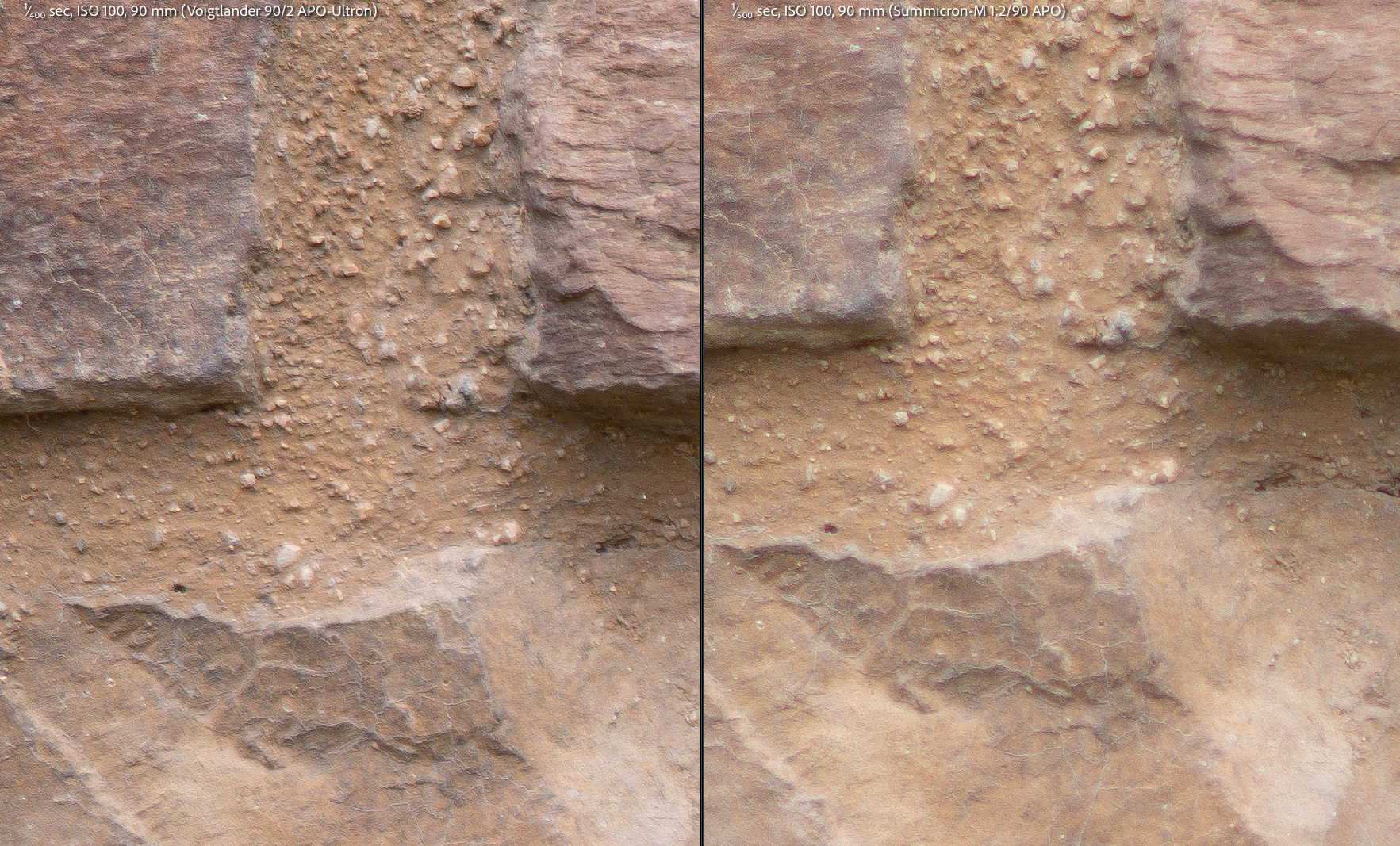
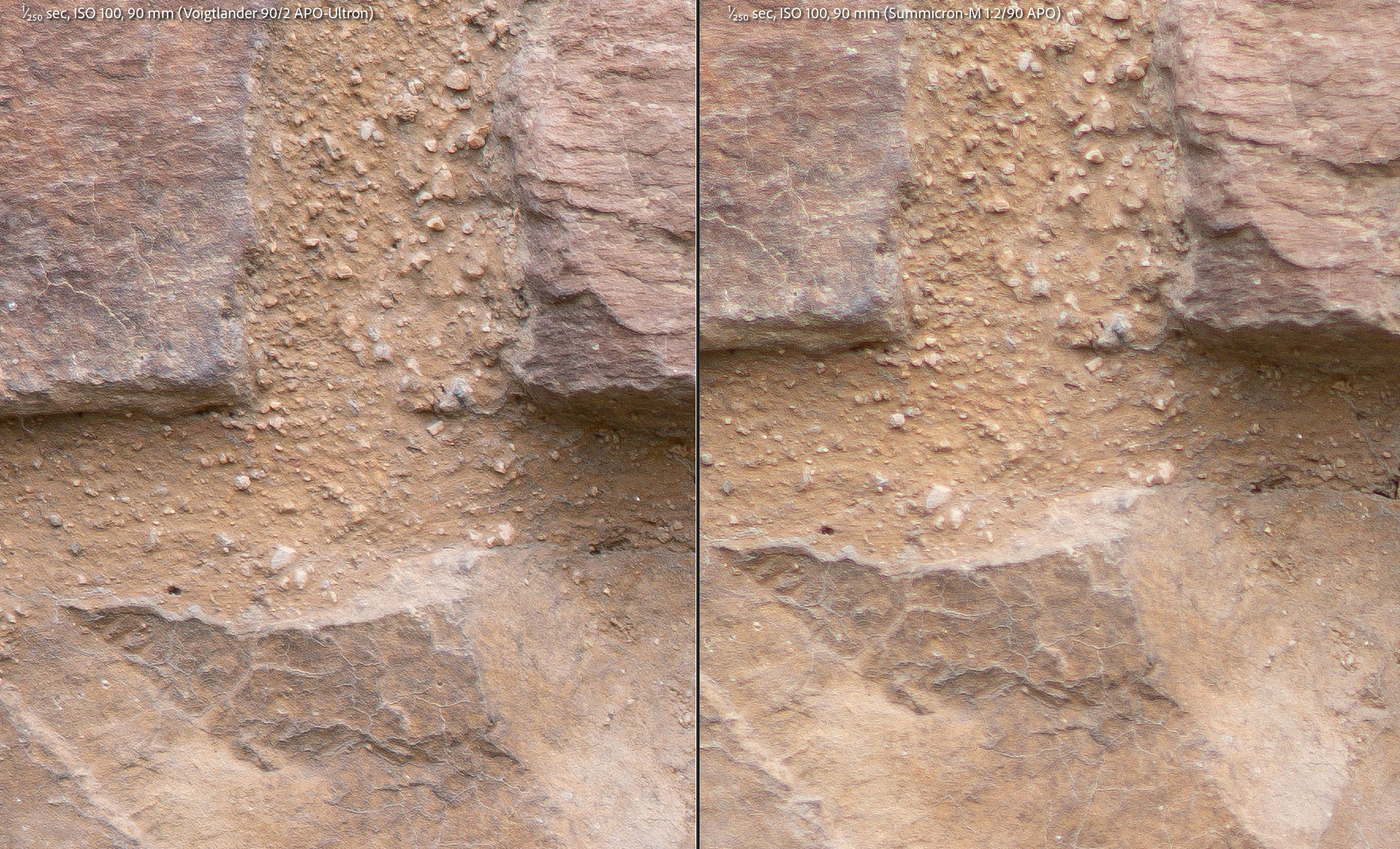
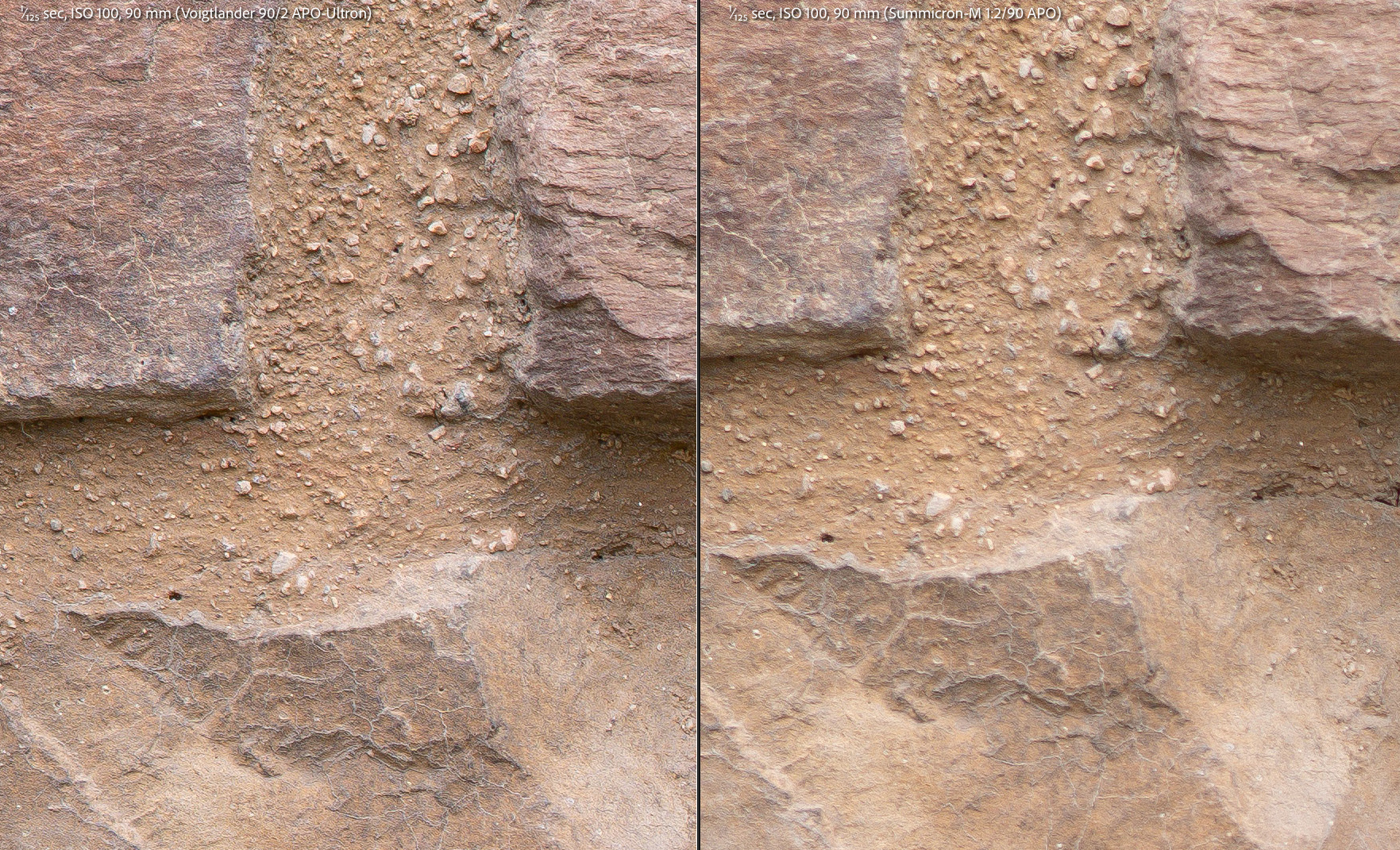
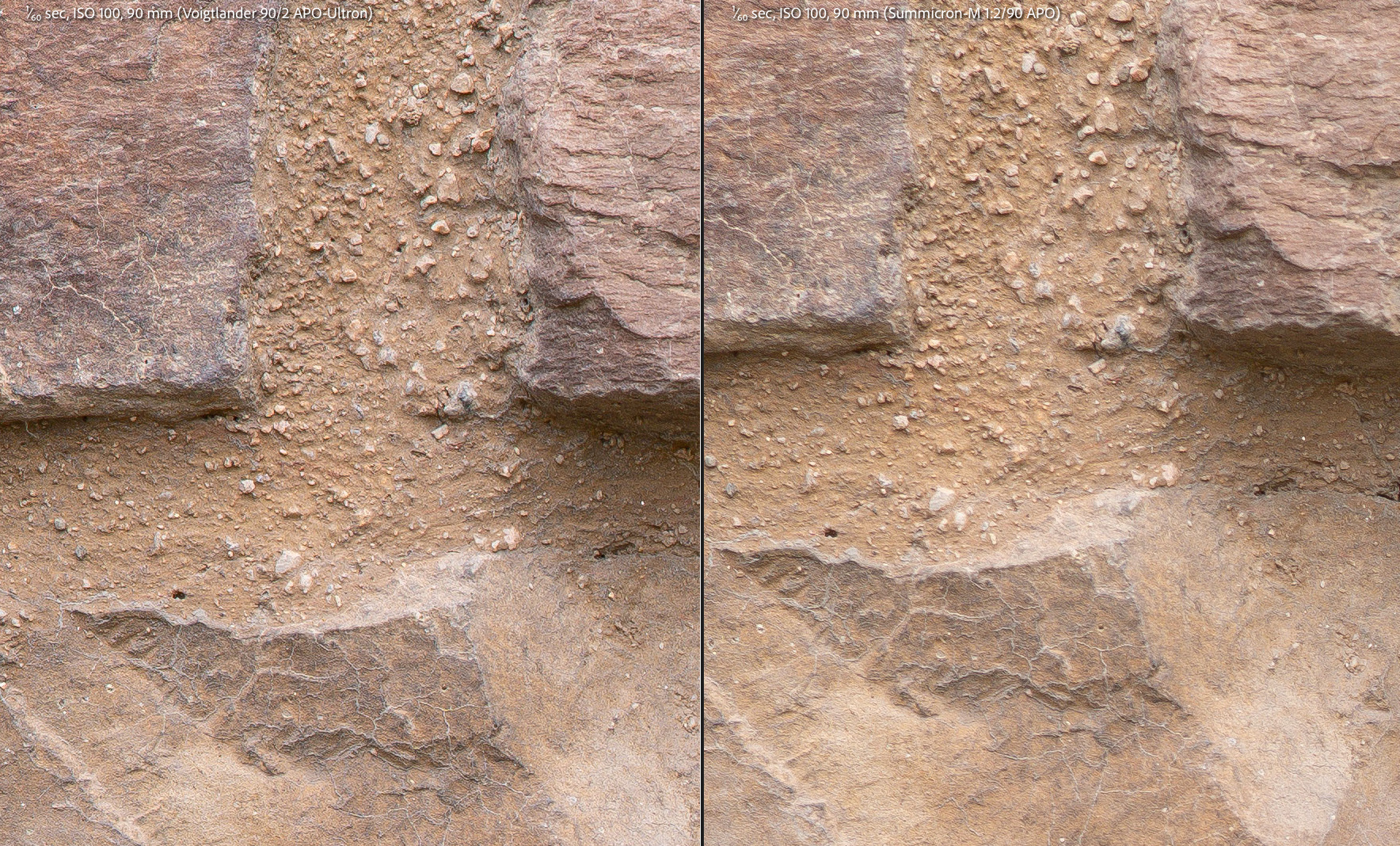
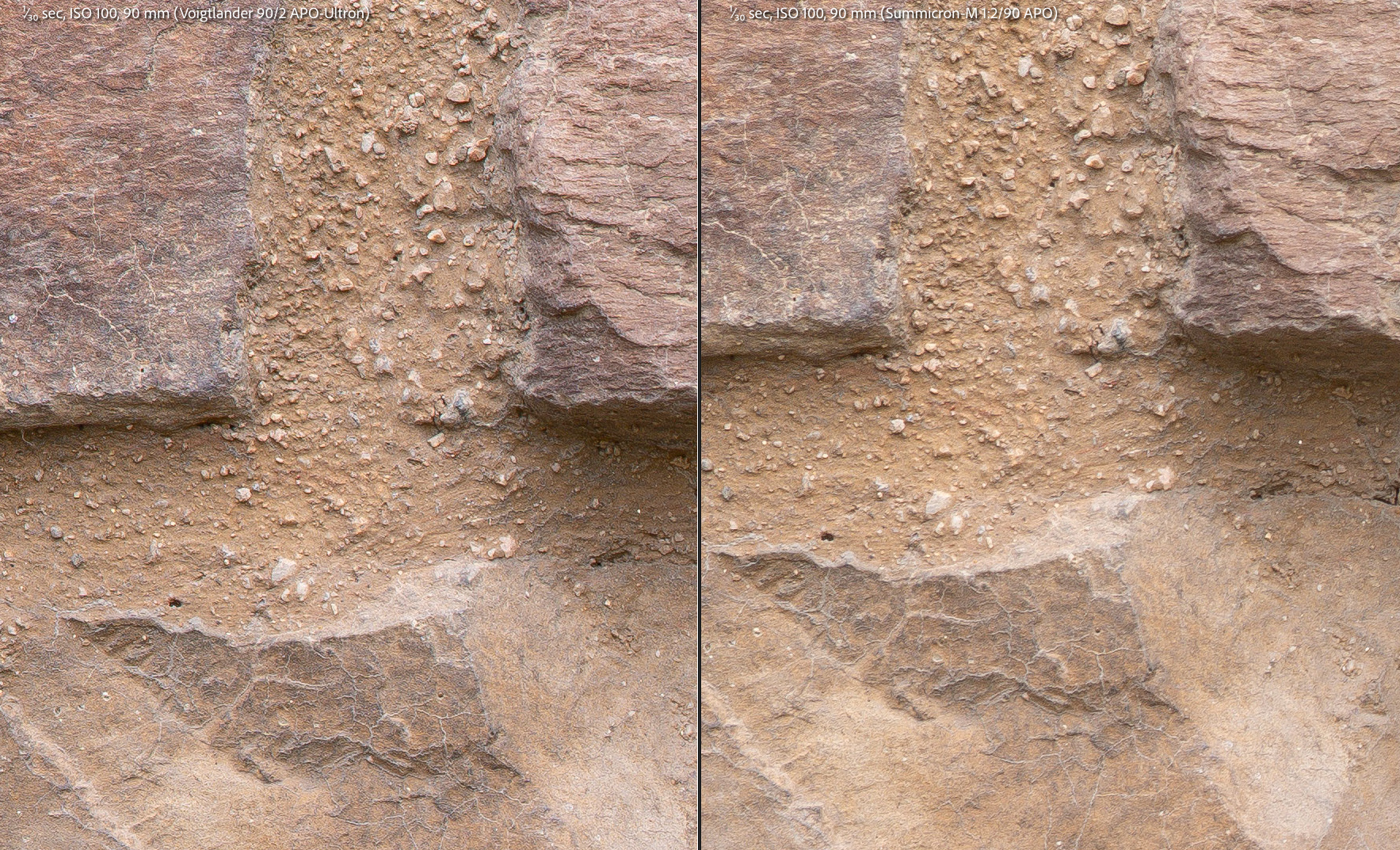
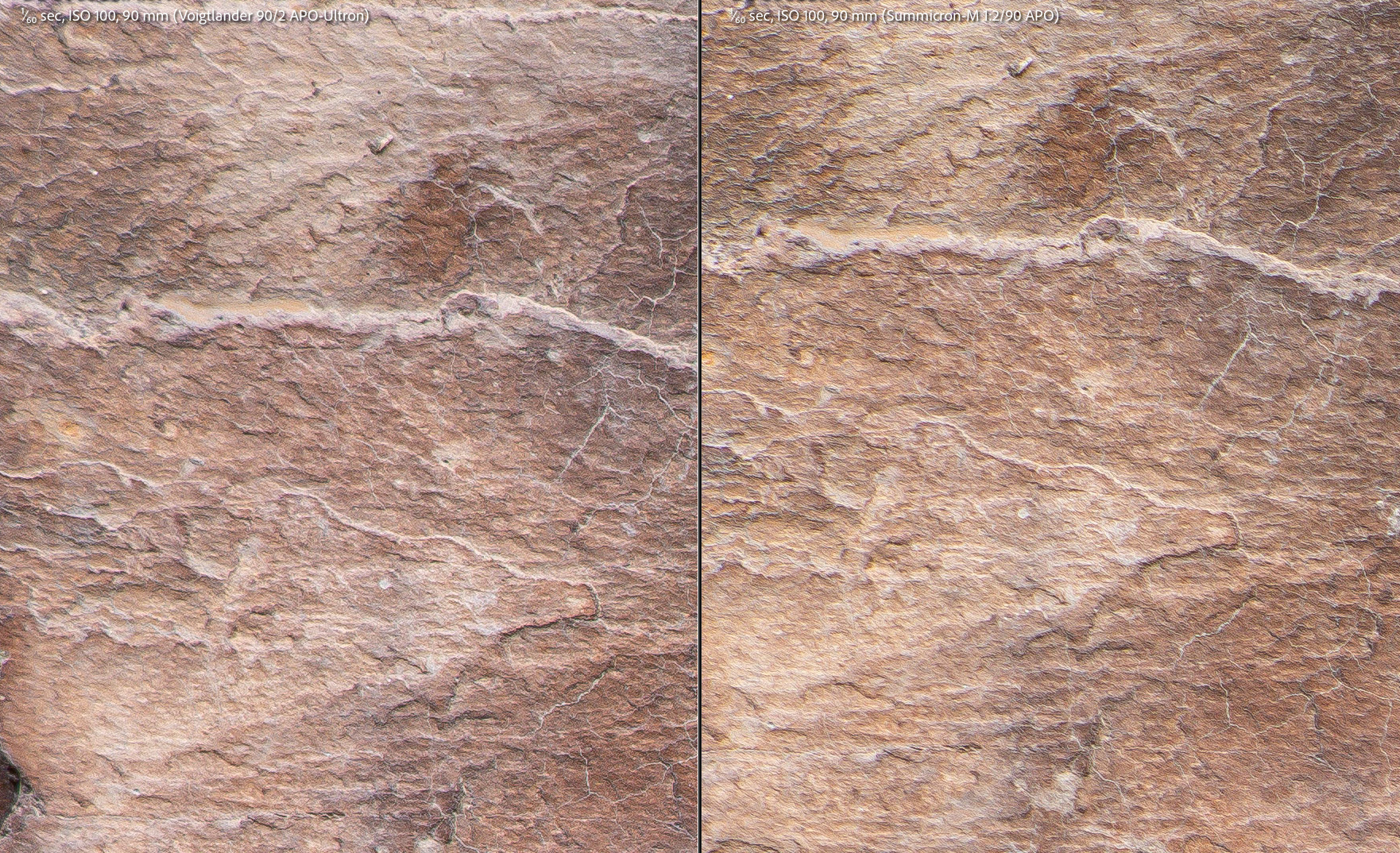
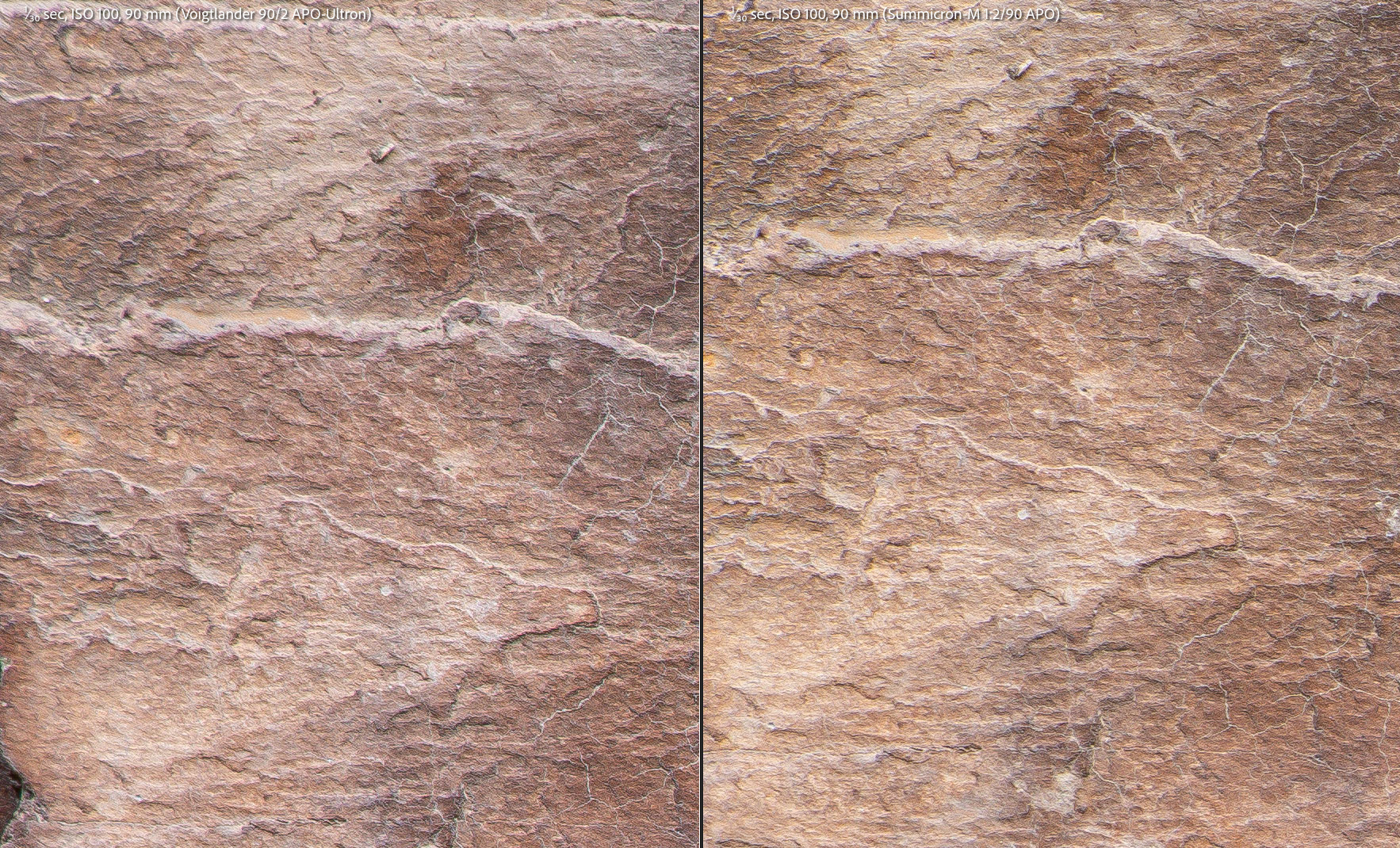
Resolution and Contrast at 2m distance: Voigtlander 90mm f/2 APO-Ultron vs Leica APO-Summicron 90mm f/2 ASPH.
When comparing resolution and contrast at infinity, the Voigtlander 90mm f/2 APO-Ultron outperforms in the center and mid-field at f/2 and f/2.8, particularly in contrast. However, the Leica lens has a slight edge in the extreme corners when shot wide open.
Curious about their performance at closer distances, I decided to test both lenses at 2 meters. The Voigtlander is marketed as a "portrait lens", leading to speculation that it might not be as well-corrected for spherical aberration. However, my testing suggests otherwise as spherical aberration appears well-controlled from about 1.5 meters to infinity. I'll explore its performance at minimum focus distance later in this review, where residual spherical aberration could become noticeable due to the lack of a floating element design.
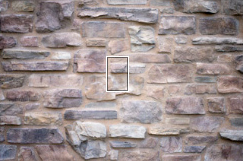
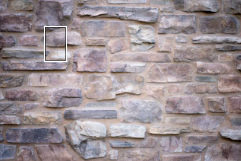
For this closer-distance test, I captured crops from the center, mid-field, and extreme corners, focusing exclusively on the center. To ensure accuracy, I used live view for precise focus and worked with optimal copies of both lenses. Misfocus was not an issue, but due to the short focus throw, focal length, and wide f/2 aperture, achieving critical focus required very fine adjustments.
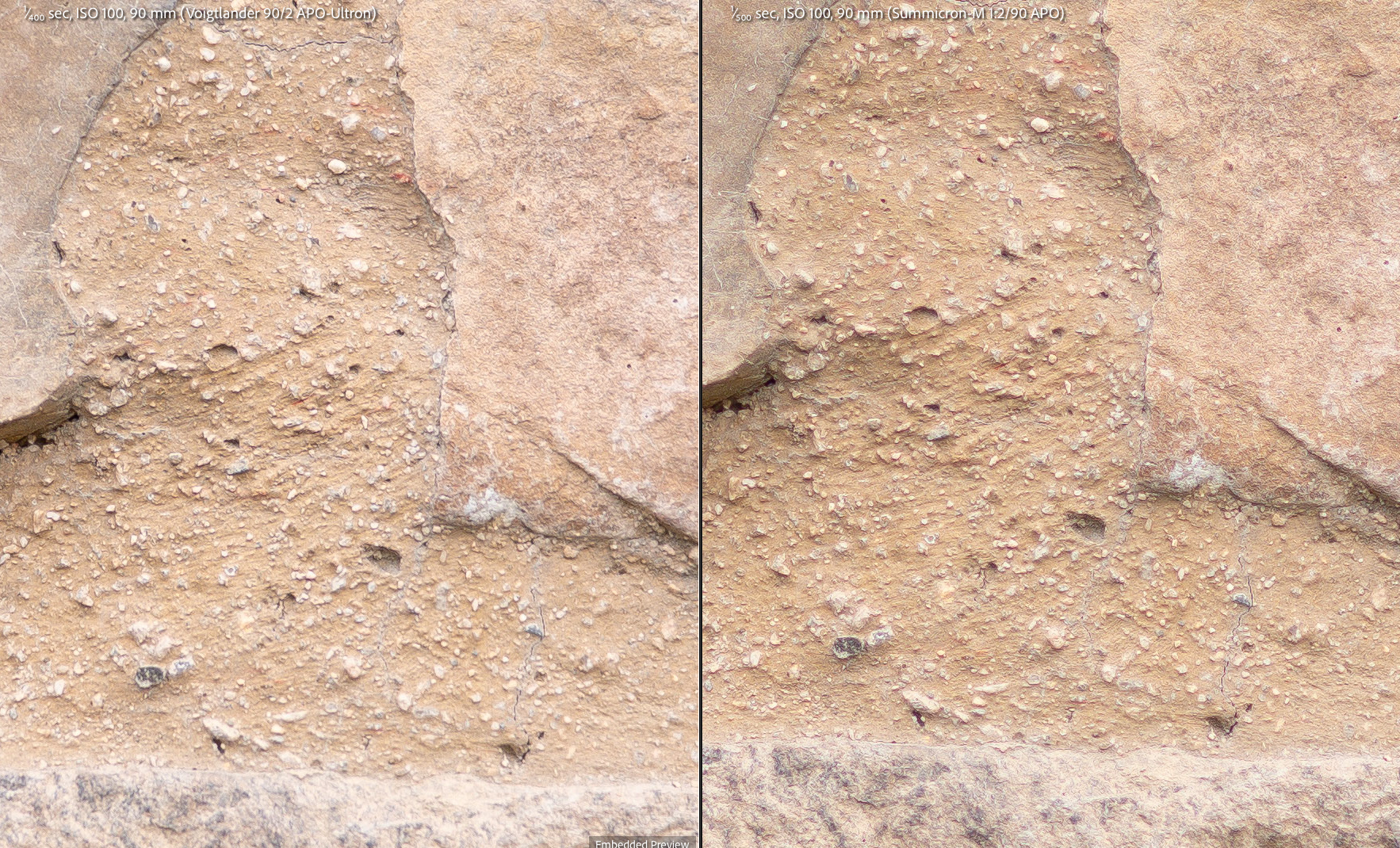
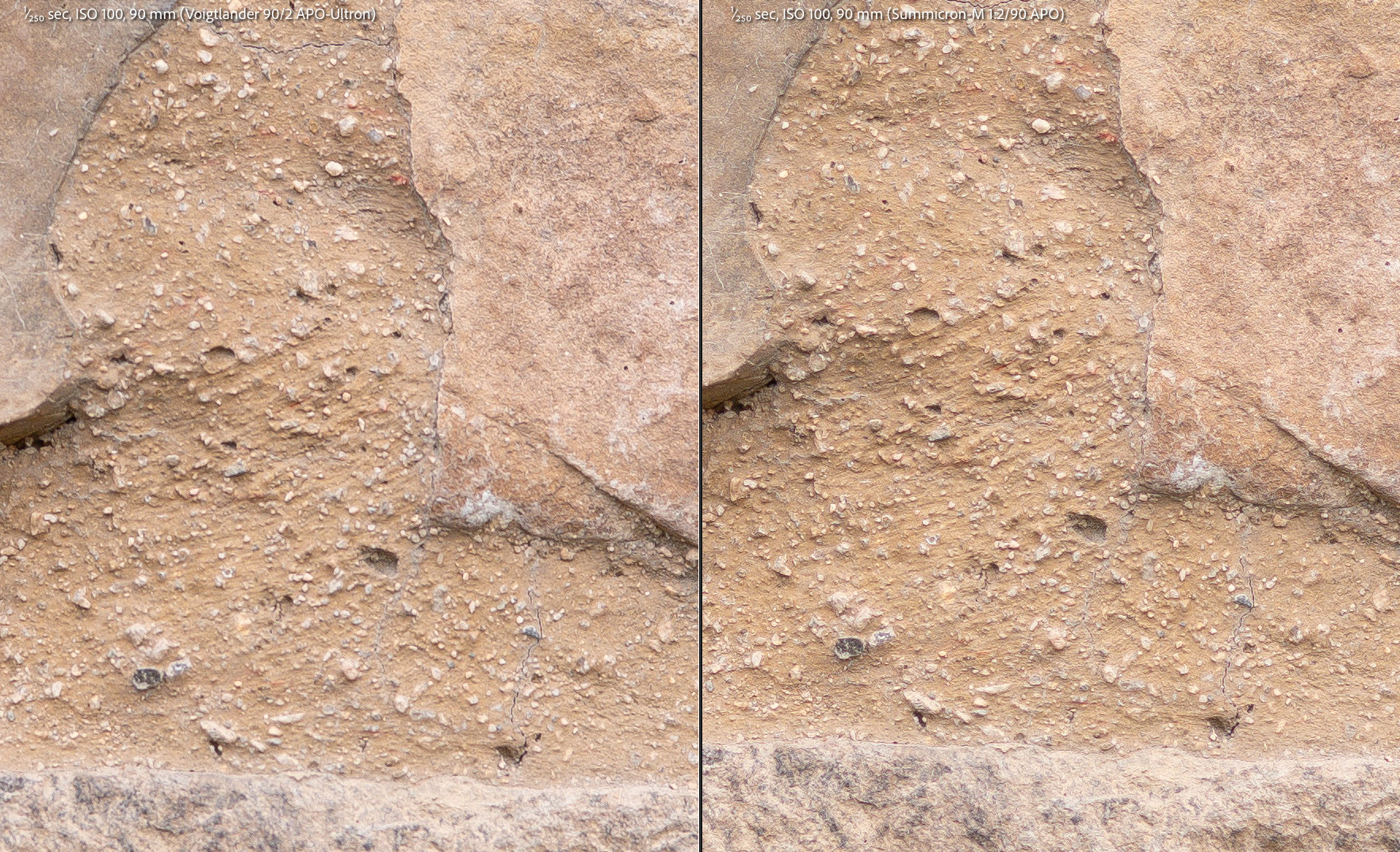
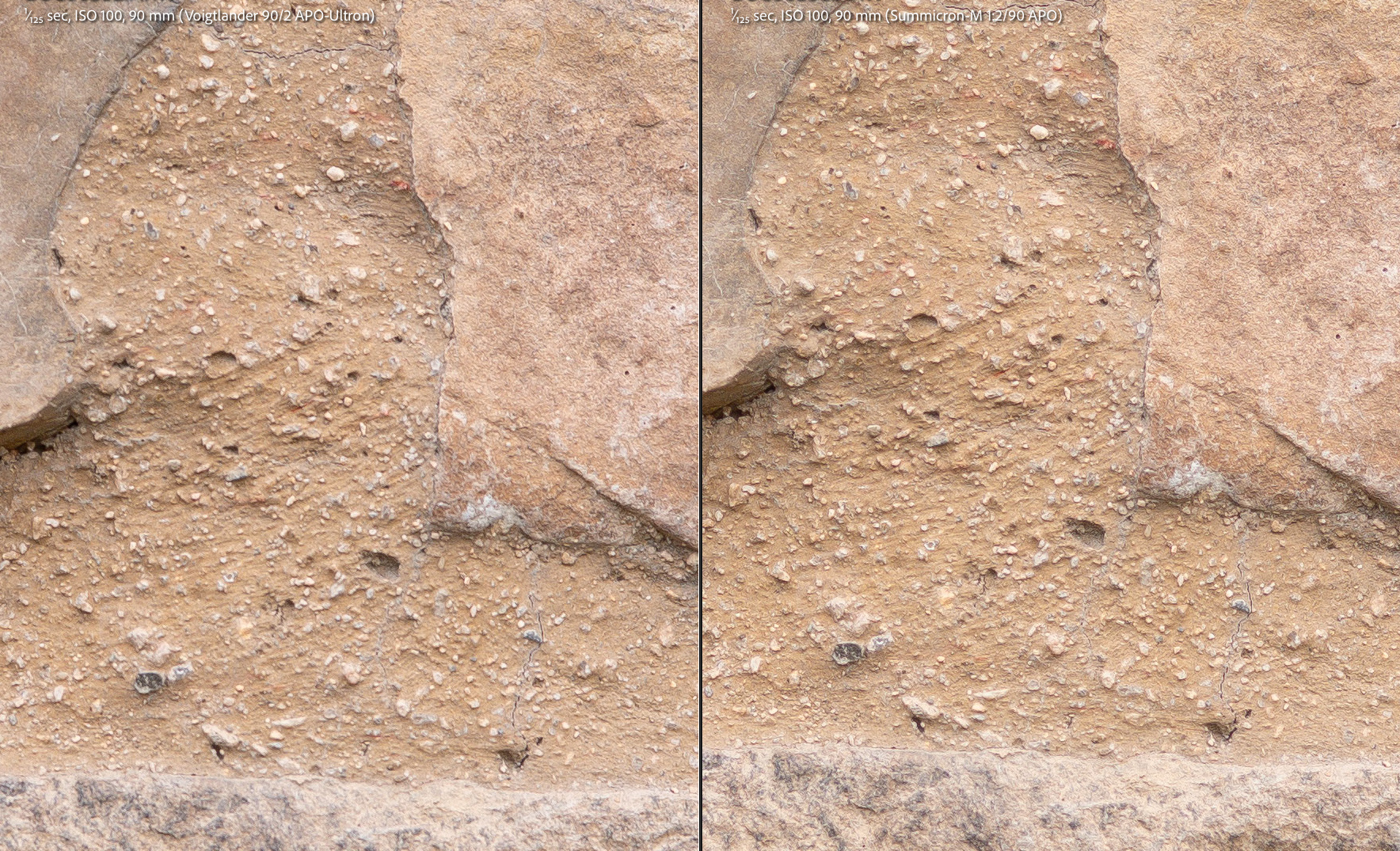
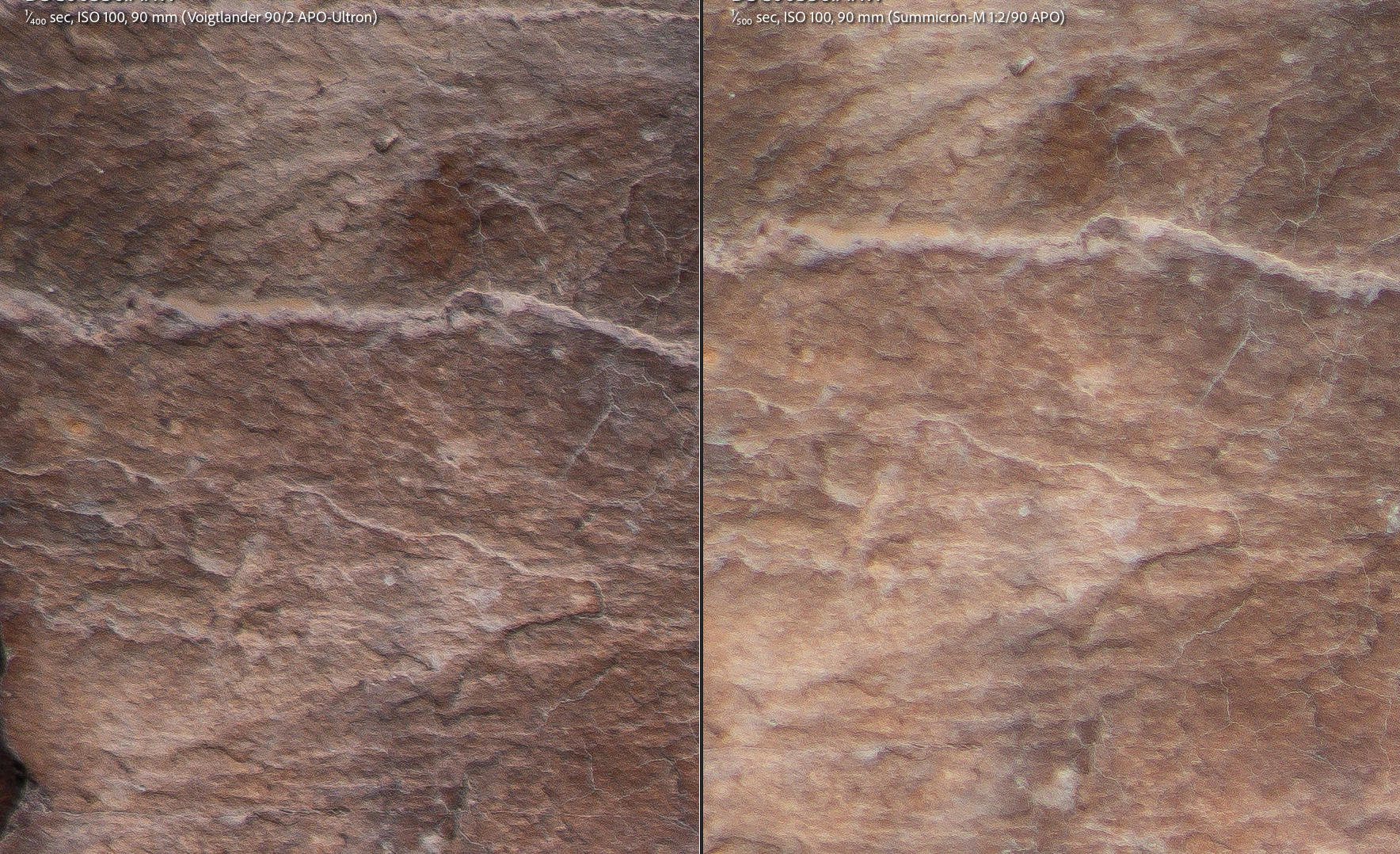
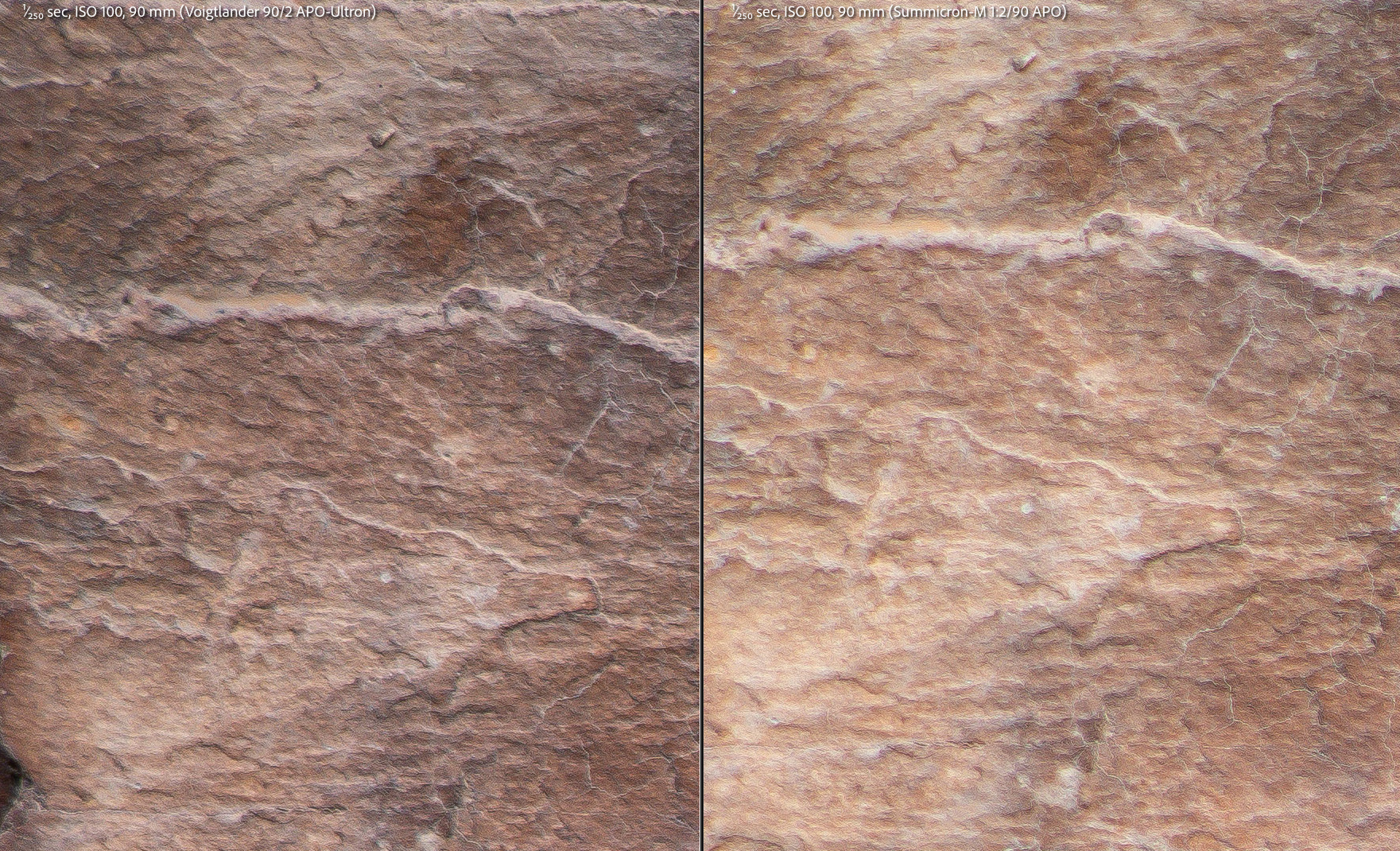
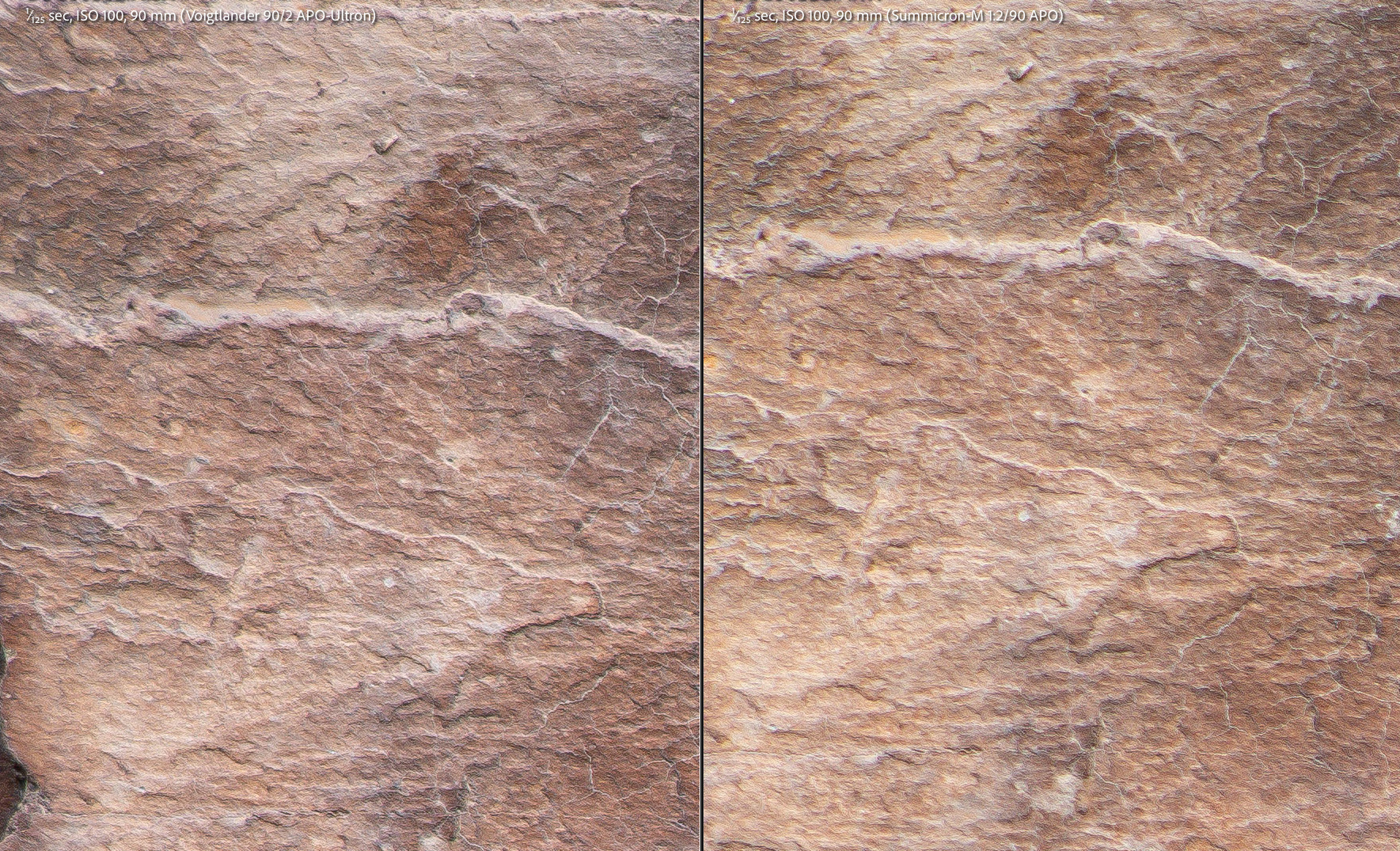
The results at 2 meters showcased excellent performance from both lenses. At the center, a closer examination of the crops at the pixel level revealed that the Leica captured slightly more fine detail than the Voigtlander at wide apertures. However, the Voigtlander offered slightly higher contrast and a cooler color temperature, matching the Leica’s resolution when stopped down.
In the mid-field, the Voigtlander outperformed the Leica in both resolution and contrast across all apertures. In the extreme corners, the Voigtlander retained a slight edge, though both lenses delivered similar performance at this distance.
Distance: 2 meters
White Balance: Daylight
Both lenses are well centered, as verified with my decentering test.
Software used: Lightroom with FM Default Landscape Sharpening; all other settings are at default.
PS: Vignetting, Chromatic Aberration (CA), and distortion were not corrected either in post-processing or in-camera.
Focused at Center
(open the browser window to view entire image without resizing)
Well the lens certainly is sharp with high contrast at both infinity and at 2M and presumably in between as well. I am interested to see the bokeh. I was one who speculated and hoped that they might leave some spherical aberrations uncorrected, but it doesn't look like they did. The lens shouldn't have hardly any axial CA even in the bokeh with all the APD glass, but I now worry that the transition from in focus to out of focus will be abrupt and a bit harsh and I think we can expect given the mechanical vignetting and narrow exit pupil football shaped bokeh balls well into the frame. I doubt we will get much swirl with so little SA. So, it looks a lot like the APO Lanthars in resolution and contrast, but it doesn't have the fancy aperture of the 35 f/2 APO and 50 f/2 APO and it doesn't have a floating element. I am a bit surprised they called this an APO Ultron instead of an APO Lanthar. The resolution and contrast certainly seems to be there to call it an APO Lanthar.
Cooler, more micro-contrast, more accurate and better separated color, better depth perception are first impressions, right or wrong. Very impressive in a test that might have gone the other way. Skin tones in uncontrolled lighting are the acid test for portrait lenses.
A rounded aperture at f2.8 and f5.6 would have been a worthwhile inclusion - they provide a lot of security in street work.
Steve Spencer wrote:
Well the lens certainly is sharp with high contrast at both infinity and at 2M and presumably in between as well. I am interested to see the bokeh. I was one who speculated and hoped that they might leave some spherical aberrations uncorrected, but it doesn't look like they did. The lens shouldn't have hardly any axial CA even in the bokeh with all the APD glass, but I now worry that the transition from in focus to out of focus will be abrupt and a bit harsh and I think we can expect given the mechanical vignetting and narrow exit pupil football shaped bokeh balls well into the frame. I doubt we will get much swirl with so little SA. So, it looks a lot like the APO Lanthars in resolution and contrast, but it doesn't have the fancy aperture of the 35 f/2 APO and 50 f/2 APO and it doesn't have a floating element. I am a bit surprised they called this an APO Ultron instead of an APO Lanthar. The resolution and contrast certainly seems to be there to call it an APO Lanthar....Show more →
I'll be covering this in detail in the rendering section of my review, but I've already taken a closer look since I’m just as curious as you are.
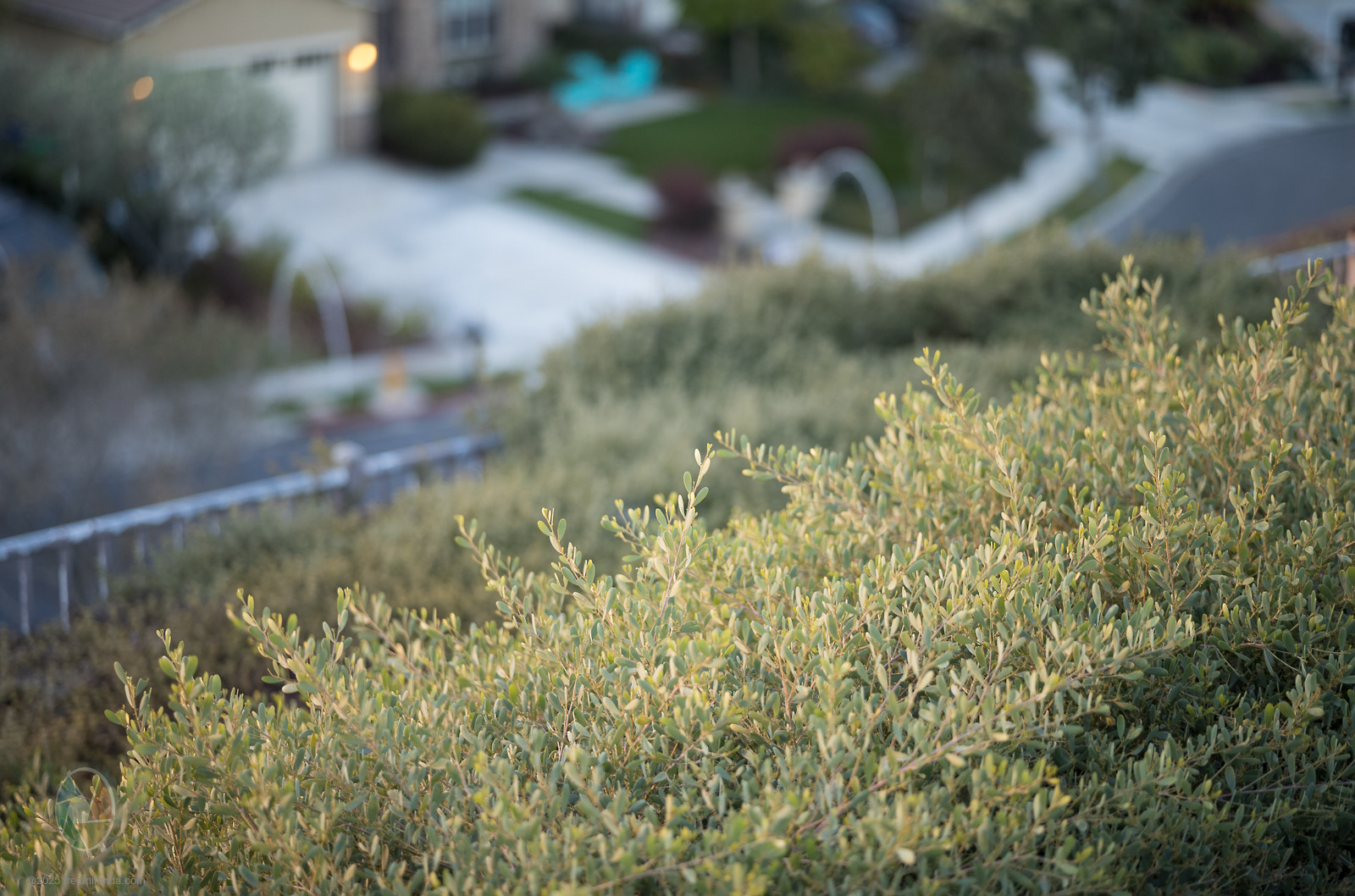
The focus transitions are smooth and pleasant, with no noticeable outlining. The only downside I've noticed so far is the optical vignetting, which causes specular highlights to take on a slight cat's-eye shape toward the edges. However, this is pretty standard for 90mm f/2 lenses, with the Leica 90/2 AA being a rare exception, offering slightly more rounded bokeh in the corners.
Here are two samples showing the focus transitions at f/2. The distance was approximately 1 and 2 meters.
Wow, this looks fantastic, I'm so curious to know what it's going to be like adapted on E, strongly considering one for that purpose based on what I've seen so far.
Fred Miranda wrote: Resolution and Contrast at 2m distance: Voigtlander 90mm f/2 APO-Ultron vs Leica APO-Summicron 90mm f/2 ASPH.
The results at 2 meters showcased excellent performance from both lenses. At the center, a closer examination of the crops at the pixel level revealed that the Leica captured slightly more fine detail than the Voigtlander at wide apertures. However, the Voigtlander offered slightly higher contrast and a cooler color temperature, matching the Leica’s resolution when stopped down.
In the mid-field, the Voigtlander outperformed the Leica in both resolution and contrast across all apertures. In the extreme corners, the Voigtlander retained a slight edge, though both lenses delivered similar performance at this distance.
It's not what I'm seeing at the center. IMO the Cron is very slightly ahead of the VM at f/2 and better at 2.8 and 4. I wonder if there is some slight focus shift happening with the VM as it's stopped down? Were these focused once at wide open and then simply stopped down, or refocused for each aperture?
rscheffler wrote:
It's not what I'm seeing at the center. IMO the Cron is very slightly ahead of the VM at f/2 and better at 2.8 and 4. I wonder if there is some slight focus shift happening with the VM as it's stopped down? Were these focused once at wide open and then simply stopped down, or refocused for each aperture?
You're absolutely right, Ron, and I've expanded my analysis to include not just the center, but also the mid-field and extreme corners at the 2m distance. As with the infinity test, I maintain the same focus point when stopping the lens down.
If you pick out a few motifs and look at the definition of the shape of the finest visible object in each lens's image, and mentally compensate for the lower contrast of the Leica, I favour the VM. Two very different styles here. But it's pretty well moot for a 2m portrait, but worth knowing how close they are to even talk about it.
Jan 07, 2025 at 11:24 PM
Steve Spencer Offline • • • • • • • Upload & Sell: On
rscheffler wrote:
It's not what I'm seeing at the center. IMO the Cron is very slightly ahead of the VM at f/2 and better at 2.8 and 4. I wonder if there is some slight focus shift happening with the VM as it's stopped down? Were these focused once at wide open and then simply stopped down, or refocused for each aperture?
Now that you point it out, I see what you see too, but it is just a small amount. With regard to MTF, the Leica M 90 cron AA has close to a 90/80/60 MTF percent contrast at 10/20/40 line pairs per mm, which is a pattern I very much like for portraits. See the MTF here:
I would expect based on Fred's resolution and contrast tests both at infinity and 2M, for this new Voigtlander to have a similar pattern. Note that although this pattern is ideal for a portrait lens, IMO, it is a bit less contrast than the CV APO Lanthars. For example the E mount 50 f/2 APO Lanthar has about 95/85/78 percent contrast at 10/30/40 lp/mm in the center as you can see at the Cosina site here:
So at the center this lens is very sharp, but perhaps not quite as sharp as the APO Lanthars, which I think may be a good thing for applications such as portraits.
To my eyes, in the 2-meter sharpness test, the Apo-Summicron-M looks sharper in the center (f/2-f/5.6), but in the mid-frame and corner, the Apo-Ultron looks clearly better.
Fred Miranda wrote: Resolution and Contrast at 2m distance: Voigtlander 90mm f/2 APO-Ultron vs Leica APO-Summicron 90mm f/2 ASPH.
The results at 2 meters showcased excellent performance from both lenses. At the center, a closer examination of the crops at the pixel level revealed that the Leica captured slightly more fine detail than the Voigtlander at wide apertures. However, the Voigtlander offered slightly higher contrast and a cooler color temperature, matching the Leica’s resolution when stopped down.
In the mid-field, the Voigtlander outperformed the Leica in both resolution and contrast across all apertures. In the extreme corners, the Voigtlander retained a slight edge, though both lenses delivered similar performance at this distance.
Focused at Center ...Show more → rscheffler wrote:
IMO the Cron is very slightly ahead of the VM at f/2 and better at 2.8 and 4. I wonder if there is some slight focus shift happening with the VM as it's stopped down? Were these focused once at wide open and then simply stopped down, or refocused for each aperture?
Steve Spencer wrote:
Now that you point it out, I see what you see too, but it is just a small amount. With regard to MTF, the Leica M 90 cron AA has close to a 90/80/60 MTF percent contrast at 10/20/40 line pairs per mm, which is a pattern I very much like for portraits. See the MTF here:
I would expect based on Fred's resolution and contrast tests both at infinity and 2M, for this new Voigtlander to have a similar pattern. Note that although this pattern is ideal for a portrait lens, IMO, it is a bit less contrast than the CV APO Lanthars. For example the E mount 50 f/2 APO Lanthar has about 95/85/78 percent contrast at 10/30/40 lp/mm in the center as you can see at the Cosina site here:
So at the center this lens is very sharp, but perhaps not quite as sharp as the APO Lanthars, which I think may be a good thing for applications such as portraits. ...Show more →
My post was more just to state what I see from a technical perspective. With respect to how it will play out in actual use, I agree that the differences will be slight to the point of insignificance in most cases and specifically for portraiture, moderated sharpness/contrast is likely a good thing.
The reason I'm wondering about focus shift at 2m is because of how the two compare at 2.8 and 4. The Cron increases in sharpness (fine detail) and contrast as one would expect, and is consistent with my experience with it at this distance. The VM on the other hand increases in contrast but does not gain fine detail sharpness - contrary to the infinity crops, the 2m crops looks IMO slightly out of focus. Yet in the midfield the VM improves considerably. So if there is some field curvature and focus shift happening, it's possible that as the VM is stopped down, the plane of focus shifts to the optimum point of focus in the midfield, but is slightly behind the intended point of focus in the center. By f/5.6 depth of field is enough to mask the problem at center. The focus shift might only be very slight but enough to notice due to the shallow depth of field of a 90/2 lens combined with the pixel density of 60MP FF.
I think everyone here recognizes that if there is focus shift, it will only be of concern for those focusing with the rangefinder of an M camera. I suspect this lens will see a lot of use on mirrorless and focus will be done at the shooting aperture, thus avoiding focus shift problems.
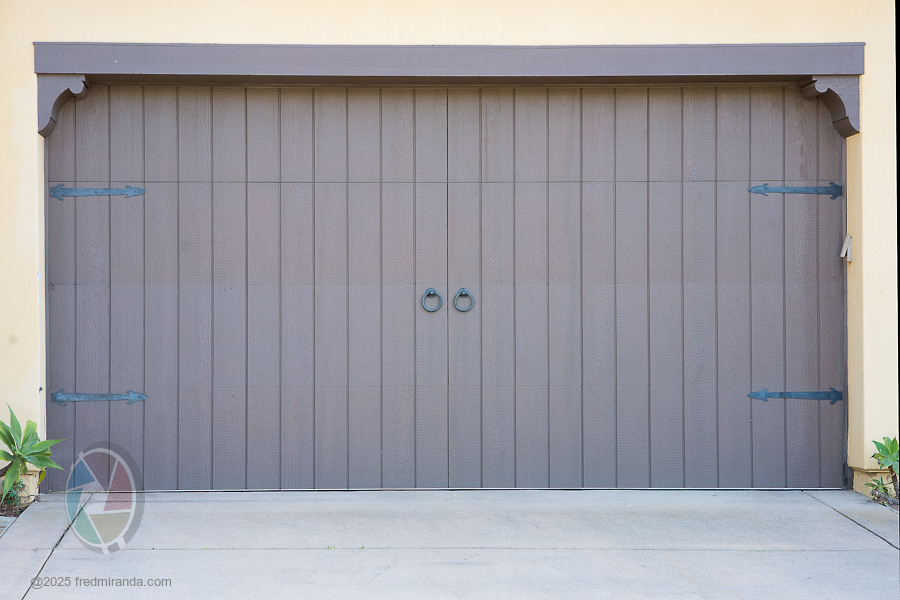
I was curious to test the Voigtlander 90mm f/2 APO-Ultron for distortion after noticing slight pincushioning in some of my initial shots. Today’s test confirmed that, like the Voigtlander 90mm f/2.8 APO-Skopar, the Ultron also producers slight pincushion distortion. In Lightroom, this can be fully corrected with a "-4" adjustment.
The CV 90mm f/2 APO-Ultron performed well, as this level of distortion is quite common in telephoto lenses. For comparison, the Leica APO-Summilux 90/2 ASPH. shows a similar amount of distortion, though possibly slightly less. With its effective distortion control, the Voigtlander 90mm f/2 APO-Ultron is a great choice for architecture and street photography.
Below are examples showing an uncorrected image followed by a distortion-corrected version, taken first with the Voigtlander and then with the Leica:
It's also interesting to observe the difference in angle of view between the Voigtlander and the Leica, as both were tested from the same distance.
The Voigtlander 90mm f/2 APO-Ultron maintains an impressively flat field of focus from close distances all the way to infinity. Unlike some 90mm lenses, which often show slight outward field curvature, Cosina has designed this lens to remain compact while preserving flatness. If any curvature is present, it’s nearly imperceptible at infinity. This aspect of the optical design is important and, in my view, a crucial priority for a high-performance lens.
Below is a GIF animation illustrating the focus area across 10 stages, transitioning from close-up to long distance:
Steve Spencer wrote:
Now that you point it out, I see what you see too, but it is just a small amount. With regard to MTF, the Leica M 90 cron AA has close to a 90/80/60 MTF percent contrast at 10/20/40 line pairs per mm, which is a pattern I very much like for portraits. See the MTF here:
I would expect based on Fred's resolution and contrast tests both at infinity and 2M, for this new Voigtlander to have a similar pattern. Note that although this pattern is ideal for a portrait lens, IMO, it is a bit less contrast than the CV APO Lanthars. For example the E mount 50 f/2 APO Lanthar has about 95/85/78 percent contrast at 10/30/40 lp/mm in the center as you can see at the Cosina site here:
So at the center this lens is very sharp, but perhaps not quite as sharp as the APO Lanthars, which I think may be a good thing for applications such as portraits....Show more →
At first glance, I had the same impression, but I was reminded that this is one of the qualities I appreciate about the Leica 90/2 AA for portraits. The lens captures fine details while maintaining lower contrast at wide apertures. I'm glad Ron pointed out that the Leica lens can resolve slightly more fine detail at the center (2m distance). However, in real-world samples and considering sample tolerances, the difference would likely be minimal. For me, the key distinctions come down to contrast and color temperature, which are influenced by the different lens coatings. Veiling flare also plays a role, and the Leica is definitely more prone to it. In many cases, though, this adds a unique and appealing look to portraits.
Cosina may have marketed the Voigtlander 90mm f/2 APO-Ultron as a portrait lens, but in reality, it's more of a high-clarity, sharp lens --- your model better have flawless skin! The lens certainly brings high resolution and contrast to the table, so don't expect the soft, dreamy look that some might associate with classic portrait lenses. I was initially imagining it would have a more relaxed contrast from uncorrected spherical aberration, but that’s not the case here. Instead, it's a lens that captures every detail, making it ideal for those who want crisp, contrasty portraits with a pop.
Late to this testing--thanks as always for doing it. Looks like a razor type lens, not something I'd prefer for portraits. And here I was all excited about an APO lens with SA.