Notice: Undefined index: Bumped in /var/www/vhosts/fredmiranda.com/httpdocs/forum/functions_2021_i.php on line 1850
Notice: Undefined index: SecondBoardID in /var/www/vhosts/fredmiranda.com/httpdocs/forum/functions_2021_i.php on line 1851
Notice: Undefined index: LatestPoster in /var/www/vhosts/fredmiranda.com/httpdocs/forum/functions_2021_i.php on line 1852 Landscape Photographer - Photography - FM Forums
Long time since posting, but finally getting back active again. Hopefully still OK to post astro images here - please advise if not OK.
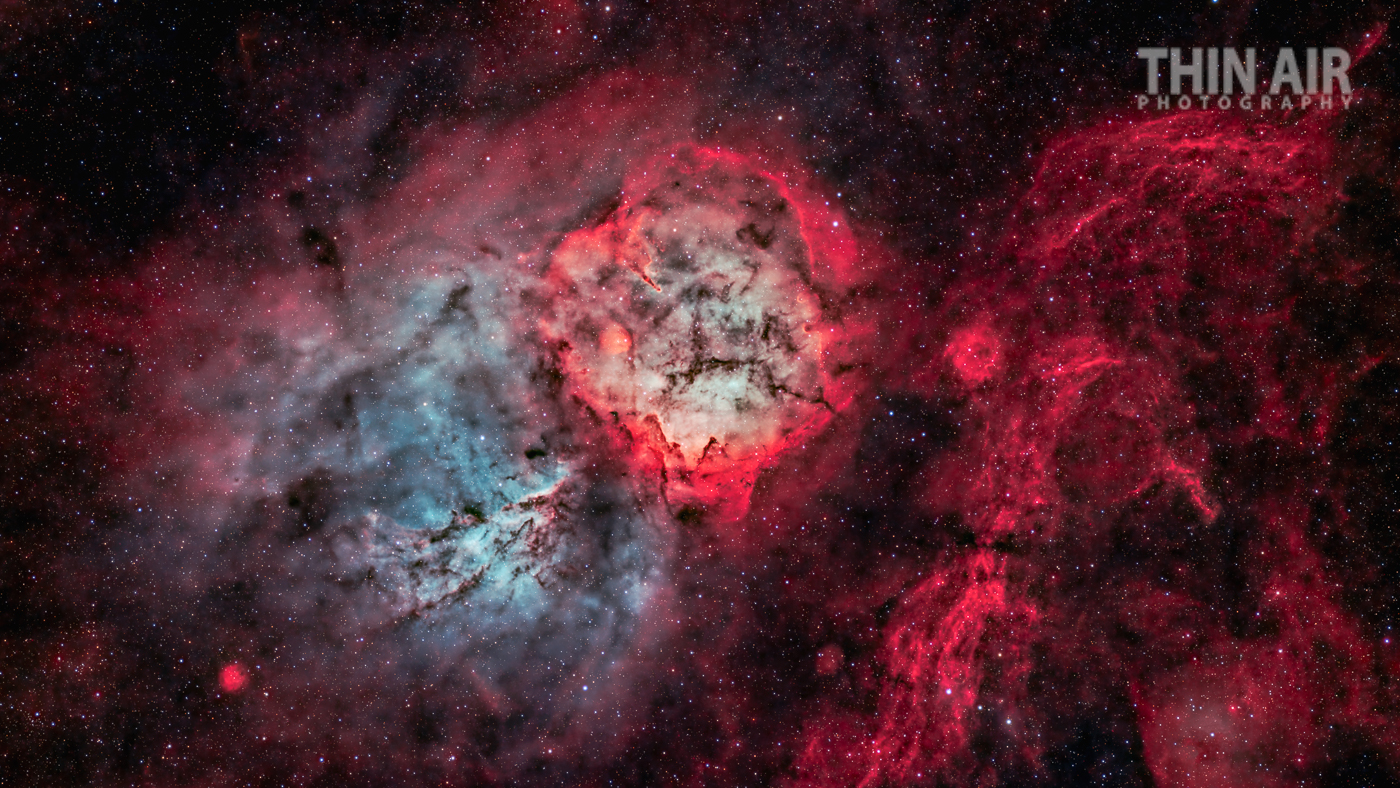
This image is one of the deeper ones I have tried, using 15 minute subframes, and still even with almost 20 hours of data the Oiii and especially the Sii signals were still weak compared to the Hα signal, making the channel combining challenging. The central round portion is most often seen, but I was pleasantly surprised to see all the weak nebulosity in the surrounding areas, especially running diagonally through the right side of the image. This was imaged from Green Valley, AZ with the equipment controlled remotely by me here in CO.
Sh2-284 is an emission nebula region, often referred to as the 'Little Rosette' Nebula or the Portal Nebula. It is shaped by a young energetic star cluster Dolidze 25 which is sending out ionizing radiation to excite the nebula. Sh2-284 is believed to be approximately 15,000 light years distant in an outer spiral arm of the Milky Way, in the constellation Monoceros.
That is a beautiful and well processed nebula. In what kind of Bortle conditions were you imaging? 15 minute subframes is bold, I'd be nervous about wind/clouds ruining the subs but apparently it worked out perfectly for you.
DistantPlaces wrote:
That is a beautiful and well processed nebula. In what kind of Bortle conditions were you imaging? 15 minute subframes is bold, I'd be nervous about wind/clouds ruining the subs but apparently it worked out perfectly for you.
Thank you! So I am in Colorado, but my gear is situated at a fellow astrophotographer's house in Southern Arizona, on the outskirts of Green Valley, south of Tucson. I remotely control it from here, after he has taken off the protective tarps and powered on the equipment for me.
I am not sure, but I would say it is likely about Bortle 3 to 4 there, although this target was to the south, looking towards the Mexican border, so not a lot of big cities in that direction. Of course, the 3nm narrowband filters no doubt helped a lot with any possible light pollution. And then I always take short 30 second subs for the stars, and replace the stars with RGB data, whenever I image in narrowband like this.