Nifty Fifty
Offline
• • •
Upload & Sell: Off
|
 p.5 #1 · Viltrox 50mm 2.0 Air - Image Thread p.5 #1 · Viltrox 50mm 2.0 Air - Image Thread | |
chiron wrote:
He has a subtle eye and a broad and deep knowledge of lenses.
Who exactly attests to that? You? Excuse me, but in my humble opinion, there's a significant difference between deep knowledge of lenses and reciting marketing claims, combined with name-dropping or references to YouTube "experts," just as there is a significant difference between unsubstantiated claims and proven facts. Statements like "Concave front elements, that's intriguing to me, so I went looking. As you'd expect, it's a mixed bag. Zeiss's ML 50/1.4, Cosina's APO-Lanthar 50/2 and Nikon's 50/1.8 Z have concave front elements. Cosina's six (!) other 50mm lenses are convex fronted, as is Sony's GM 50/1.4, Thypoch's Simera 50/1.4, Leica's revised 50/1.4 Summilux-CF (M), Leica's 50/1.4 Summilux-SL (a 2016 lens), and Leica's 35/2 APO-Summicron-M. hmm" in my opinion indicate more interest in lens construction than knowledge of it. Be that as it may. If the gentleman in question is such an authority in the field of photo optics, I would appreciate some links to his scientific papers. A lot of writing and claims are made in forums, as the day goes by. That means little. The 3D Pop thread is a prime example.
And as for a good eye. What good is that good eye if you exaggerate what you see to the point of absurdity? The statement "Sony is determined that, other than the plane and its immediate vicinity, you do not notice anything other than the low contrast, amorphous blur blanket, destroying all medium to high spatial data in a low contrast wash.
It's actually hard to look into that flat blur effect. Same with the far windows above the path. The V50 is a very good general purpose lens, more true-to-life even in its bokeh field," which refers to page 3 #11, does exactly that, in my humble opinion. Who defines the degree of blur that appears natural, and what prevents the photographer from adjusting the degree of blur to the subject constellation by choosing the aperture? What if the subject you want to emphasize is larger and farther away, and f/2 is far from sufficient to achieve "natural" bokeh (whatever that may be)? Does the Sony, whose bokeh is so unbelievably difficult to bear, suddenly render better than the Viltrox, whose "natural" bokeh has practically vanished into thin air? All these blanket statements about the background dissolving completely into gray fog beyond the focal plane are simply utter nonsense.
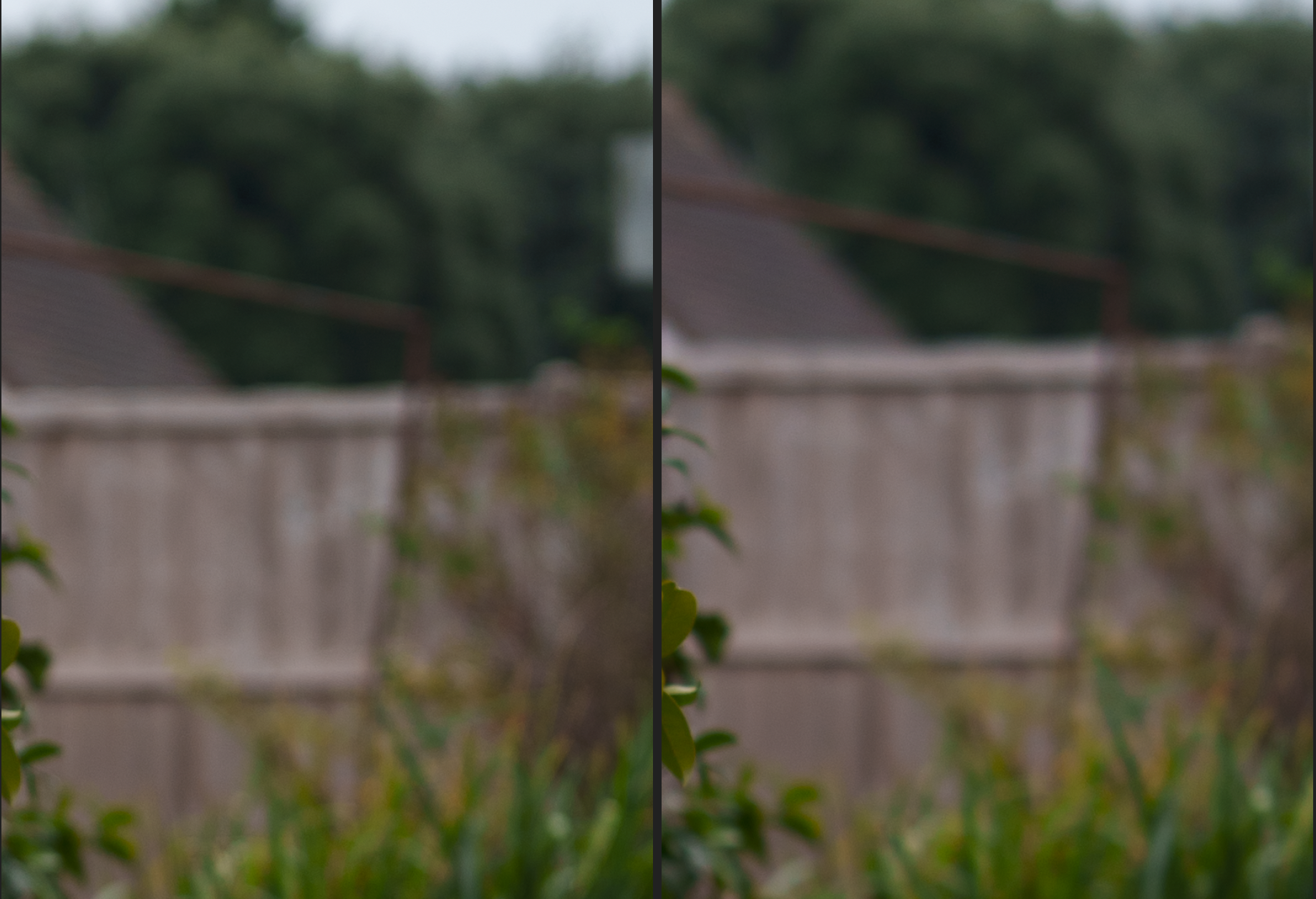
I'm attaching an example image that proves this. Here, under the given conditions, the GM still manages to separate the main subject from its surroundings by suggesting a certain depth through a varying degree of sharpness, while every detail in the background remains recognizable. Thus, it achieves something it is incapable of, as the student recently learned from his teacher.
 DSC07406 by Werner Wurst, on Flickr DSC07406 by Werner Wurst, on Flickr
chiron wrote:
Sometimes (often?), the problem is with the student rather than the teacher.
The fact that you are arbitrarily dividing people into teachers and students shows your error in thinking.
|


 (just a joke based off the "3d pop" thread).
 A photo from the Viltrox 50. One straight out of camera and one with noise reduction from Adobe.