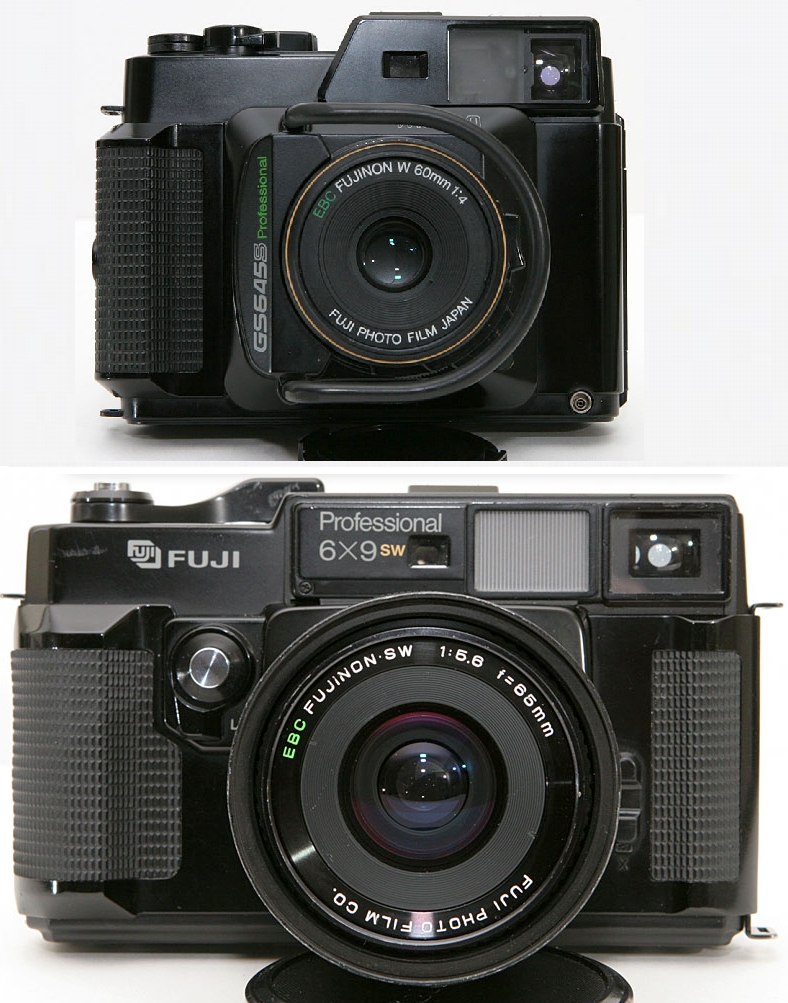
I don’t know if there are any 35mm film photographers out there that want to try a compact medium format camera, but this is my re-entry into this segment. I have five medium format film cameras, two of which are the extremely competent Mamiya 7 & 7ii, although these cameras are smaller than other offerings, they are not compact by today's standards. My ETRsi is small for this form factor and a joy to use, but it doesn’t fit my definition of a small camera that is good for traveling light.
I’m partial to rangefinders for the type of photography that I engage in these days. I no longer shoot sports, or events and haven’t plans to go on safari. My mainstay film cameras have been various Leica M and in digital the M11 Monochrom, so looking to another rangefinder to limit size/weight for wider lenses make the two mentioned cameras in the title, naturals.
I purchased my NIB Bronica years before dabbling in digital, but then left the camera sit in the safe for fifteen years. This did in this camera and it is off to be repaired/CLA. My camera has the standard 65mm f/4 lens, which brings up one possible negative and that is lens speed. Manual slow lenses are the ticket for small/light medium format optics.
Bronica RF645
The Bronica is a much newer camera. It allows for both aperture and shutter priority and will even help you out with a program mode. Lenses are interchangeable with a 45mm, 65mm and 100mm available. I’ve only used the 65mm. The viewfinder is bright with an accurate rangefinder. Exposure information is available in the viewfinder. Simple controls like exposure compensation and multi exposure are readily available. This camera has a solid and in my opinion professional feel to it. Like the Fuji, the viewfinder presents vertically oriented frame lines.
Fuji GS645W
Having sent off the Bronica for repair and being more than a bit impatient, I decided to purchase a wider angle 645 camera and the Fuji from the 1980s has an excellent reputation for it’s optics, but perhaps a mixed reputation for reliability, which I can’t really comment on in that I just received the camera. My copy of the Fuji GS645W looks as if it is new. It is quite compact and light. I compared the + - 0 (over, under and properly exposed light diodes) metering with an 18% card against a couple Sekonic meters and it seems spot on. The lens and controls are quite small and will take some time to get use to. The shutter is pronounced, but not objectionable. The only real negative is that the detents on the aperture ring are weak and only engage at full stops. Film loading is simple and the view through the viewfinder is bright and contrasty. Zone focusing the f/5.6 lens is fast and accurate The meter LED’s are difficult to see in bright sunlight. Added a UV filter, which was an extravagant expense on a $600 camera, a Fotasy wide angle metal hood and Peak Design Cuff. A 72mm lens cover now fits into the hood. I’m using a Godox Lux Senior light/portable strobe in that the round reflector will support the vertically oriented negative. Also, once my Bronica RF646 is repaired the flash can do double duty. I have a preference for an understated fill flash for some subjects and the little Godox is a reasonable solution.
In the early 2000's, I shot the GS645S Wide 60, GW670II, and GSW690II. I had also heard of reliability problems with the Fuji 645's, but mine worked fine. OTOH, I much prefer the larger 67 and 69 images, and so the GS645S didn't get used a lot.
I posted photos of my 645 and 69 below. I can't find one of the 67 atm, but it's pretty close to the average of the two others.
I'm plotting to buy a Mamiya 645, preferably a newer one with changeable film backs, to go with my Mamiya 645 C N-series and A-series lenses. I've been using the M645 lenses with a Mirex tilt-shift adapter on Canon DSLR, since 2007. They're excellent lenses. Otherwise, I'd probably go for a GWS670II or III. For starters.
I had one of the first GSW 690 III bodies in 1992 IIRC. The II version must have been older than that.
What I recall most is that the viewfinder was partly bocked by the lens and that the shutter release was massively energetic, shaking the camera unless you were very careful used a mechanical release.
IQ was very good with acceptable distortion. Ultimately the 28mm equivalent fixed focal length and lack of metering pushed me toward the Mamiya M7 system with it's variety of lenses, metering, and smooth electronic shutter.
I’ve been interested in 6X9 and the Mamiya 7 is definitely a superior camera, but my limited goal is to maximize what’s on the negative via the smallest camera possible. In B&W, maybe I can do that with Leica’s new Monopan 50. Theoretically, it is capable of 271Mpix of resolution with great tonality. Maybe I did the math wrong and definitely the math and reality are separate and unrelated. I just can’t believe that film 35mm will out resolve the M11 Monochrom. The 645 definitely won’t out resolve the X2D, but these film cameras are much lighter/smaller. Velvia/Provia and the Mamiya 7(ii) would give the X2D some competion, but with much restricted dynamic range.
With no loss of resolution when scanning and in theory:
Leica Monopan 50
280lp/mm
Total Line Pairs (24mmx36mm)
10,080 line pairs
6,720 line pairs
Equivalent Digital Pixels
20,160 pixels
13,440pixels
Resolution (Pix)
270,950,400 pix
Leica Monopan 50 Equivalent Digital Resolution:
271 MPix
bwcolor wrote:
I’ve been interested in 6X9 and the Mamiya 7 is definitely a superior camera, but my limited goal is to maximize what’s on the negative via the smallest camera possible. In B&W, maybe I can do that with Leica’s new Monopan 50. Theoretically, it is capable of 271Mpix of resolution with great tonality. Maybe I did the math wrong and definitely the math and reality are separate and unrelated. I just can’t believe that film 35mm will out resolve the M11 Monochrom. The 645 definitely won’t out resolve the X2D, but these film cameras are much lighter/smaller. Velvia/Provia and the Mamiya 7(ii) would give the X2D some competion, but with much restricted dynamic range.
With no loss of resolution when scanning and in theory:
Leica Monopan 50
280lp/mm
Total Line Pairs (24mmx36mm)
10,080 line pairs
6,720 line pairs
Equivalent Digital Pixels
20,160 pixels
13,440pixels
Resolution (Pix)
270,950,400 pix
Leica Monopan 50 Equivalent Digital Resolution:
271 MPix...Show more →
Leica Monopan is repackaged Adox 50 HR. Adox also make an even higher resolution film with the Adox 20 CMS. But these are specialized films that ideally want to be developed using certain developers and they generally have very high contrast and low dynamic range.
Imo not worth chasing the highest resolution on film when other film stocks have a nicer look, might as well shoot digital when it’s just about resolution.
In terms of highest quality in the smallest camera, probably the Fuji GA645. Electronic cameras but very nice lenses and arguably better reputation in terms of reliability than the GS series.
fjablo wrote:
Leica Monopan is repackaged Adox 50 HR. Adox also make an even higher resolution film with the Adox 20 CMS. But these are specialized films that ideally want to be developed using certain developers and they generally have very high contrast and low dynamic range.
Imo not worth chasing the highest resolution on film when other film stocks have a nicer look, might as well shoot digital when it’s just about resolution.
In terms of highest quality in the smallest camera, probably the Fuji GA645. Electronic cameras but very nice lenses and arguably better reputation in terms of reliability than the GS series. ...Show more →
All good points. I prefer to shoot emulsions based on the look and not resolution, but I also prefer to maximize resolution. The reason is that I like to print 24”x36” and 24”x48” wall prints that can be viewed from relatively close-up.
I already have the Bronica RF645 to occupy the GA645 niche. I wouldn’t doubt that the Fuji’s lens might outperform my Bronica by a bit, but the Bronica is a rangefinder (which I enjoy) vs an early generation autofocus.
The calculation exercise, if correct, suggest that our scanning methods are leaving a good bit of resolution on the table. Even Ektar 100 is at least 80lp/mm and Velvia/Provia/E100 hovering around 100 lp/mm which suggest a digital equivalent of around 96Mpix for a 35mm image..w/perfect optics, exposure, lighting and development. My Coolscan 9000ED/35mm scans might compete with 12Mpix - 18Mpix digital, but that is about it.
After shooting high resolution digital cameras with unbelievable APO lenses and very effective IBIS, I’ve come to realize that many of my images shot on film will require much more care when recording the image. After all, we don’t have IBIS, or very high clean ISO to rely upon.
The lp/mm that are quoted in film stock spec sheets are based on contrast ratios you’ll rarely see in the real world. Real results will be much much lower resolution and not really limited by scanning methods.
Imo around 50mp is realistic for a good 6x6 negative with ISO 50-100 film and even that requires good glass, good technique, usually a tripod, etc.
Some specialized films like the Adox ones might exceed that but I doubt you can beat 100mp digital in terms of resolution.
fjablo wrote:
The lp/mm that are quoted in film stock spec sheets are based on contrast ratios you’ll rarely see in the real world. Real results will be much much lower resolution and not really limited by scanning methods.
Imo around 50mp is realistic for a good 6x6 negative with ISO 50-100 film and even that requires good glass, good technique, usually a tripod, etc.
Some specialized films like the Adox ones might exceed that but I doubt you can beat 100mp digital in terms of resolution.
That is in line with my experience. It has been years since I owned/used a wet darkroom, but given that experience, I believe that we are leaving something on the table vs all analog. For me, that doesn’t make any difference for the vast majority of what I print and is never an issue with what I post for viewing on screen. I also suspect that many on FM rarely print their images and only view them on a monitor. I could be wrong and within this forum I believe this is not the case.
My strategy with 645 is to use my X2D to copy. The next firmware update should bring a version of pixel shift which allow tethered copying at 400MPix. The other advantage of pixel shift, which is available in the current version of X2D, as well as many other cameras firmware, is better color fidelity. Again, not an issue with a vast majority of images.
All chasing leprechauns..and of course the leprechauns are chasing the pot of gold at the end of the rainbow.
campy wrote:
I recently bought the GA645, only shot 1 roll so far of things around the yard to test. Looks to have a sharp lens and good meter.
Sounds promising. I’m a big fan of fill flash, but the vertical orientation of the images makes for immediate disqualification for most flashes. There are lots of round head flashes, but these are rather large. The solution offered by Fuji was a flash bracket that rotated flashes 90 degrees, or their dedicated vertical flashes. The Bronica RF-20 is $400, if you can find it. I picked up and have been happy with the Godox Lux Senior. It has a collapsible round beauty dish and offers an old school automatic at one aperture.. f/2.8 for 100 iso and adjustable manual power. I was using Ektar rated at ISO 80 and this flash covered all distances where I wanted a fill flash.
Recently, started to copy my first 645 and 6x7 images in the last fifteen years. I shot new Ektar, Portra 160 and 2012 expired, but frozen, Portra 400 and all looked good. The 6x7 was impressive, even with the old Portra 400. The 645 Ektar and Portra 160 looked good, but not what I want to take it on vacation good. I print up to 24”x48” to hang at home and I don’t think that even 645 Ektar would hold up. I’m copying with an A7CR set to pixelshift through the most recent Tamron 90mm Macro. I wanted to buy the Fuji foldable GF670, which is smaller than the Mamiya, but being over $2499.99, the import process is pretty complicated/opaque, so picked up a GS645S and twenty rolls of E100. That makes for two focal lengths and a great high resolution transparency film. I leave in a couple of weeks for a one week film only road trip and will see how it goes. At this point, given the own digital and capture images for free makes purchasing $400 worth of film and another $200+ to ship and develop is a bit painful. That said, I’ll probably use 5-7 rolls max and buying the only 120 transparency film stock available @ B&H tells me that transparency film is an endangered species.. so I made my contribution to keeping E100 around for another day.