30MP cropped to 20Mp is like 1.22x zoom, not a big difference. Lose 33% megapixels, but only 18% of the resolution. Even printed very large, I am not sure anyone will notice 30 vs 20 megapixel, or 20 vs. 13 megapixel. 300ppi vs. 245ppi, or 245ppi vs. 200ppi, maybe some pixel peepers can tell the difference.
doady wrote:
30MP cropped to 20Mp is like 1.22x zoom, not a big difference. Lose 33% megapixels, but only 18% of the resolution. Even printed very large, I am not sure anyone will notice 30 vs 20 megapixel, or 20 vs. 13 megapixel. 300ppi vs. 245ppi, or 245ppi vs. 200ppi, maybe some pixel peepers can tell the difference.
When printing large most people can't even tell the difference between 100ppi and 300ppi at normal viewing distances. I have so many prints and test prints I've done over the years and even 2mp-3mp will make a nice 8x10. There are prints hanging on my walls from a Canon 10D (6mp) that look outstanding, even at 20x30.
JeffMD wrote:
When printing large most people can't even tell the difference between 100ppi and 300ppi at normal viewing distances. I have so many prints and test prints I've done over the years and even 2mp-3mp will make a nice 8x10. There are prints hanging on my walls from a Canon 10D (6mp) that look outstanding, even at 20x30.
Agree! I have two 12X16 prints on my wall that are different tiger close ups -- one shot with the Olympus E-M1 Mkll (20 MP) and one was shot with the Olympus E-1 (5 MP) -- there is no visual difference in detail or print quality. I can distinctly see every hair on the tiger's nose in either print. Pixel peeping has distorted many people's thinking about resolution needs, in my opinion.
Until Sony has a fastish telezoom with a built in TC like the 150-400 I'm going to maintain a m4/3 kit.
What a great lens this is.
If Sony does come up with something relatively close to the 150-400Pro I'd probably sell all my Oly kit as I don't think they seem to have the resources to keep up.
Seems crazy that they don't launch an updated retro compact PEN given the current state of the market.
They may have missed out on the hype train of the X100VI but it seems that segment of the market combined with some of the computational advantages that OM has would make for a compelling offering in that segment.
liggy wrote:
Until Sony has a fastish telezoom with a built in TC like the 150-400 I'm going to maintain a m4/3 kit.
What a great lens this is.
If Sony does come up with something relatively close to the 150-400Pro I'd probably sell all my Oly kit as I don't think they seem to have the resources to keep up.
Seems crazy that they don't launch an updated retro compact PEN given the current state of the market.
They may have missed out on the hype train of the X100VI but it seems that segment of the market combined with some of the computational advantages that OM has would make for a compelling offering in that segment....Show more →
Keep up in which regard? In practical terms, what is it that you need that will result in photos you miss now?
liggy wrote:
1. 20mp doesn't really offer much leeway for cropping
2. My OM-1 is a solid performer but doesn't track or recognize subjects as quickly or as accurately as my A1 II or shoot as quickly as the A9 III
3. The EVF is nice but not immersive like the Sony top shelf units
4. Hi ISO performance is definitely not on par with the A1 II
These are the more noticeable difference to me.
Granted I have not tried the OM-1 MK II but I can't imagine it has closed the gaps from Sony.
Sure, but those are differences in use, not differences in photos per se.
From my perspective, the lighter weight lens allows for flexibility that makes me miss fewer opportunities and the reach makes up for the lower resolution sensor. Noise is easily removed nowadays.
liggy wrote:
1. 20mp doesn't really offer much leeway for cropping
2. My OM-1 is a solid performer but doesn't track or recognize subjects as quickly or as accurately as my A1 II or shoot as quickly as the A9 III
3. The EVF is nice but not immersive like the Sony top shelf units
4. Hi ISO performance is definitely not on par with the A1 II
These are the more noticeable difference to me.
Granted I have not tried the OM-1 MK II but I can't imagine it has closed the gaps from Sony.
Regarding
4. Hi ISO performance is definitely not on par with the A1 II
In case you are comparing the two cameras at THE SAME ISO -this means that you set the A1 to capture four times (2 stops) more light than the OM-1. In this case, the better "high ISO performance" is exclusively due to the camera settings and has nothing to do with the camera tech. If you set the OM-1 to capture more light than the A1 then the latter should display more noise.
I have the impression that the ISO is commonly misunderstood. ISO correlates with the amount of light per unit sensor surface area. The A1 sensor is four times larger than the OM-1 sensor. Thus, when exposed to the same amount of light, the ISO gain on the A1 should be four times the ISO on the OM-1.
If you set the two cameras side-by-side, and expose the sensors to the same amount of light, then you should see that, for example, the ISO is 6400 on the A1 when it is 1600 on the OM-1.
This is a common myth that larger sensors have better high ISO performance (e.g., less noise). In fact, the advantage of the larger sensors is in that they allow capturing more light at the base ISO. For, example the A1 can capture 8 times more light at the base ISO 100 than the OM-1 can do at this camera base ISO 200. From ISO 800 and higher on the A1, the sensor of this camera has no advantage over the OM-1 in terms of high ISO performance.
There's a difference in lenses, however, that should be noted. For example, the A1 with a 600mm F4 lens has no equivalent micro-four-thirds lens. The OM-1 with the 300mm F4 lens can capture only one-fourth (two stops less) of the light that the 600mm F4 lens protects on the A1 sensor. But this reduced light-gathering ability of the micro-four-thirds 300mm F4 lens is exactly what makes it relatively light and compact. A wildlife photographer who picks a micro-four-thirds system should know that the sensor has the same high ISO performance as the larger sensors. The difference is in that the smaller micro-four-thirds telephoto lenses that have reduced light-gathering ability compared to the larger lenses of the larger sensor systems. Naturally, this doesn't mean that the larger lenses should always give significantly better image quality. Yet, in low light they can perform better.
ruthenium wrote:
There's a difference in lenses, however, that should be noted. For example, the A1 with a 600mm F4 lens has no equivalent micro-four-thirds lens. The OM-1 with the 300mm F4 lens can capture only one-fourth (two stops less) of the light that the 600mm F4 lens protects on the A1 sensor. But this reduced light-gathering ability of the micro-four-thirds 300mm F4 lens is exactly what makes it relatively light and compact. A wildlife photographer who picks a micro-four-thirds system should know that the sensor has the same high ISO performance as the larger sensors. The difference is in that the smaller micro-four-thirds telephoto lenses that have reduced light-gathering ability compared to the larger lenses of the larger sensor systems. Naturally, this doesn't mean that the larger lenses should always give significantly better image quality. Yet, in low light they can perform better. ...Show more →
Let me offer a specific, practical example. I've been shooting California Condors recently. Due to the hiking involved, weight/size of the camera is an important factor for me. I've alternated between shooting with the OM-1 II + 150-400mm and the Sony A1 II + 300mm f2.8 + 1.4X or 2X TC. With the Sony, I get more pixels on the bird and better noise performance because I shoot the OM-1 @ f5 or f5.6 and the Sony at @ f5.6 when using the 2X TC (shutter speed is the same and ISO is either the same or less than one stop different). Of course, these aren't "photographically equivalent" exposures as the DOF won't be the same. But the difference in DOF doesn't matter to me in this scenario. Add to that, that the Sony combo is about the same combined weight (maybe slightly less) and the lens balances better in my hands than the Oly 150-400. So generally I'm going to be using the Sony more frequently for this scenario. Obviously, there is one significant downside with this specific Sony setup: no zoom. So I do miss some shots when the birds get close (and I have the TC mounted) that I would have gotten with the 150-400. On a side note, I'm pleasantly surprised with the improvements in focus/tracking of the OM-1 II over the OM-1.
amv8 wrote:
Let me offer a specific, practical example. I've been shooting California Condors recently. Due to the hiking involved, weight/size of the camera is an important factor for me. I've alternated between shooting with the OM-1 II + 150-400mm and the Sony A1 II + 300mm f2.8 + 1.4X or 2X TC. With the Sony, I get more pixels on the bird and better noise performance because I shoot the OM-1 @ f5 or f5.6 and the Sony at @ f5.6 when using the 2X TC (shutter speed is the same and ISO is either the same or less than one stop different). Of course, these aren't "photographically equivalent" exposures as the DOF won't be the same. But the difference in DOF doesn't matter to me in this scenario. Add to that, that the Sony combo is about the same combined weight (maybe slightly less) and the lens balances better in my hands than the Oly 150-400. So generally I'm going to be using the Sony more frequently for this scenario. Obviously, there is one significant downside with this specific Sony setup: no zoom. So I do miss some shots when the birds get close (and I have the TC mounted) that I would have gotten with the 150-400. On a side note, I'm pleasantly surprised with the improvements in focus/tracking of the OM-1 II over the OM-1.
"photographic equivalence" is centered around one key requirement (among several others): exposing sensors to the same amount of light. In your example, the DOF is a symptom, not the cause of why "these aren't "photographically equivalent" exposures."
Assuming your zoom is at 300mm and f/5.6, and the prime + 2x TC is at 600mm f/5.6. and the shutter speed is the same, then the sensor of the Sony camera shall acquire four times more total light than the micro-four-thirds sensor. As a consequence of this (four times more light over the four time larger sensor) the ISO gain on the signal from the sensors is indeed expected to be the same on both cameras. Assuming that the shadow noise is the same in both cameras, then the signal-to-noise ratio in the Sony camera is going to be four times that in the OM-1. Again, this doesn't mean that the photo taken with the Sony camera should have immediately visible better image quality. No, more light only gives more freedom in post-processing, if and when that becomes necessary.
When photographically equivalent (meaning the cameras are set to acquire the same amount of ight), the ISO on a full-frame camera must be(!) four times larger than the ISO on a micro-four-thirds camera.
ruthenium wrote:
"photographic equivalence" is centered around one key requirement (among several others): exposing sensors to the same amount of light. In your example, the DOF is a symptom, not the cause of why "these aren't "photographically equivalent" exposures."
Assuming your zoom is at 300mm and f/5.6, and the prime + 2x TC is at 600mm f/5.6. and the shutter speed is the same, then the sensor of the Sony camera shall acquire four times more total light than the micro-four-thirds sensor. As a consequence of this (four times more light over the four time larger sensor) the ISO gain on the signal from the sensors is indeed expected to be the same on both cameras. Assuming that the shadow noise is the same in both cameras, then the signal-to-noise ratio in the Sony camera is going to be four times that in the OM-1. Again, this doesn't mean that the photo taken with the Sony camera should have immediately visible better image quality. No, more light only gives more freedom in post-processing, if and when that becomes necessary.
When photographically equivalent (meaning the cameras are set to acquire the same amount of ight), the ISO on a full-frame camera must be(!) four times larger than the ISO on a micro-four-thirds camera....Show more →
You state "Again, this doesn't mean that the photo taken with the Sony camera should have immediately visible better image quality. " But the bottom line is in my specific scenario, the image quality from the Sony combo is visibly better for two reasons, higher resolution (more pixels on the bird) and the improved S/N ratio under the parameters that I'm shooting (these rare birds have a lot of black on their bodies and are frequently backlit). I've shot these birds with both rigs multiple times, the results are plainly visible. Again, the downside is that I will miss some shots due to the lack of zoom to a shorter focal length. I'm going again tomorrow and taking the Sony (I used the OM last week).
While I've stated this to you in the past, I think you continue to miss the point I'm making. I'm not constrained to "photographically equivalent" images to get the results I want. In photographing these birds, while I do have a shutter speed constraint I don't have the DOF constraint. In previous examples that I've mentioned to you in other threads, for landscapes I can often use a slower shutter speed with FF to bring the camera down to it's native ISO while maintaining an equivalent DOF to what I would have gotten with m43 and hence achieve a significantly improved dynamic range over m4/3.
This is not to say one format is superior to another. Rather depending on the specific use case/need of the photographer, one format can achieve a superior result compared to another.
amv8 wrote:
You state "Again, this doesn't mean that the photo taken with the Sony camera should have immediately visible better image quality. " But the bottom line is in my specific scenario, the image quality from the Sony combo is visibly better for two reasons, higher resolution (more pixels on the bird) and the improved S/N ratio under the parameters that I'm shooting (these rare birds have a lot of black on their bodies and are frequently backlit). I've shot these birds with both rigs multiple times, the results are plainly visible. Again, the downside is that I will miss some shots due to the lack of zoom to a shorter focal length. I'm going again tomorrow and taking the Sony (I used the OM last week).
While I've stated this to you in the past, I think you continue to miss the point I'm making. I'm not constrained to "photographically equivalent" images to get the results I want. In photographing these birds, while I do have a shutter speed constraint I don't have the DOF constraint. In previous examples that I've mentioned to you in other threads, for landscapes I can often use a slower shutter speed with FF to bring the camera down to it's native ISO while maintaining an equivalent DOF to what I would have gotten with m43 and hence achieve a significantly improved dynamic range over m4/3.
This is not to say one format is superior to another. Rather depending on the specific use case/need of the photographer, one format can achieve a superior result compared to another.
I understand that in your "specific scenario, the image quality from the Sony combo is visibly better for two reasons, higher resolution (more pixels on the bird) and the improved S/N ratio" - the improved S/N ratio indeed should help when processing photos of "birds that have a lot of black on their bodies and are frequently backlit" The higher resolution can help when cropping. I don't expect the higher resolution to be visible without pixel-peeping, as 20MP is already more than an average modern monitor can display.
Your other point "for landscapes I can often use a slower shutter speed with FF to bring the camera down to it's native ISO while maintaining an equivalent DOF to what I would have gotten with m43 and hence achieve a significantly improved dynamic range over m4/3" also makes sense to me. Your Sony camera at the base ISO 100 can capture 8 times more light than the OM-1 at its base ISO 200. For this same reason (to capture more light), I like using the GFX100S II with two GF lenses (20-35mm F4 and 55mm F1.7) for landscapes and environmental portraits more than using my Sony A1 for the same applications.
I don't see a fundamental disagreement between us. Having said this, I can restate that in my experience, a reasonably well-exposed image from the OM-1 I/II that doesn't require much cropping and lifting shadows by more than 1-1.5 stops can look beautiful when viewed on a 27 - 32" 4K display. What full-frame and medium formate systems allow photographers to do more successfully (in a relative way) is to better deal with the more extreme cases, like major cropping or recovering image detail from deep shadows.
The cost of capturing less light is more visible shadow noise.
I can shoot the Om1 Mark II at ISO 51,000 in dim light and run the image through DXO Deep Prime and the image looks like it was shot at iso1600 on a medium format camera i.e. it's totally usable and enlargeable to 20x30 inches, gallery level quality...
I have 40 years experience as a professional photographer, so I know what I'm looking at and if it wasn't so I would say so. I'm interested in actual performance, not theoretical performance.
So I wonder, how much more does all this need to improve before it's good enough?
HS-LD wrote:
I can shoot the Om1 Mark II at ISO 51,000 in dim light and run the image through DXO Deep Prime and the image looks like it was shot at iso1600 on a medium format camera i.e. it's totally usable and enlargeable to 20x30 inches, gallery level quality...
I have 40 years experience as a professional photographer, so I know what I'm looking at and if it wasn't so I would say so. I'm interested in actual performance, not theoretical performance.
So I wonder, how much more does all this need to improve before it's good enough?
Share examples, please. Especially if you have portraits or environmental portraits shot at ISO 51000.
Note that ISO 51000 isn't a "native" ISO. The native upper ISO is 25600, after that the camera does digital scaling.
I can imagine that shooting at ISO 25600 (equivalent to effective full-frame ISO 120000) with subsequent digital 2x brightness boost can possibly work to some extent on wildlife subjects that no one has seen up close - any furry or feathered creatures. That is, the wildlife subjects that we have "an idea" of how these should look (from the experience of looking at their pictures) but have never seen at close distances, e.g. 1-2m.
Try this on a human portrait and post the results; this should be interesting to see. Optionall, pull the shadows by 0.5 stops.
Like yourself, "I'm interested in actual performance" - who isn't?
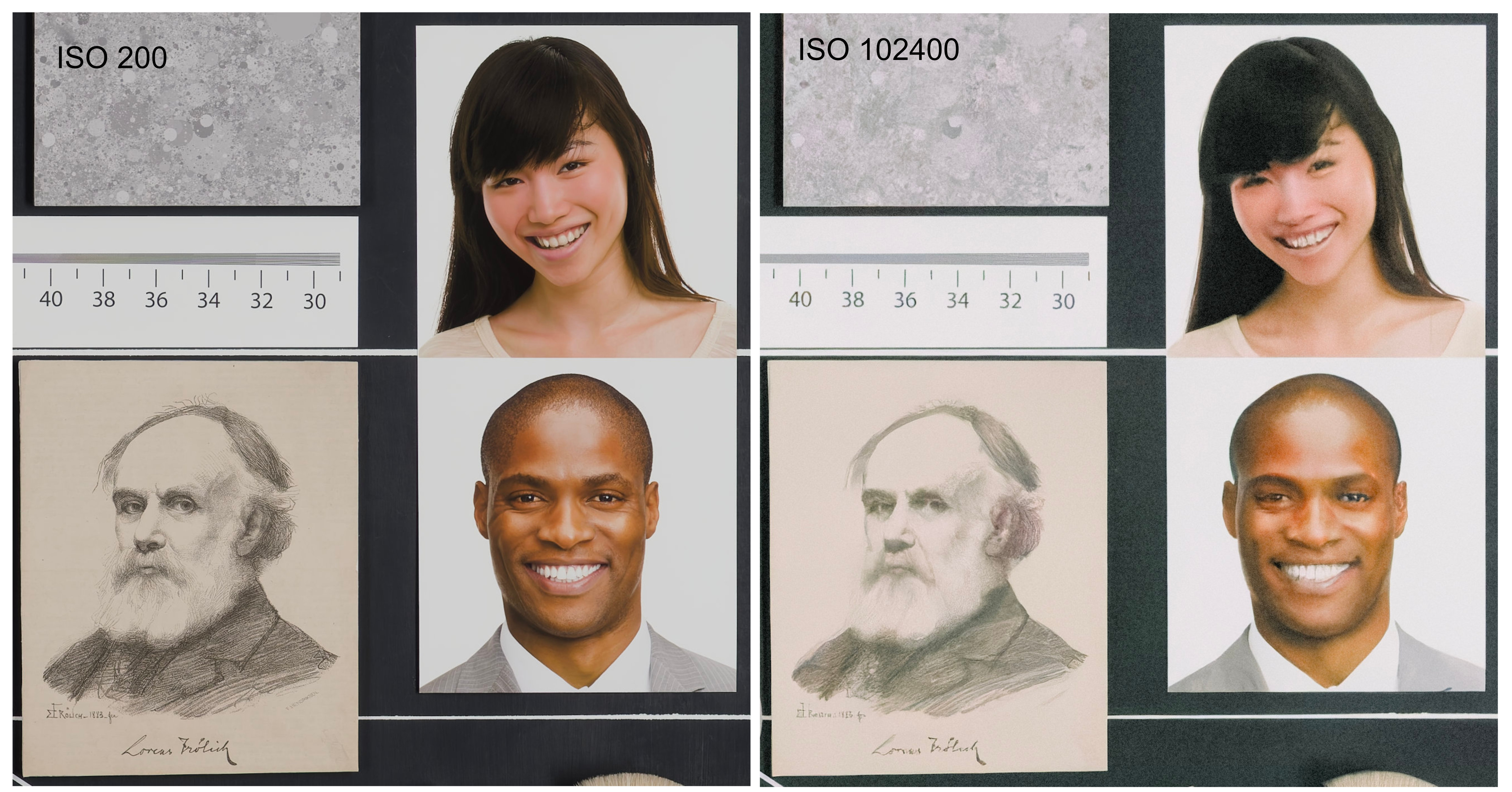
Here is a comparison of ISO200 vs 102400, using the "standard test scene" from DPReview.
I downloaded the OM-1 raw files acquired at ISO200 and ISO102400, and applied lens corrections and denoising with DeepPRIME XD3 in Photolab 9.
Below, we are looking at a crop from the "standard test scene"
Is the DxO denoising awesome? - Absolutely. Is the ISO102400 useable? - to some extent, yes, but the quality is poor.
As a "rule of thumb", a full-frame photographer would try to keep ISO under 12800, at 6400 and lower.
Now recall that the larger FF sensors must use ISO values that are 4 times larger than the ISO values on a micro-four-thirds camera (because the exposure on a full-frame sensor is four times lower than than that on a micro-four-thirds sensor, when both sensors are equally illuminated).
Therefore, a micro-four-thirds photographer may want to keep the ISO below 3200, at 1600 and lower, if the objective is to try to match the quality of equivalent full-frame images.
Yes, one can use a higher ISO than 3200 on a micro-four-thirds camera. But this must be done with the understanding that there is going to be a loss of quality beyond what is acceptable among full-frame photographers.
"a reasonably well-exposed image from the OM-1 I/II that doesn't require much cropping and lifting shadows by more than 1-1.5 stops can look beautiful "
i love my OM-1 but i don't think I agree with this... i may have to do some experiments. the OM-1 sensor is not that forgiving in the shadows _and_ the highlights...my god especially with highlights...i can't use the OM-1 in situations where it's very high contrast (think early afternoon with full sun and clear skies on a football game) because either i have crushed shadows or blown out highlights...never a problem with full frame.
RoamingScott wrote:
OMDS has a pretty unique problem in that their biggest supporters tend to be buying their last camera system for physical reasons. They need to figure out some broader market appeal.
The good news is, everyone is getting older -- so there's a steady supply of new customers!