Some tripod reviews I recently read recommend getting a tripod without a center column. My current tripod (a Slik Pro 824CFL) that I purchased more than 10 years ago, and have only rarely used, does have a center column. I recognize that extending a tripod's center column reduces stability, but in cases when I'm pointing the camera up (e.g. at a bird or nest high in a tree), I sometimes raise it to avoid having to bend/crouch for a long period of time while looking through the viewfinder. How do folks handle that situation with a tripod that doesn't have a center column?
It helps to have a tripod tall enough for you with some extra height for uneven terrain.
A Gitzo 35xxLS is good for most users, but much over 6' maybe the 35xxXLS. Systematic tripods allow for an interchangeable leveling base, video bowl, or center column with the same legs.
There are some similar RRS or Asian geriantrics.
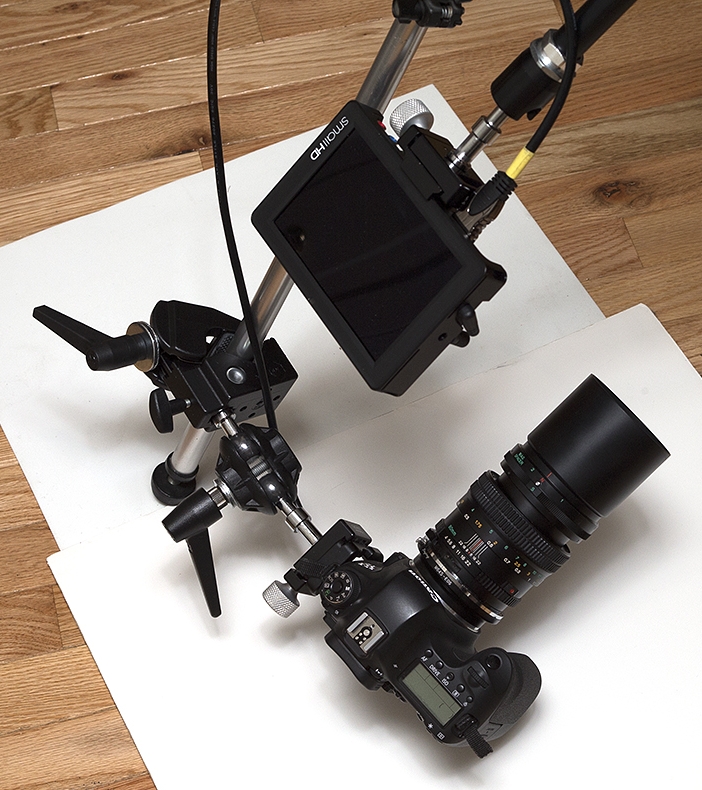
Also, you can use a remote monitor to show the camera's rear-screen LiveView output, at a convenient location. I used a SmallHD DP6 monitor for many years, for both awkward positions; where the LV output is not easy to see (like in your case), and for tilt-shift shooting, where the larger (but still small) monitor provides more visual detail.
The attached image shows the DP6 supported on a magic arm, to show the LV output from a camera located near the floor and pointing slightly up. Sometimes, I would attach the screen to the camera's hot shoe (e.g. for T-S shooting), but most often, I'd attach it to the tripod centre post or a leg, using a double-ball head (as shown holding the camera, in the image below).
SmallHD DP6 monitor shows camera LiveView output from a convenient location.
The quick answer to your question is that you get a tripod without a center column that is tall enough to be able to position the camera above eye level.
I’ve used both setups — tripods with and without center columns. Each has its pluses and minuses, but you can get a plenty stable setup from either one.
My current landscape photography tripod is a very tall RRS systemic type with no center column. There’s no question that it is stiff. However, in order to ensure that it is tall enough for uneven ground I had to get longer legs that I’d get on a tripod with a center column, which creates its own set of issues. (Weight, packed size, carrying, etc.) In addition, the systemic design — common when you don’t use a center column — means that the top platform has a significantly larger diameter, which creates some minor challenges when carrying it in the field.
It is true that introducing a center column adds more flex points to the tripod’s structure, and that the single support when extended is potentially more subject to vibration/motion than otherwise. But if you let the vibrations “settle,”’ even for a few seconds, before exposing the system is typically pretty darned solid. If you get long enough legs you won’t have to extend the column when set up on flat ground, and you might think of the column as an optional plus that let’s you work on uneven surfaces or raise the camera even higher than you can with a no-column model. (With my old heavy center column tripod I can position the camera well above eye height, in some cases high enough to photograph over obstructions.)
It is ironic for me to say his after that long post, but… it is possible to over-think this and to become overly-paranoid about “perfect” tripod rigidity.
I have this problem all the time for landscape shooting. Some options are:
- taller tripod
- push legs closer together to get extra height
- get a center column extension pole (sits on the base where the 3 legs meet)
- get leg extensions
- put the tripod on chairs or table
These all make the setup less stable. But with electronic first shutter, you can get away with a lot and still have very sharp images.
The geared center column will have a lot of play. Very different is the center column kit for the Feisol CT-3472 tripod that has double the diameter and a great deal more rigidity. I use this combination with a 10 lb camera and lens combo fully extended and have a very solid support. I can remove the center column when not needed to gain additional working height.
I haven't used tripods with center columns in years, with the only exception being my GT2540EX (with the offset center column) I break out every once in a while for macros of flowers which are low to the ground. For the most part I use a RRS TFC-24L/Arca Swiss P0 (fully extended the camera is above my head) and RRS Versa-43i/Arca Swiss P1+ (just a hair shorter). The former is kind of my all arounder and the latter is my no compromise beast and the tripod I use when I think I'm going to be in the muck or tough conditions. That little bit of extra height for me is important, as I have sold other shorter tripods that felt limiting for some of my shooting.
At the end of the day though, whatever solution works for you, works for you. Personal preferences do come into play.
Thanks for all the info and suggestions. The problem with a taller tripod, for me, is that it is heavier and bulkier. I primarily do wildlife photography, and rarely use a tripod, opting for handholding or a monopod, but I'm starting to try more video where I find I need a tripod more often. When I anticipate needing the tripod I attach it to my backpack, and typically hike a couple of miles or more, so weight is an issue.
tsdevine wrote:
At the end of the day though, whatever solution works for you, works for you. Personal preferences do come into play.
Yep, YMMV. I'd rather carry a tripod than always handhold a camera and lens. The overall pain and suffering is less for me. At my age legs are in much better shape than arms.
vbnut wrote:
Thanks for all the info and suggestions. The problem with a taller tripod, for me, is that it is heavier and bulkier. I primarily do wildlife photography, and rarely use a tripod, opting for handholding or a monopod, but I'm starting to try more video where I find I need a tripod more often. When I anticipate needing the tripod I attach it to my backpack, and typically hike a couple of miles or more, so weight is an issue.
What is your desired weight to carry, I mean optimally it would be 0.....but what weight do you feel would be acceptable for your normal uses?
I think it might be easier to target the goal - target weight, target max height, etc. Then you can start looking for options. Someone here might even be able to throw out suggestions.
Probably one of the most important questions is, what is your budget for this?
This is why I have so many tripods. I'm also a Slik user, though 212 Pro, and I have two of them. About (I think) a dozen tripods and two camera stands at this time. Each has benefits that the others don't, and I choose based on my need. In the studio the camera stands are my choice for footprint and stability, but my goto tripods for most out of studio shoots are the Slik 212 Pro. A bit heavy for any long walking distances to the shoot, at about 5 lbs, but their adjustment capabilities and steadiness are great and worth the heavy carry every time. Yes, I'm an old guy, with old ideas, but I see no reason to buy new when something that I already have works better than most of the new alternatives that I've tried.
CharleyL wrote:
This is why I have so many tripods. I'm also a Slik user, though 212 Pro, and I have two of them. About (I think) a dozen tripods and two camera stands at this time. Each has benefits that the others don't, and I choose based on my need. In the studio the camera stands are my choice for footprint and stability, but my goto tripods for most out of studio shoots are the Slik 212 Pro. A bit heavy for any long walking distances to the shoot, at about 5 lbs, but their adjustment capabilities and steadiness are great and worth the heavy carry every time. Yes, I'm an old guy, with old ideas, but I see no reason to buy new when something that I already have works better than most of the new alternatives that I've tried.
One is a very tall RRS Series 3 model that is tall enough to put the camera well above eye height without a center column, just the BH-55 head. That's my go-to for landscape photography when I'm out and about in a vehicle and not walking long distances.
Another is a Gitzo 2542L, the "long" model, with a center column plus an Acratech Ultimate Ballhead. This is my "serious lighter" system that I'll use if I'm hiking (or even backpacking) with the gear. I also carry it on some occasions when I go out with the RRS as a second tripod. (I sometimes carry two systems.)
The third is my "emergency travel tripos," an Induro CT014. This is a quite small tripod that barely gets a small camera to eye level with the center column fully extended. I sometimes throw it in my luggage when traveling "just in case." It has saved me more than once.
I'm thinking I should name them: Papa Bear, Mama Bear, and Baby Bear?
Ever have trouble adjusting your light transmitter on top of your camera when it's on a high tripod above your head?
I was tipping the camera and tripod over on two legs to make flash transmitter adjustments, until it dawned on me to use one of the readily available hot shoe extensions intended for moving a speedlite flash off camera. I use this coiled cord extension as a way to remote locate my Godox X Pro II flash transmitter. Adding the coiled hot shoe extension cable to the camera hot shoe and then using a magic type clamp and a cold shoe attached to the X Pro II, lets me move the X Pro II off the top of the camera and down on one of the legs of the tripod to where I can see and adjust it without needing to tilt the tripod over to see and adjust it. You just need to be careful not to locate the transmitter behind an object (like someone's head or furniture) if you will be using the laser cross hatch projection focus aid feature of the X Pro II or other flash control transmitter. I now keep one of these extension cables in my field bags, and a second in my studio, so I'll always have one with me. I don't use it often, but almost always when the camera is on a high tripod now. Godox forgot that sometimes your head and eyes aren't above your camera while using it. If they had installed a pivot between the transmitter head/display and it's hot shoe base, the display could be tilted so as to be seen and adjusted, even when using high tripods. If they did, this hot shoe extension wouldn't be needed.
Just a tip that I thought you and others might not have thought of, when using tall tripods.
Maybe this is a better explanation. Sorry if not clear enough. My mind works faster than my fingers, sometimes.
When your camera is on a 6 or 7' tripod and the flash transmitter is in it's hot shoe. how do you make adjustments to the flash transmitter? A ladder?, Or tilting the tripod over on two of it's legs so you can reach and adjust the flash transmitter? Then stand the tripod back up in it's near original position and hope nothing like the tripod head adjustments have changed and the camera lens is no longer pointing where it was.
My suggestion is to use one of the hot shoe extension cables, normally used when you want the speedlite off the camera, so you can hold the flash in one hand and the camera in the other. You can remote the flash transmitter from the camera hot shoe using one of these cables as well, but nobody considers this possibility.
Attach the cable to the camera hot shoe and the other end to the hot shoe on the bottom of the flash transmitter. The cold shoe on the bottom of this end of the extension cable can then be attached to a leg of the tripod down lower than the camera, and at a height where you can see the transmitter display and controls, and use a magic clamp or similar with a cold shoe attached to it to allow you to locate the flash transmitter lower than the camera on one of the legs of the tripod, and where you can easily see and adjust it. The flash transmitter then attaches to the hot shoe on the top side of this end of the extension cable.
Normally, these hot shoe extension cables are used to get a speedlite off the top of the camera, but within about 3 feet of it, like in the hand that's not holding the camera, but it also works to let you get a flash transmitter located down lower than the camera, where you can see and adjust it. My Godox Pro II flash transmitters have their control and display panels angled up when attached to the hot shoe on one of my cameras. If the camera is lower than my head, it is easy to look down to see and adjust the flash transmitter. I'm 5'8", so when using a tripod that's 6'5" to the base of the camera, the flash transmitter display is almost 7' and with the display angled up, it is impossible to see and adjust it without a ladder and tilting the tripod over far enough to reach the camera and flash transmitter to make needed adjustments has been my previous method, but getting the tripod back in exactly the same position with the camera aimed exactly as before, has been a problem. Fortunately, I haven't had this problem often, since I rarely want or need to use that tall tripod. I also use a remote camera shutter trigger to get it down where it's easy to use. The articulating display on the camera, when set in Live View will let me assure that the lens remains pointed in the correct direction, or I can add a remote display and mount it in a lower position near the flash transmitter in a similar way that I attach the flash transmitter to the tripod leg. So lots of versatility here, and down below the camera so a ladder or tipping the tripod for adjustments isn't necessary.
Here is a link to one of these hot shoe extension cables on Amazon so you can see what one looks like. Just be sure you buy the version that is made for your camera and flash transmitter and speedlite, as different Brands of Cameras have different hot shoe electrical designs. My cables happen to be JJC and match my Canon cameras and Godox speedlites and flash transmitters.
These links are intended to show you what I'm talking about. There are other brands and versions at maybe lower prices. It's a simple job to assemble them and then attach them to a tripod leg. If a remote display is needed, attach it in a similar way using another one of these clamps and arms, maybe also with a cold shoe, depending on how the display needs to be attached. The displays usually come with a cable for attaching it to the camera.
tsdevine wrote:
What is your desired weight to carry, I mean optimally it would be 0.....but what weight do you feel would be acceptable for your normal uses?
I think it might be easier to target the goal - target weight, target max height, etc. Then you can start looking for options. Someone here might even be able to throw out suggestions.
Probably one of the most important questions is, what is your budget for this?
Well, my existing Slik Pro 824CF weighs 3.5 lbs, and while I might be willing to a bit higher, I think I'd want to keep it below 5 lbs.
The RRS BH55 I've been using on it adds 1.9 lbs and the Wimberly Sidekick another 1.3 lbs, and I'm carrying an EOS R5II, EF 300 2.8 II, 1.4x and 2x teleconverter, and an EF-RF adapter in my backpack which adds more than 8 lbs. I just purchased a PromediaGKJr. Katana Pro Gimbal at 2.4 lbs which I expect will replace the BH55 and Sidekick. If Canon comes out with a faster telephoto than the 100-500mm I already have (a 500mm or one of the rumored zooms), and I will probably buy it, and I expect it will weigh more than my 300mm + teleconverters. Of course none of that will change with a different tripod.
The last time I checked I was 67.5 inches tall. Even with the ball head or gimbal, I have to extend the column of my Slik tripod a few inches to get the camera to eye level (when its aimed horizontally), so I assume I would need a taller tripod if I don't have a center column. FWIW, Scott Keys recommends getting a little extra height for when you need to set up on a slope.
I've spent most of my life being frugal, so I'm trying to adjust to being in the position where price is not an issue. I'm happy to spend more to get the best, but I'm finding that figuring out what is the best can be difficult (and not just for photography gear).
Yes, I prefer a slightly taller tripod for the reason Scott Keys mentions as well. I'm often setup on uneven ground and that extra bit of height can really make a difference at times. I also have the PMG gimbal, although I don't use that as often. I'm using an Arca Swiss P1+ most of the time, which shaves some weight from what something like the BH55 sets you back. I'm shooting more landscape than teles for birding. My question would be whether the center column hurts you as much there. For perched birds you'd want to shoot as low ISO as you can, but you can only go so slow on the shutter speed before any movement by the bird becomes a problem. I do long exposures (well...short long exposures) doing waterfall photography. There I'm shooting base ISO and holding the shutter open long enough that I want rock solid. But I'm not sure the shooting you describe in your original post is as sensitive.
I have three tripods, all Gitzo, that serve distinct needs regarding weight, height and stability—tradeoffs abound. Series 4 Systematic three-section is above eye level with an attached head. Series 2 Traveler 4-section is just at eye level, but stooping is acceptable to reduce weight in the field. Most interesting is my Gitzo 224 from 1980: alu, 3 leg sections, center column with two sections, 80" max height of the platform. The 224 is not stable with a telephoto in the wind, but that's a non-issue in the studio with strobes. I still use this old thing when that height allows a sharp down-angle perspective on the subject, usually with a step ladder. I'm using it right now with a radio-wireless Sony flash to get down-angle illumination. Flash power is remotely adjustable so no ladder needed at all.