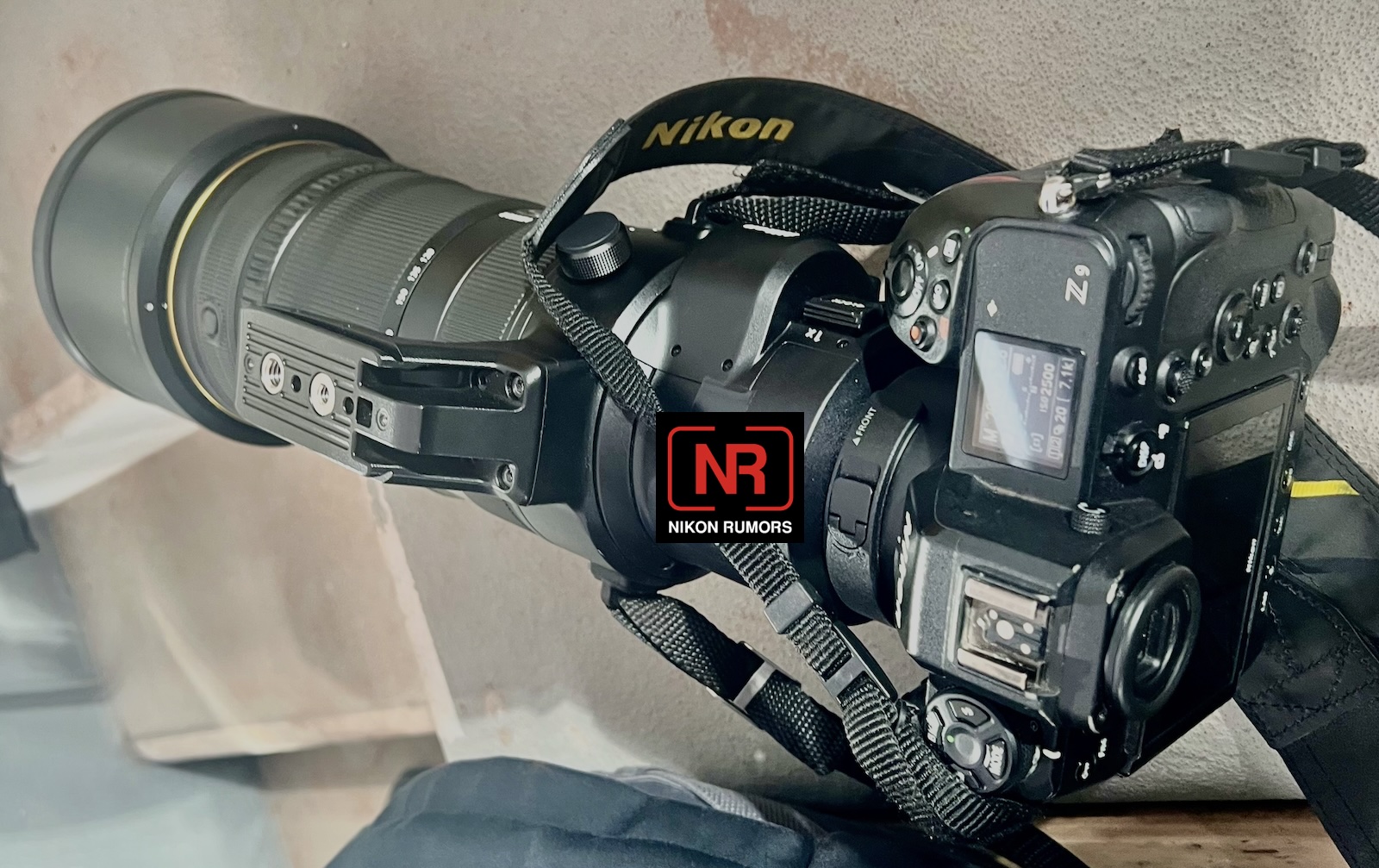
p.4 #1 · Official Nikon Z 120-300mm 2.8 TC - Image Thread
OwlsEyes wrote:
It's funny, as shortly before I went to bed I spent about 90 minutes editing work from Thursday's morning outing. This was sometime after my last post where I was considering the 120-300 f2.8TC as a viable alternative to my current long lens set up. Just out of curiosity, I did an analysis of the most used focal lengths for 2025. I shoot 2 to 5 days a week and take several photo-specific trips each year. 65% of my work is wildlife and 35% is landscape. The most used focal length was 560mm and most of my shooting was between f/4 and f/5.6. Furthermore, many of my images require some degree of cropping. My least used lens was my 100-400, and its use was mostly tied to landscape photography. My 24-120 was my second most used lens with the 180-600 appearing as the 3rd most used optic... almost entirely linked to shooting from a kayak or sailing vessel.
So, what does this suggest for me? At this point, I am more likely to replace my 100-400 with a 70-200S (v1 or v2), than buy a 120-300 f2.8. I would love to have a smaller option than what I am currently using for most of my photography, but I'm not sure it is the best option.
I'll close with a shot taken at 560mm (400TC + Z9) and then a cropped section that is actually the photo I like best. I'm sharing this because if your subject interests align with mine and you have the option to buy only one "great" lens (this is my situation), the 120-300mm TC may not be your best option. To be clear, I am not saying it isn't the best option for others, I am simply stating that unfortunately, it isn't the best option for me.
The quality of the photo after that crop is pretty astounding. With my 600mm, I rarely crop more than 15% of the photo, so good to know I'll have plenty of flexibility with a 400mm f/2.8!
Your analysis of the 120-300mm is the same as mine, save for one factor: I have a 4 year old and an almost 2 year old, so we're on the cusp of kids sportsdom. My current plan is to swap my 600mm FL E for a 400mm f/2.8 TC and pick up the new 70-200mm f/2.8. I'll then take my time to decide whether the 120-300mm makes sense. As I just responded to Geoff, though, if the 120-300mm is under 6 lbs. and takes TCs well, it is a foregone conclusion that it will wind up in my bag at some point. I can only imagine how great that lens would be for seabird colonies and shorebirds. The minimum focus distance of the F mount was 6.5 feet; hopefully that is basically the same. All that said, I don't need to be in a hurry on the 120-300mm.
p.4 #2 · Official Nikon Z 120-300mm 2.8 TC - Image Thread
RoamingScott wrote:
The R1 and A1 II don’t “run circles” around the Z9, each has a few strong points and a few where it’s weaker than the others. People who care about brands (lol) will latch onto these extreme edge case differences as ammo that their BRAND is better and all other brands are behind and laughable to even consider shooting.
I know I personally have very rarely been held back by my Z9 and that it has gotten consistently more capable with every major FW update. Sony apologists might have to google what those are.
I agree with this and have been making that point for years. The Z9 almost never falters for me. I took it to Ft. DeSoto and Sanibel this winter and spring, and I'd bet that less than 1% of my photos missed focus. My hit rate is the same locally and with kids.
But there are plenty of reports that Sony and Canon perform better in extreme edge cases, like swallows. That kind of subject isn't something I shoot much of, and I think that is true for 99% of photographers. So, differences in AF competency are certainly overstated. But if swallows and other difficult BiF targets were my main priority, I'd have to think very hard about staying with Nikon. TBH, though, if I were still with Nikon right now, I'd stay because the Z9 ii will almost certainly be on par with the A1ii and R1, and the Z9 ii could surpass them. It also seems clear that the other manufacturers are not going to prioritize similar lens offerings as Nikon, and I'd value that much more than small differences in AF competency.
p.4 #3 · Official Nikon Z 120-300mm 2.8 TC - Image Thread
groob wrote:
I agree with this and have been making that point for years. The Z9 almost never falters for me. I took it to Ft. DeSoto and Sanibel this winter and spring, and I'd bet that less than 1% of my photos missed focus. My hit rate is the same locally and with kids.
But there are plenty of reports that Sony and Canon perform better in extreme edge cases, like swallows. That kind of subject isn't something I shoot much of, and I think that is true for 99% of photographers. So, differences in AF competency are certainly overstated. But if swallows and other difficult BiF targets were my main priority, I'd have to think very hard about staying with Nikon. TBH, though, if I were still with Nikon right now, I'd stay because the Z9 ii will almost certainly be on par with the A1ii and R1, and the Z9 ii could surpass them. It also seems clear that the other manufacturers are not going to prioritize similar lens offerings as Nikon, and I'd value that much more than small differences in AF competency. ...Show more →
I can't think of a single outing in challenging conditions where I missed a shot on my Z9 that wasn't in some part due to me not performing MY best, and the camera has only gotten better the 3 years I've had it.
p.4 #4 · Official Nikon Z 120-300mm 2.8 TC - Image Thread
groob wrote:
I agree with this and have been making that point for years. The Z9 almost never falters for me. I took it to Ft. DeSoto and Sanibel this winter and spring, and I'd bet that less than 1% of my photos missed focus. My hit rate is the same locally and with kids.
But there are plenty of reports that Sony and Canon perform better in extreme edge cases, like swallows. That kind of subject isn't something I shoot much of, and I think that is true for 99% of photographers. So, differences in AF competency are certainly overstated. But if swallows and other difficult BiF targets were my main priority, I'd have to think very hard about staying with Nikon. TBH, though, if I were still with Nikon right now, I'd stay because the Z9 ii will almost certainly be on par with the A1ii and R1, and the Z9 ii could surpass them. It also seems clear that the other manufacturers are not going to prioritize similar lens offerings as Nikon, and I'd value that much more than small differences in AF competency. ...Show more →
Just to chime in - I don’t disagree that the AF differences can be overstated depending on what someone shoots. And to be clear, I’m not talking about swallows or tiny erratic birds — I don’t really shoot that either.
My comparison/comment is coming from my own use case. With the Z9 + 600TC, shooting wild dogs hunting and coming fast through brush, grass, and obstacles, the Nikon would lose focus. Not constantly, and not enough for me to say the Z9 isn’t a great camera — because it is. But it did happen... and more than once.
More recently, I was shooting a fast-moving animal coming directly toward me with the R1, the camera tracked perfectly, with not a single frame out of focus. That kind of difference matters to me because it shows up in the type of wildlife I actually shoot, not just in extreme swallow-type edge cases.
But overall, I fully agree their lens lineup is incredibly compelling — the 400TC is still one of my favorite lenses ever. I’m just saying that, for my specific shooting, the R1’s AF/tracking has given me more confidence in those moments where the subject is fast moving from far to close, and moving through a messy background, midground and sometimes foreground environments.
p.4 #5 · Official Nikon Z 120-300mm 2.8 TC - Image Thread
robert_in_ca wrote:
Just to chime in - I don’t disagree that the AF differences can be overstated depending on what someone shoots. And to be clear, I’m not talking about swallows or tiny erratic birds — I don’t really shoot that either.
My comparison/comment is coming from my own use case. With the Z9 + 600TC, shooting wild dogs hunting and coming fast through brush, grass, and obstacles, the Nikon would lose focus. Not constantly, and not enough for me to say the Z9 isn’t a great camera — because it is. But it did happen... and more than once.
More recently, I was shooting a fast-moving animal coming directly toward me with the R1, the camera tracked perfectly, with not a single frame out of focus. That kind of difference matters to me because it shows up in the type of wildlife I actually shoot, not just in extreme swallow-type edge cases.
But overall, I fully agree their lens lineup is incredibly compelling — the 400TC is still one of my favorite lenses ever. I’m just saying that, for my specific shooting, the R1’s AF/tracking has given me more confidence in those moments where the subject is fast moving from far to close, and moving through a messy background, midground and sometimes foreground environment. ...Show more →
Yeah, I believe you mainly shoot African mammals, right? There seem to be reliable reports that Nikon is less dependable than Canon in that context. I’m not sure if the newest firmware has materially changed Nikon’s performance in that respect. For my own experience, I’ll say that AA struggled a bit with monkeys in Costa Rica last summer, but 3D was very solid.
If I were in your shoes and shooting your subjects, I’d probably have an R1 also. But I would be interested to know if people have tested FW 5.31-5.32 on African mammals and have seen any difference.
p.4 #6 · Official Nikon Z 120-300mm 2.8 TC - Image Thread
RoamingScott wrote:
I can't think of a single outing in challenging conditions where I missed a shot on my Z9 that wasn't in some part due to me not performing MY best, and the camera has only gotten better the 3 years I've had it.
I’ve certainly missed focus with my Z9 in circumstances that can only be explained by a Z9 error. Those are mainly BiF sequences. I also had some shorebird series from a recent trip to Sanibel where some photos were just slightly OOF.
But that seems to happen about 90% less than it did with my old D850/D500. The Z9 performs so spectacularly 99% of the time that missing focus in any circumstance is pretty shocking. To your point, if I just get the subject anywhere in the frame with a decent exposure, the Z9 is going to grab it. While I’m in the field, I never have concerns the Z9 missed when the subject appeared even slightly in focus before I tripped the shutter.
p.4 #7 · Official Nikon Z 120-300mm 2.8 TC - Image Thread
Not sure how this thread got turned into a brand war of body focus system minutiae.
I am not the target market for the 120-300 Z TC since I am not that well heeled and not making money with my equipment. I am excited/hopeful that this results in continuing to see some number of the 120-300 F mount lenses hitting used sales at increasingly compelling prices though. A Z mount 70-200 or F mount 120-300 would not be compelling lenses for my son’s XC bicycle events. I tend to think the 120-300 paired with a 24-70 or a 24-120 on two bodies would be the bees knees.
p.4 #8 · Official Nikon Z 120-300mm 2.8 TC - Image Thread
groob wrote:
Yeah, I believe you mainly shoot African mammals, right? There seem to be reliable reports that Nikon is less dependable than Canon in that context. I’m not sure if the newest firmware has materially changed Nikon’s performance in that respect.
I don't think the differentiating point is the continent or even animal species but simply if the animals are moving across tall grass or other vertical lines then the camera will prioritise those vertical lines and focus on them simply because the phase-detection sensors in Nikon mirrorless cameras are all linear (and oriented so that they are sensitive to vertical lines). In a D6, all the sensors are cross-type and thus it's easier to use that camera to photograph animals through grass and with vertical lines present in the foreground and background than using current Z mirrorless cameras. The Canon R1 has cross-type sensors and thus it would naturally perform better in this context as it is equally sensitive to vertical and horizontal lines. You can bypass this problem with the Z cameras by turning the camera into vertical orientation, of course this requires that the user accepts the compositional change or is willing to crop to adjust the framing to match the intended composition and orientation of the frame.
Canon has also the advantage that all the pixels are functioning as phase-detection sensors (arranged into thousands of selectable blocks) and so their cameras have a perfect spatial correspondence between the subject's identified location and the distance (focus discrepancy) information given by phase detection, while Nikon has only a small percentage of pixels that give phase-detection information and thus the subject's identified position may not be perfectly coincident with the phase-detection sensor(s) used and this can lead to the camera grabbing some high-contrast, brightly lit grass instead of the eye behind the grass even if the grass is not exactly aligned with the eye. I would like to see Nikon address this issue as soon as possible. So it's important to keep talking about it until they address it.
In the Z9 latest firmware, it is possible to use single point AF with subject detection; this may help a little in this specific context of animals partly behind grass, but since I'm using the Z8 instead of Z9, I don't have access to this feature yet. I can confirm that I've run into this problem photographing deer behind grass and in many other situations, and can also say that the D6 (even the D850, if the right sensors are selected) does better in this situation especially if the subject is backlit.
However, Canon does not have a stacked sensor high-resolution camera, probably because they need to have two photosites per image pixel to implement dual-pixel AF, and so a 45 MP camera really has a 90 MP sensor, and the technology might not yet exist to implement that with a stacked sensor architecture, at least no one has done that yet. Whether action-photographers need high resolution is debatable but often when working with a prime telephoto lens, one has to crop to get the right composition and having those extra pixels does help maintain decent image quality when cropping. When following fast-moving action, leaving some room around the subject for compositional freedom and correction in post is generally beneficial to avoid accidental truncation of subject parts. However, of course, there are downsides in file size and storage space required.
For me the 120-300/2.8 would be too large, heavy, and expensive and I will not be interested in buying it at the price I would assume to be around 12-13k€. I would have preferred Nikon to make a straight 300/2.8 similar to Sony's (which is smaller than a zoom, and much lighter no doubt) but as it is, I will simply continue to use the older F-mount lens at 300mm even though it is similarly heavy but at least it is smaller and paid for. The ridiculously expensive lenses can be sold to those who are happy to pay for and use them.
May 11, 2026 at 04:14 AM
Steve Spencer Offline • • • • • • • Upload & Sell: On
p.4 #9 · Official Nikon Z 120-300mm 2.8 TC - Image Thread
ilkka_nissila wrote:
However, Canon does not have a stacked sensor high-resolution camera, probably because they need to have two photosites per image pixel to implement dual-pixel AF, and so a 45 MP camera really has a 90 MP sensor, and the technology might not yet exist to implement that with a stacked sensor architecture, at least no one has done that yet. Whether action-photographers need high resolution is debatable but often when working with a prime telephoto lens, one has to crop to get the right composition and having those extra pixels does help maintain decent image quality when cropping. When following fast-moving action, leaving some room around the subject for compositional freedom and correction in post is generally beneficial to avoid accidental truncation of subject parts. However, of course, there are downsides in file size and storage space required.
The Canon R5 II is a stacked sensor architecture with 45 MP and has a quite decent 6ms sensor scan speed. Not as fast as the Z9 and Z8, or the Canon R1 or R3, but still very fast and very capable for action photography.
p.4 #10 · Official Nikon Z 120-300mm 2.8 TC - Image Thread
ilkka_nissila wrote:
I don't think the differentiating point is the continent or even animal species but simply if the animals are moving across tall grass or other vertical lines then the camera will prioritise those vertical lines and focus on them simply because the phase-detection sensors in Nikon mirrorless cameras are all linear (and oriented so that they are sensitive to vertical lines). In a D6, all the sensors are cross-type and thus it's easier to use that camera to photograph animals through grass and with vertical lines present in the foreground and background than using current Z mirrorless cameras. The Canon R1 has cross-type sensors and thus it would naturally perform better in this context as it is equally sensitive to vertical and horizontal lines. You can bypass this problem with the Z cameras by turning the camera into vertical orientation, of course this requires that the user accepts the compositional change or is willing to crop to adjust the framing to match the intended composition and orientation of the frame.
Canon has also the advantage that all the pixels are functioning as phase-detection sensors (arranged into thousands of selectable blocks) and so their cameras have a perfect spatial correspondence between the subject's identified location and the distance (focus discrepancy) information given by phase detection, while Nikon has only a small percentage of pixels that give phase-detection information and thus the subject's identified position may not be perfectly coincident with the phase-detection sensor(s) used and this can lead to the camera grabbing some high-contrast, brightly lit grass instead of the eye behind the grass even if the grass is not exactly aligned with the eye. I would like to see Nikon address this issue as soon as possible. So it's important to keep talking about it until they address it.
In the Z9 latest firmware, it is possible to use single point AF with subject detection; this may help a little in this specific context of animals partly behind grass, but since I'm using the Z8 instead of Z9, I don't have access to this feature yet. I can confirm that I've run into this problem photographing deer behind grass and in many other situations, and can also say that the D6 (even the D850, if the right sensors are selected) does better in this situation especially if the subject is backlit.
However, Canon does not have a stacked sensor high-resolution camera, probably because they need to have two photosites per image pixel to implement dual-pixel AF, and so a 45 MP camera really has a 90 MP sensor, and the technology might not yet exist to implement that with a stacked sensor architecture, at least no one has done that yet. Whether action-photographers need high resolution is debatable but often when working with a prime telephoto lens, one has to crop to get the right composition and having those extra pixels does help maintain decent image quality when cropping. When following fast-moving action, leaving some room around the subject for compositional freedom and correction in post is generally beneficial to avoid accidental truncation of subject parts. However, of course, there are downsides in file size and storage space required.
For me the 120-300/2.8 would be too large, heavy, and expensive and I will not be interested in buying it at the price I would assume to be around 12-13k€. I would have preferred Nikon to make a straight 300/2.8 similar to Sony's (which is smaller than a zoom, and much lighter no doubt) but as it is, I will simply continue to use the older F-mount lens at 300mm even though it is similarly heavy but at least it is smaller and paid for. The ridiculously expensive lenses can be sold to those who are happy to pay for and use them....Show more →
If I’m not mistaken (and I could be), Steve Perry and others have found that Nikon isn’t as sticky with mammals relative to Canon, regardless of the situation. That was pre-5.31, though. Again, not sure if that has changed.
groob wrote:
If I’m not mistaken (and I could be), Steve Perry and others have found that Nikon isn’t as sticky with mammals relative to Canon, regardless of the situation. That was pre-5.31, though. Again, not sure if that has changed.