Steve Spencer wrote:
Here is one test by Brian Smith and you don't see much advantage of 5 axis over 3 axis and these are fairly close shots when theoretically 5 axis should help the most:
I think the image with the Zony 55/1.8 and steadyshot on is crisper than the one with Leica 75/1.4 and steadyshot on. Other than that, these lenses are too different to be certain of any conclusion, I think.
Dec 19, 2018 at 04:16 PM
Steve Spencer Offline • • • • • • • Upload & Sell: On
bjornthun wrote:
I think the image with the Zony 55/1.8 and steadyshot on is crisper than the one with Leica 75/1.4 and steadyshot on. Other than that, these lenses are too different to be certain of any conclusion, I think.
Yeah, ideally you would use the same lens that allows 5 axis but the tape over the contacts to see how it does with 3 axis. I haven't see that sort of a test.
Steve Spencer wrote:
Here is one test by Brian Smith and you don't see much advantage of 5 axis over 3 axis and these are fairly close shots when theoretically 5 axis should help the most:
Fred Miranda wrote:
Loxia lenses do not report distance and therefore only capable of 3-axis IBIS. Only the latest Voigtlander E-mount lenses have a distance encoder and it's a big plus.
Tokina has a distance encoder in their manual 20mm. Not sure if we'll see another MF lens from them, though.
Fred Miranda wrote:
No doubt 5-axis is better but I think the advantage would be more noticeable at macro distances.
The theory is that x and y stabilization (which are the two axes added to make 3 axis into 5 axis stabilization) add less and less to the stabilization until you approach infinity when they add nothing. So, according to the math they should add nothing at infinity focus and they should add more and more as you focus closer. Macro stabilization is super hard, however, so although theoretically 5 axis should help the most for that type of shooting I am not sure it can add enough to be all that noticeable in practice. I would love to see some good tests, however.
Said another way, 5-axis might be a bit better than 3-axis for macro shooting, but I suspect that difference will be tiny compared to either type of stabilization and using a tripod.
Steve Spencer wrote:
The theory is that x and y stabilization (which are the two axes added to make 3 axis into 5 axis stabilization) add less and less to the stabilization until you approach infinity when they add nothing. So, according to the math they should add nothing at infinity focus and they should add more and more as you focus closer. Macro stabilization is super hard, however, so although theoretically 5 axis should help the most for that type of shooting I am not sure it can add enough to be all that noticeable in practice. I would love to see some good tests, however.
Said another way, 5-axis might be a bit better than 3-axis for macro shooting, but I suspect that difference will be tiny compared to either type of stabilization and using a tripod....Show more →
This makes total sense.
It works quite well with the CV 65/2 APO at 1:2 macro handheld. I would not attempt 1:1 macro handheld but it's a possibility with the 110/2.5 APO. I assume the FE 90/2.8 OSS is also capable of 5-axis combining in-body and in-lens stabilization.
Fred Miranda wrote:
This makes total sense.
It works quite well with the CV 65/2 APO at 1:2 macro handheld. I would not attempt 1:1 macro handheld but it's a possibility with the 110/2.5 APO. I assume the FE 90/2.8 OSS is also capable of 5-axis combining in-body and in-lens stabilization.
If anyone is doing 1:1 handheld what’s even more important than extra axes on the 90g is continuous AF. Tiny forward and backward movements are largely beyond stabilisation, but by carefully positioning an AF point and using C-AF you can compensate quite well. but I generally do 1:1 on a tripod, where wind and vibration are the main enemy, against which oss is no help.
DavidBM wrote:
If anyone is doing 1:1 handheld what’s even more important than extra axes on the 90g is continuous AF. Tiny forward and backward movements are largely beyond stabilisation, but by carefully positioning an AF point and using C-AF you can compensate quite well. but I generally do 1:1 on a tripod, where wind and vibration are the main enemy, against which oss is no help.
I think I did some 1:1 macro handheld during the time I own the Canon 100/2.8L IS and never really liked the results. However, if AF is fast and accurate at macro distances it would be useful as wind defeats the purpose of using a tripod.
DavidBM wrote:
If anyone is doing 1:1 handheld what’s even more important than extra axes on the 90g is continuous AF. Tiny forward and backward movements are largely beyond stabilisation, but by carefully positioning an AF point and using C-AF you can compensate quite well. but I generally do 1:1 on a tripod, where wind and vibration are the main enemy, against which oss is no help.
I have the same experience as you with AF-C.
---------------------------------------------
Fred Miranda wrote:
I think I did some 1:1 macro handheld during the time I own the Canon 100/2.8L IS and never really liked the results. However, if AF is fast and accurate at macro distances it would be useful as wind defeats the purpose of using a tripod.
I think the clue is this: The Sony 90/2.8 G has a different kind of AF motor than the DSLR macro lenses, more suited for contrast AF with small movements back and forth. I think this may be the reason AF-C can be made to work in macro photography under the right circumstances. Then it can give me more sharp images than only using MF. More sharp images from which to choose keepers. This is one reason not to give up the Sony 90/2.8 G.
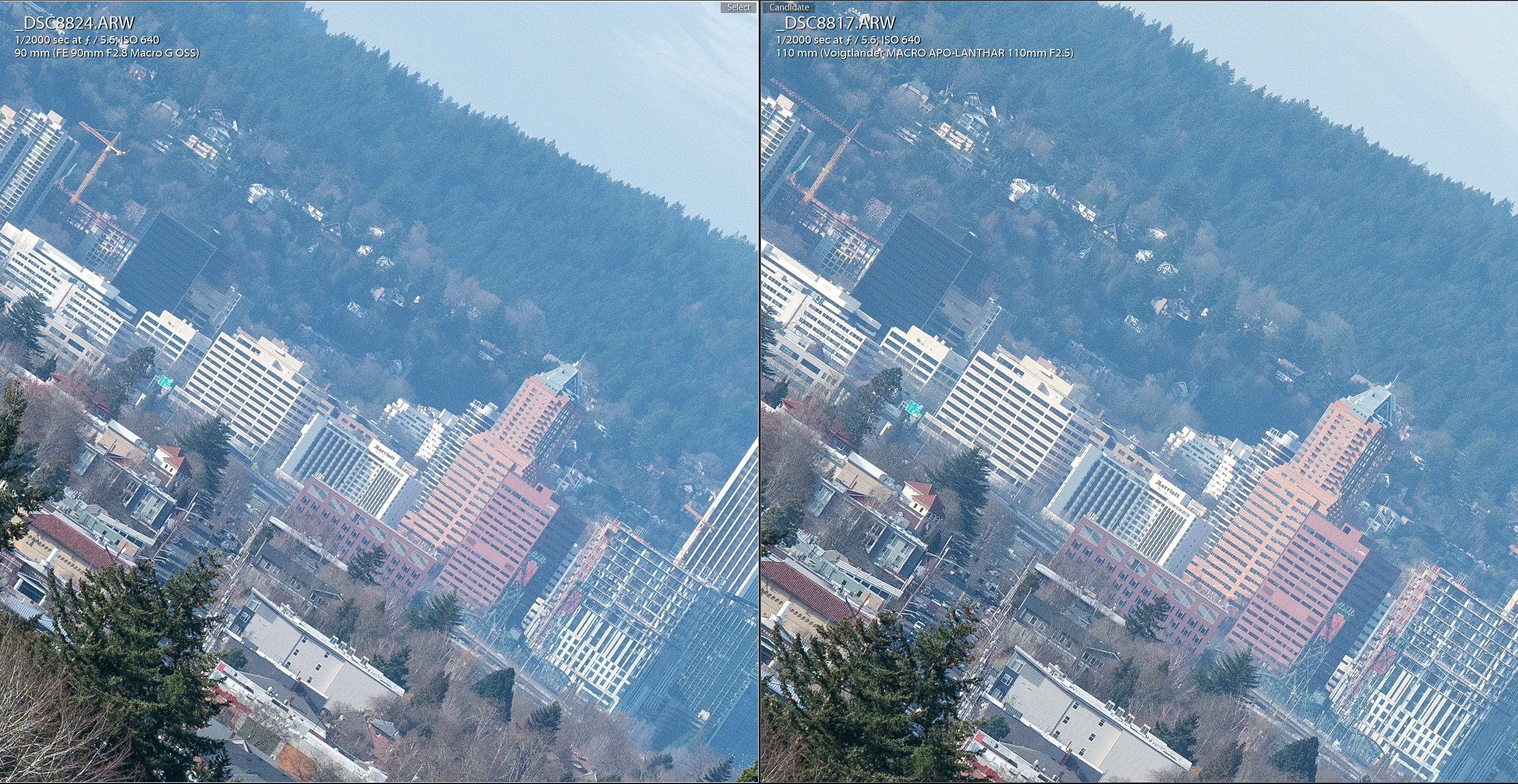
Here is my center crop comparison at infinity to the Sony 90 macro at f5.6. While the center of the Sony 90 Macro holds up fairly well against the CV 110 in the center, towards the edges there is no contest where the CV 100 does much better.
bjornthun wrote:
This is a good selling point for Voigtländer FE lenses compared to the Loxia series. The better the stabilization the better the image quality from expensive lenses. It seems silly for Zeiss to leave this out when the differences may be otherwise small.
What do you mean by this? The Voigtlander and Loxia lenses have electronic contacts and no in-lens stabilization, but because they have electronic contacts, the IBIS and appropriate focal length at which IBIS is optimal for would apply automatically to both, right?
They are referring to the Loxia lenses not supporting 5-axis stabilization, based on the evidence that they aren't transmitting the distance information, which is required for 5-axis stabilization. The Voigtlanders do transmit the distance information, so they should support 5-axis stabilization. I find it odd that the Loxia's may not support the 5-axis stabilization, but if they aren't capable of knowing the distance, then they can't use 5-axis.
Hodie wrote:
What do you mean by this? The Voigtlander and Loxia lenses have electronic contacts and no in-lens stabilization, but because they have electronic contacts, the IBIS and appropriate focal length at which IBIS is optimal for would apply automatically to both, right?
Loxia lenses do work with IBIS but only with 3-axis stabilization because they lack a distance encoder. Lenses like the CV 65/2 and 110/2.5 APO offer 5-axis stabilization which makes a difference when handholding at macro distances. I believe the only Voigtlander E-mount lenses that do not offer 5-axis stabilization are the 10/5.6, 12/5.6 and 15/4.5 E-mount lenses. All others do. (21/3.5, 35/1.4, 40/1.2, 65/2 and 110/2.5)
pdmphoto wrote:
Here is my center crop comparison at infinity to the Sony 90 macro at f/2.8. While the center of the Sony 90 Macro holds up fairly well against the CV 110 in the center, towards the edges there is no contest where the CV 100 does much better.
Could you post the mid and corners at infinity too? What aperture the FE 90/2.8 needs for optimal sharpness across the field at 1:1 macro? The 110/2.5 APO is already great from wide open.
Sorry, my last post of crops at infinity was at f/5.6, not f/2.8 (now edited). I already sold my lens but will go through the pics I have. Even at f/5.6 the Sony can't come close to the VC 110 at infinity. The building/crane/trees in the upper left corner of the center crops I posted show the Sony already losing the race just a little off center.
At 1:1 macro my Sony 90 almost matches the VC 110 at f/2.8. The VC has just a tad more clarity (probably due to the APO) and sharpness, and maybe just another tad more sharpness in the extreme corners, but the differences are small even in the corners. The Sony has a touch more contrast. The Sony sharpness may improve a little at f/4 in the extreme corners, but not by much as it is already very good at f/2.8. I would say the Sony 90 is close (enough for me) to optimal sharpness across the frame at f/2.8. The reduction of CA, which isn't too much to begin with, may be the biggest advantage to stopping down the Sony at macro distances.
pdmphoto wrote:
Sorry, my last post of crops at infinity was at f/5.6, not f/2.8 (now edited). I already sold my lens but will go through the pics I have. Even at f/5.6 the Sony can't come close to the VC 110 at infinity. The building/crane/trees in the upper left corner of the center crops I posted show the Sony already losing the race just a little off center.
At 1:1 macro my Sony 90 almost matches the VC 110 at f/2.8. The VC has just a tad more clarity (probably due to the APO) and sharpness, and maybe just another tad more sharpness in the extreme corners, but the differences are small even in the corners. The Sony has a touch more contrast. The Sony sharpness may improve a little at f/4 in the extreme corners, but not by much as it is already very good at f/2.8. I would say the Sony 90 is close (enough for me) to optimal sharpness across the frame at f/2.8. The reduction of CA, which isn't too much to begin with, may be the biggest advantage to stopping down the Sony at macro distances.