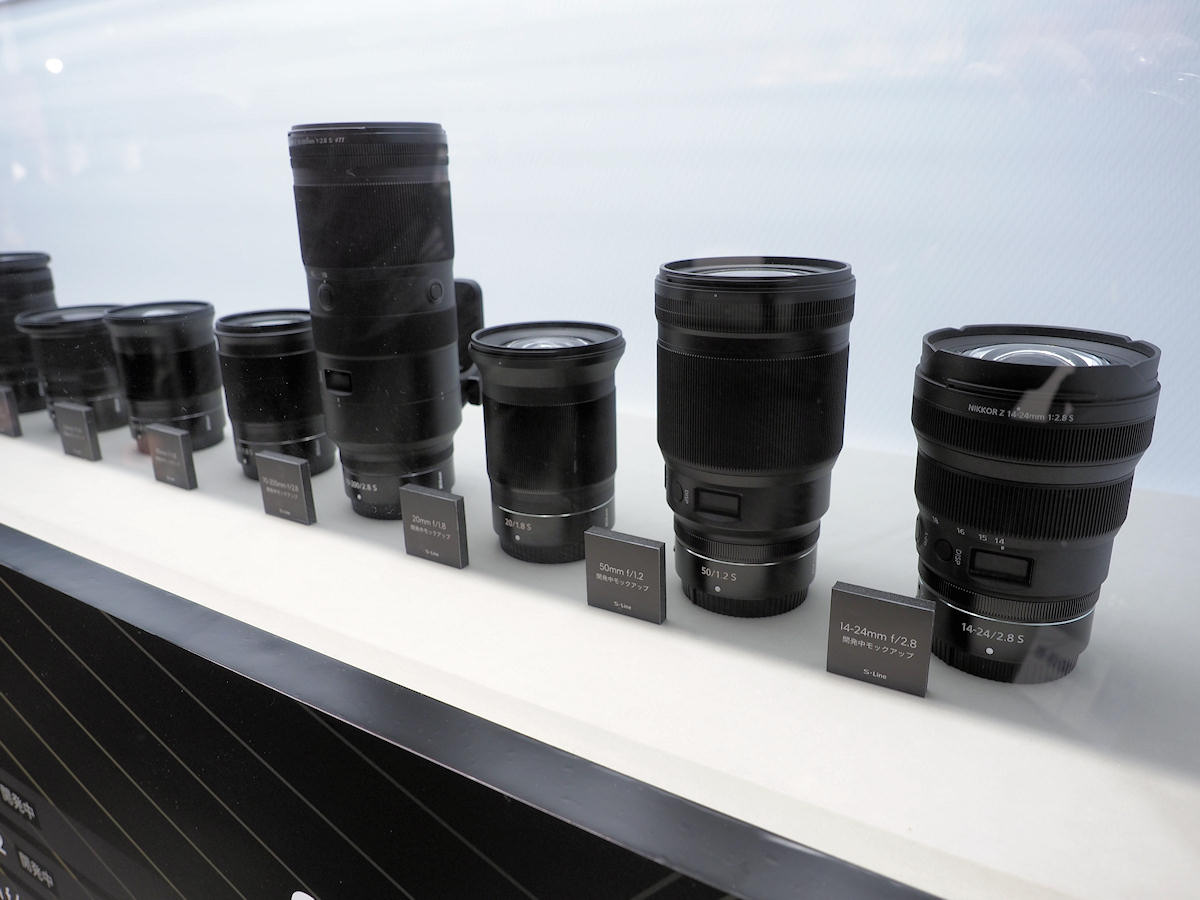
While moving the optical projection closer to the film plane does wonders for the acutance of the projected image ... HMMM, maybe there's a limit / tradeoff regarding the steeper angles involved (without the bulbous design). Optics always seem to be an issue of compromises. While I'm drawn to the 14-30 range, 14mm may not be playing so well to the strong suit of the uber-close flange distance (intrinsically, that is). It may be that the UWA Zone C pays the penalty for the the gains in Zone A & B (angles involved).
That's not to dismiss the value of the lens / software combo for a lot of folks ... but, for some folks it may incur some trade-offs / compromises they aren't very fond of....Show more →
I wonder how you quantify lens performance and tradeoffs without a baseline for comparison.... which UWA zoom lens with a bulbous design do you use or would you use that doesn't have the tradeoffs you're referring to so that you can use that as the basis for comparison to the 14-30 f4? That way when the side by side comparisons are available you can point to the specific trade offs you mention here as compared to that lens. Otherwise, to me it seems like it's a moving target. A tradeoff that still results in better overall performance in the end is a tradeoff I'll take. It's only when it results in worse performance that it matters which means you need some kind of baseline for comparison.
RobCD wrote:
I wonder how you quantify lens performance and tradeoffs without a baseline for comparison.... which UWA zoom lens with a bulbous design do you use or would you use that doesn't have the tradeoffs you're referring to so that you can use that as the basis for comparison to the 14-30 f4? That way when the side by side comparisons are available you can point to the specific trade offs you mention here as compared to that lens. Otherwise, to me it seems like it's a moving target. A tradeoff that still results in better overall performance in the end is a tradeoff I'll take. It's only when it results in worse performance that it matters which means you need some kind of baseline for comparison. ...Show more →
Tradeoff, as I understand it, means that in order to improve aspect A without impairing aspect B, you need to spend more than you would need to spend in order to just improve aspect A without regard for the impact on aspect B. To identify such a tradeoff, you actually do not need a baseline. But you need a baseline, or at least a point of comparison, in order to draw meaningful conclusions from the specific kind of tradeoff at hand.
RobCD wrote:
A tradeoff that still results in better overall performance in the end is a tradeoff I'll take. It's only when it results in worse performance that it matters which means you need some kind of baseline for comparison.
Most folks would take an "overall" positive tradeoff ... unless, that which was negative was perceived as a deal breaker / poison.
As to the comp / baseline ... not a lot of options out there for 14mm zooms to compare with. But, it would be good to know where the gains / losses are (so you can be better prepared to contend with them) ... in order to know if you are going from the frying pan to the fire. By that, it would be a drag to go from the 14-24 / 2.8 (yes, different size) and learn that the 14-30/4 has more distortion or more corner smearing with near FG corners.
RustyBug wrote:
Most folks would take an "overall" positive tradeoff ... unless, that which was negative was perceived as a deal breaker / poison.
As to the comp / baseline ... not a lot of options out there for 14mm zooms to compare with. But, it would be good to know where the gains / losses are (so you can be better prepared to contend with them) ... in order to know if you are going from the frying pan to the fire. By that, it would be a drag to go from the 14-24 / 2.8 (yes, different size) and learn that the 14-30/4 has more distortion or more corner smearing with near FG corners.
Yes, my thoughts as well. I am prepared for some compromises for reasons you've mentioned but I would be a little disappointed to find that the net of the tradeoffs leaves you with a lens that has too many compromises as compared to the lenses filling similar needs like the 14-24 f2.8 or the Tamron 15-30 f2.8.
RobCD wrote:
Yes, my thoughts as well. I am prepared for some compromises for reasons you've mentioned but I would be a little disappointed to find that the net of the tradeoffs leaves you with a lens that has too many compromises as compared to the lenses filling similar needs like the 14-24 f2.8 or the Tamron 15-30 f2.8.
Understood.
For me, I use my UWA's with a fair amount of up close, foreshortening effect ... so the jury will be out for a bit yet for that application. This isn't meant to "run down" the lens, just to recognize where it's strengths are (and are not) before committing that direction. I think many folks just want to know which of it is lens, vs. which of it is software ... just so they know where that frying pan / fire thing is.
(+++) Weight and size
(+++) Takes standard filters, goodbye Wanderpana
(+) Good optically in the corners, comments to the contrary in this thread notwithstanding
(+) Good sunstars (Jimmy McIntyre claims better than the 14-24)
(-) Significant vignetting at 14mm, assuming that pics in this thread are representative
(0-) f/4, may limit a few very specific types of shots
Unless it turns out that all the early access accounts are not representative, the lens is a massive win for me. In fact, the only reason I own a Z6 is because of the early availability of this lens.
(+++) Weight and size
(+++) Takes standard filters, goodbye Wanderpana
(+) Good optically in the corners, comments to the contrary in this thread notwithstanding
(+) Good sunstars (Jimmy McIntyre claims better than the 14-24)
(-) Significant vignetting at 14mm, assuming that pics in this thread are representative
(0-) f/4, may limit a few very specific types of shots
Unless it turns out that all the early access accounts are not representative, the lens is a massive win for me. In fact, the only reason I own a Z6 is because of the early availability of this lens.
I'd score it the roughly the same ... and the relationship to the Z6, as well (but the jury is still out on the lens' natural distortion and natural corner performance).
But, for me, the first two are gravy, not my meat and potatoes.
I figure when Snapsy comes through with his comps, then we'll have good info to evaluate ... and some decisions to make regarding how much it matters / doesn't matter. Till then, we're kinda in suspense waiting for the jury to finish deliberations.
RobCD wrote:
I wonder how you quantify lens performance and tradeoffs without a baseline for comparison.... which UWA zoom lens with a bulbous design do you use or would you use that doesn't have the tradeoffs you're referring to so that you can use that as the basis for comparison to the 14-30 f4? That way when the side by side comparisons are available you can point to the specific trade offs you mention here as compared to that lens. Otherwise, to me it seems like it's a moving target. A tradeoff that still results in better overall performance in the end is a tradeoff I'll take. It's only when it results in worse performance that it matters which means you need some kind of baseline for comparison. ...Show more →
Maybe I am mistaking what is being discussed here, but it's been pretty standard through the release of UWA lenses that corner sharpness, vignetting, ability to take screw-on filters, and weight/size are all in conflicting categories where one has to give for the other to improve. The Nikon 14-24, Tamron 15-30, Canon 11-24, Sigma 8-16, and many others all seem to improve either/or both corner sharpness and corner brightness compared to equivalent UWA (non bulbous) lenses with similar focal lengths and apertures. Without the front bulbous element, lenses have to choose between corner sharpness and corner brightness wide open. The Canon 16-35 L III, super sharp lens, but horrendous vignetting. The All-Mighty Zeiss 15mm? Same corner sharpness but with wicked vignetting.
While the bulbous front element doesn't in itself guarantee both corner sharpness and less vignetting, as is the case of the 14mm Samyang series of primes, it's been pretty well established that no lens (or few?) can offer a compact lightweight design that takes front filters, is sharp in the corners, and doesn't suffer from extreme vignetting over 3 stops on faster lenses wide open.
The 14-30 seems to give up BOTH corner sharpness wide open and corner brightness in making the lens smaller. It could just be that it was designed around software corrections like how some of Sony's lenses are built with intrinsic optical flaws that get swept under the rug by software.
JohanEickmeyer wrote:
like how some of Sony's lenses are built with intrinsic optical flaws that get swept under the rug by software.
Swept under the rug means what - designed differently than you are used to? Either the lens produces or it doesn't. You have the evidence in the pictures taken using those lenses and that would include any flaws. If the "flaws" aren't in the final image then they weren't flaws. From what I've seen most of the latest Sony lenses are at least as good as any Nikon equivalent and arguably better (software corrections and all).
JohanEickmeyer wrote:
The 14-30 seems to give up BOTH corner sharpness wide open and corner brightness in making the lens smaller. It could just be that it was designed around software corrections like how some of Sony's lenses are built with intrinsic optical flaws that get swept under the rug by software.
Comparing wide-angle lenses/zooms for DSLR cameras, i.e. lenses with a retro-focus design, to lenses for ML, i.e. lenses with much shorter flange-to-sensor distance, is technically wrong.
Nevertheless, I've not seen any serious (at least to my standards) test of the 14-30/4 S yet.
We will see.
JohanEickmeyer wrote:
Maybe I am mistaking what is being discussed here, but it's been pretty standard through the release of UWA lenses that corner sharpness, vignetting, ability to take screw-on filters, and weight/size are all in conflicting categories where one has to give for the other to improve. The Nikon 14-24, Tamron 15-30, Canon 11-24, Sigma 8-16, and many others all seem to improve either/or both corner sharpness and corner brightness compared to equivalent UWA (non bulbous) lenses with similar focal lengths and apertures. Without the front bulbous element, lenses have to choose between corner sharpness and corner brightness wide open. The Canon 16-35 L III, super sharp lens, but horrendous vignetting. The All-Mighty Zeiss 15mm? Same corner sharpness but with wicked vignetting.
While the bulbous front element doesn't in itself guarantee both corner sharpness and less vignetting, as is the case of the 14mm Samyang series of primes, it's been pretty well established that no lens (or few?) can offer a compact lightweight design that takes front filters, is sharp in the corners, and doesn't suffer from extreme vignetting over 3 stops on faster lenses wide open.
The 14-30 seems to give up BOTH corner sharpness wide open and corner brightness in making the lens smaller. It could just be that it was designed around software corrections like how some of Sony's lenses are built with intrinsic optical flaws that get swept under the rug by software. ...Show more →
I'd have to agree. The 14-30 is a lens designed to be small, light and diminutive and thus probably has compromises that allow this to be the case. Using software to help correct some of those flaws seems to be the way with many modern lenses manufactured by the camera makers themselves for their cameras, like Sony and now Nikon and probably even Canon if they go the small route. Point and shoots have been doing this sort of thing for years as have camera phones. For many, the small design is a Godsend for travel. Those that what a less compromised standard of lens will probably have to wait for the 14-24 f2.8 version, but that will be bigger, bulkier and heavier. The new 24-70 f2.8S is the less compromised design of the 14-70 f4S but as we can all see, it is bigger, bulkier and heavier. Having just got the 24-70 f2.8S, I can say that it is definitely a step up from the 24-70 f4S but the penalty is size and weight.
For a FF lens in this range the 14-30 has flaws, but when taken into context with it's size and weight, it has excellent IQ.
RobCD wrote:
Swept under the rug means what - designed differently than you are used to? Either the lens produces or it doesn't. You have the evidence in the pictures taken using those lenses and that would include any flaws. If the "flaws" aren't in the final image then they weren't flaws. From what I've seen most of the latest Sony lenses are at least as good as any Nikon equivalent and arguably better (software corrections and all).
Well, it's pretty simple actually. If a lens needs a heavy dose of barrel distortion correction on the wide end, then it needs to stretch the image. Stretching the image in post has some disadvantages to correcting things in the lens itself. Most notably is that you are in essence reducing the size of the effective image sensor area for the image. The full frame level of photon gathering is slightly reduced by the subsequent crop factor of post-correction. Another issue with "permanently" baked in corrections of RAW files, there can be some issues with noise reduction software when it has to be applied after distortion correction. The character of the noise may be stretched and not respond evenly across the frame.
Vignetting correction can also be a real pain, especially when dealing with a scene that is high contrast. If a shadow area at the edge of the frame is already pushed 3+ stops by vignetting correction, then there isn't much dynamic range left over for other edits, even with today's excellent sensors.
I am all for software corrections as long as they are not forced at any point in the production workflow, and not reducing the inherent advantages of the larger sensor.
Lance B wrote:
For a FF lens in this range the 14-30 has flaws, but when taken into context with it's size and weight, it has excellent IQ.
It looks like an otherwise excellent option for a compact UWA zoom, indeed. I think there is just a little disappointment that there isn't any magic sauce that lets this lens be small, sharp in the corners at 14mm, acceptable distortion, and vignette less than 3 stops.
JohanEickmeyer wrote:
It looks like an otherwise excellent option for a compact UWA zoom, indeed. I think there is just a little disappointment that there isn't any magic sauce that lets this lens be small, sharp in the corners at 14mm, acceptable distortion, and vignette less than 3 stops.
JohanEickmeyer wrote:
[
Maybe I am mistaking what is being discussed here, but it's been pretty standard through the release of UWA lenses that corner sharpness, vignetting, ability to take screw-on filters, and weight/size are all in conflicting categories where one has to give for the other to improve. The Nikon 14-24, Tamron 15-30, Canon 11-24, Sigma 8-16, and many others all seem to improve either/or both corner sharpness and corner brightness compared to equivalent UWA (non bulbous) lenses with similar focal lengths and apertures.
I am not aware of any 14mm/2/8 FF lenses for Nikon F mount that are non-bulbous. Extending that further to the Z mount, the images of the 14-24/2.8 Z also appears to be a fairly bulbous front element, possibly with filter threads though it is hard to say for sure. I can't see how you can put ascrew-in filter on that lens and not cause vignetting. Those notches are there for a reason after all