Sonnar-7 wrote:
What with all those 35mm? What is even that focal length?
Have we an idea of the date of the release of the S21, it’s soon, but how soon?
I did say we measured it to be .558 so could it be .6 sure, but after 50 years of using Leica lenses I am pretty sure I understand how to determine the difference between a lens at minimum focus distance of .7 and one of .6 or possibly less, but hey I was simply sharing my experience with my lens.
insideline wrote:
I did say we measured it to be .558 so could it be .6 sure, but after 50 years of using Leica lenses I am pretty sure I understand how to determine the difference between a lens at minimum focus distance of .7 and one of .6 or possibly less, but hey I was simply sharing my experience with my lens.
There may be a mistake in your measurement. Here's a simple way to find the actual MFD using a Leica M camera and an external ruler:
1. Set the lens to its closest focusing distance using the focusing ring.
2. Move the camera until the subject is perfectly in focus.
3. Use a ruler or a laser meter to measure the distance from the subject to the lens mount (the back of the lens).
4. Add 27.8mm (the Leica M flange distance) to get the true MFD.
Since Leica M bodies lack a sensor distance mark, using a ruler offers an alternative way to measure the true MFD. I would expect it to be more than 0.6m, just like my black version, indicating there is nothing particularly different about the Titanium version in this regard.
In the past I've been impressed that LLL has recreated vintage lenses no longer in production that are often hard to find and/or prohibitively expensive.
But to create a top flight Leica lens that's currently in production sort of leaves me feeling the ick.
In the past I've been impressed that LLL has recreated vintage lenses no longer in production that are often hard to find and/or prohibitively expensive.
But to create a top flight Leica lens that's currently in production sort of leaves me feeling the ick.
Perhaps it's not a replica to the Leica's optical design.
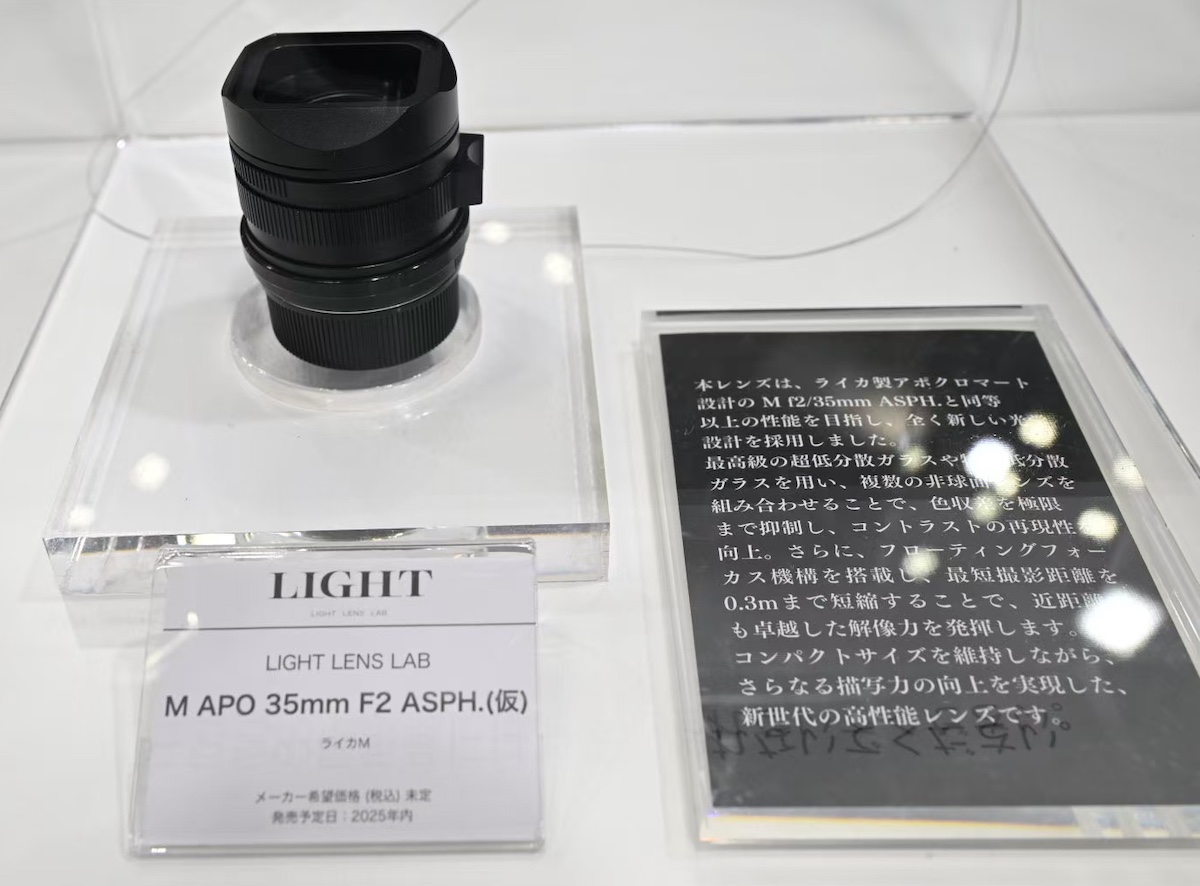
The lens is a Leica-type apochromatic M f/2/35mm ASPH. design and aims for a performance of more than...a completely new design was adopted.
*Design...
The highest quality anomalous dispersion glass, high refractive glass, and multiple aspherical elements.
The combination of these glasses suppresses refractive errors to the utmost limit and improves contrast reproduction.
*In addition, the floating focus...
The lens is equipped with a floating focus mechanism to reduce the minimum focusing distance to a minimum.
*Minimum focusing distance of 0.3m...
The minimum focusing distance has been shortened to 0.3m, which enables the lens to deliver outstanding resolution even when returning the focus.
This is a new generation of dual-performance lens that achieves further improvements in descriptive performance while maintaining its compact size.
Translated with DeepL.com (free version)
I pulled out what characters I could from the photo.
Fred Miranda wrote:
Perhaps it's not a replica to the Leica's optical design.
We don't know about the optical design, but the housing and lens hood design lean to ripoff. Not impressed with this turn of the company, although I did get an Elcan copy that I'm quite happy with.
I think I'll stay away from them until we see what's going on.
Henning wrote:
We don't know about the optical design, but the housing and lens hood design lean to ripoff. Not impressed with this turn of the company, although I did get an Elcan copy that I'm quite happy with.
I think I'll stay away from them until we see what's going on.
It's true that the optical design hasn't been released yet, but Light Lens Lab has stated that it’s a "new" design, meaning it's not a replica of the current Leica 35mm f/2 APO. We should find out soon.
Wouldn't Leica have a patent on the 35mm APO optical formula? The rumor sites are always posting such patents. Hence why LLL would have to make an original optical formula (that they would likewise patent).
It seems that Z21 covers also Hasselblad sensor. Have you considered developing M-to-Hasselblad adapters, too?
I have always wanted the S21 but it is way too rare and expensive piece of glass, so needless to say that I will be ordering Z21 for my M11. But would be cool to use it with my X1D II too
Fred Miranda wrote:
@insideline@, thanks for taking the time to capture and post this picture. Somehow, I missed it earlier.
I agree with @highdesertmesa@ . Given the distance between 0.8m and 0.7m, and assuming the distance to 0.6m is slightly longer on the scale, I’d say the lens is likely focusing a bit longer than 62mm, possibly near the rangefinder’s limit. It’s pretty similar to how my black version performs. Here’s a quick picture I just took:
Out of curiosity, I measured the true minimum focus distance of my Leica 50mm f/1.4 pre-ASPH (v3) black today, factoring in the camera's 27.8mm flange distance. As expected, it's closer than 0.7m, as shown in the picture, measuring exactly 0.628 meters. I believe this is very close to the rangefinder's limit.
My Light Lens Lab ELCAN 50 f/2 is one of my favorite 50mm lenses, but one thing that keeps me from taking it with me sometimes is the aperture ring. No, not the direction it turns, that doesn't actually bother me. It's the "tab" on top.
I had a moment of inspiration yesterday and made a simple 3d-printed part that goes around the aperture ring and adds two side finger grips (like you find on a lot of other lenses). I stuck it on using a custom cut thin strip of 3M 300 LSE tape, and I'm loving it. I took the lens with me on a short walk this morning, and it made me very happy.
I recently picked up one of last LLL Elcans from Popflash in black. I was heading off to Greenland and it being mil spec clone of being useful with gloves and temperature extremes called to me for imaging. Using it I discovered I am quite fond its rendition of scenery. The center sharpness blending off to less sharp sides is how I see the world unaided by optics. These two images show this effect and centering the eye on scenery center with the softness bringing the center forward. Both images were captured off Ilulissat on the west coast of Greenland well above the arctic circle. This place is famous for the Jacobshavn glacier, that calves huge icebergs, one of which was suspected to have collided with the Titanic. The Elcan clone was adapted to a Nikon Z7II.
I have not seen a lot of use of this lens for scenery but it has some potential, back in Arizona I have been using it on the scene out my front door and in the right light I am quite pleased with it. I am going to have to take it on the road again and try some other locale and lighting.