nehemiahphoto wrote:
Photogs are bored and need bokeh is why. Many of us have to glam on to extreme bokeh or other tricks to make our photos feel special or different. Look at how many photos are shot at 1.2 or 1.4 and then what would happen if those photos these photos were taken at f4. Some types of photos (landscape or street for example) are exceptions. Look at most of the photos on FM on IG or where ever—so much crutching on bokeh and shallow DOF. The subjects, photo aesthetic, deeper commentary, processing is lacking IMO.
I also thinks we are seduced by marketing and manufacturing—think of Leica or Thypoch or Zeiss or whoever. Much of their revenue for these high end lenses is built on OOF. Like you said, gone are the days of needing 1.2 lenses because of film limitations and whatnot for much of the time.
Not throwing stones—I love my Noct 50/1 and I really only shoot it WO because that’s where it’s special. But are my photos much meaningful, singular, speaking to larger issues? Nah, I am just a hobbyist photog who likes to shoot photos of my family or hikes and such and needs the OOF to give photos more juice.
What would be very fascinating (and an impossible hypothetical) is if you have everyone a 35mm f4 lens and said go make interesting photos and watch what happens…I think many of us would been quite challenged and disheartened. At least I would be....Show more →
I agree. I also think it's a subconscious counter-reaction to the deep focus look of the gazillions of cellphone photos we consume daily.
pmeheut wrote:
Indeed and my guess is it could have shot the same review with a 1000$ Voigt 1.2 or even a 800$ Voigt 1.5, pretend it was with the Leica Nocti and I wonder if anybody would have been able to tell.
The pictures told me more about him than about the lens.
Perhaps, as Milan's style has huge relevance to the images, but I read his preceding blog reviews, including the LLL 35 Lux AA clone, and those images did not have quite the same 'feel' as the 35 Noctilux. That said, it could also be that his style is evolving fairly rapidly. I was not pulled into the images of his earlier reviews the way I was with some of the 35 Noct images.
The Nocti, to my eyes, has a very uniform background rendering that is not so common with 35mm rangefinder lenses. It's definitely a modern look like the 50 Lux ASPH and to me the background blur suggests the look of longer focal length.
I would hands down pick it over the various 35 Lux ASPH options. But I'm also a 50 Lux ASPH fan. Would love a 28mm with the same background rendering/character.
retrofocus wrote:
Not trying to badmouth this lens and the innovative aspect Leica showed here with this one. But at least from my experience owning both fast lenses like the CV 35/1.2 II and slower ones like the Leica 35/2.0 Vers. IV and the Leica 35/2.4 Summarit-M, my favorite and most often used is actually the slowest of these, the Summarit lens. I wonder why many are hyped about this new lens at faster speed - to get some specific bokeh/blurriness?
Decades ago, lens manufacturers tried to compete with faster lenses at f/1.2 or even 0.95 (in case of the Canon 50/0.95 LTM) to cope with ISO speed limitations of film and being able to take photos in darker environments. Some depth of field is lost, but the photographer could still take a photo by being unable to change ISO to several thousand up to tens of thousands like in modern digital cameras. It is interesting to me, that now that fast aperture is no longer required to get "the" shot, even more faster lenses pop up by all kind of lens manufacturers. Also, lenses have become so good in quality, that stopping down one stop from the maximum wide open one is often no longer needed to get significantly better image quality like in the old days. The bokeh circles of fast f/1.2 lenses will differ in size from some slower f/2.0 lenses for example - but does it really change the context of the photo so much especially at wider than 50 mm focal length? There might be some situations where the answer is yes, but in the majority I believe the effect is not very distinguishable for an outside viewer of the final image. Is this the reason why users are willing to pay so much more over a slower f/1.4 or even f/2.0 lens? ...Show more →
---------------------------------------------
nehemiahphoto wrote:
Photogs are bored and need bokeh is why. Many of us have to glam on to extreme bokeh or other tricks to make our photos feel special or different. Look at how many photos are shot at 1.2 or 1.4 and then what would happen if those photos these photos were taken at f4. Some types of photos (landscape or street for example) are exceptions. Look at most of the photos on FM on IG or where ever—so much crutching on bokeh and shallow DOF. The subjects, photo aesthetic, deeper commentary, processing is lacking IMO.
I also thinks we are seduced by marketing and manufacturing—think of Leica or Thypoch or Zeiss or whoever. Much of their revenue for these high end lenses is built on OOF. Like you said, gone are the days of needing 1.2 lenses because of film limitations and whatnot for much of the time.
Not throwing stones—I love my Noct 50/1 and I really only shoot it WO because that’s where it’s special. But are my photos much meaningful, singular, speaking to larger issues? Nah, I am just a hobbyist photog who likes to shoot photos of my family or hikes and such and needs the OOF to give photos more juice.
What would be very fascinating (and an impossible hypothetical) is if you have everyone a 35mm f4 lens and said go make interesting photos and watch what happens…I think many of us would been quite challenged and disheartened. At least I would be....Show more →
I think this writeup by "elmars" on LUF posted below, might align with my own feelings about the Noctilux allure. Today we not only have yet another fascinating accomplishment by Leica, but also a relative tiny 1.2 achievement as well:
"If Rembrandt had been a photographer: The Noctilux look
Why are Noctilux lenses so fascinating? On the one hand, it is probably because they push the boundaries in many respects: they represent the limits of what is technically feasible; they are the lenses with the highest light intensity; they have the smallest focus area at open aperture; focusing requires great skill and experience. But above all, it is because you can tell when photos have been taken with a Noctilux at open aperture. They have the Noctilux look, which is a mixture of optical performance, minimal depth of field, bokeh and unique vignetting."–By elmars ( LUF)
rscheffler wrote:
I agree. I also think it's a subconscious counter-reaction to the deep focus look of the gazillions of cellphone photos we consume daily.
Perhaps, as Milan's style has huge relevance to the images, but I read his preceding blog reviews, including the LLL 35 Lux AA clone, and those images did not have quite the same 'feel' as the 35 Noctilux. That said, it could also be that his style is evolving fairly rapidly. I was not pulled into the images of his earlier reviews the way I was with some of the 35 Noct images.
The Nocti, to my eyes, has a very uniform background rendering that is not so common with 35mm rangefinder lenses. It's definitely a modern look like the 50 Lux ASPH and to me the background blur suggests the look of longer focal length.
I would hands down pick it over the various 35 Lux ASPH options. But I'm also a 50 Lux ASPH fan. Would love a 28mm with the same background rendering/character. ...Show more →
That's a good way to describe the 35/1.2 Noct "Look". From the first sample images, it immediately struck me as a 50mm f/1.4 Lux ASPH. in 35mm. If you're a fan of the 50/1.4 Lux ASPH., you will likely be drawn to the new 35/1.2 as well. It delivers that modern clean smooth look in the rendering, with very low chromatic aberration and almost no outlining in the bokeh.
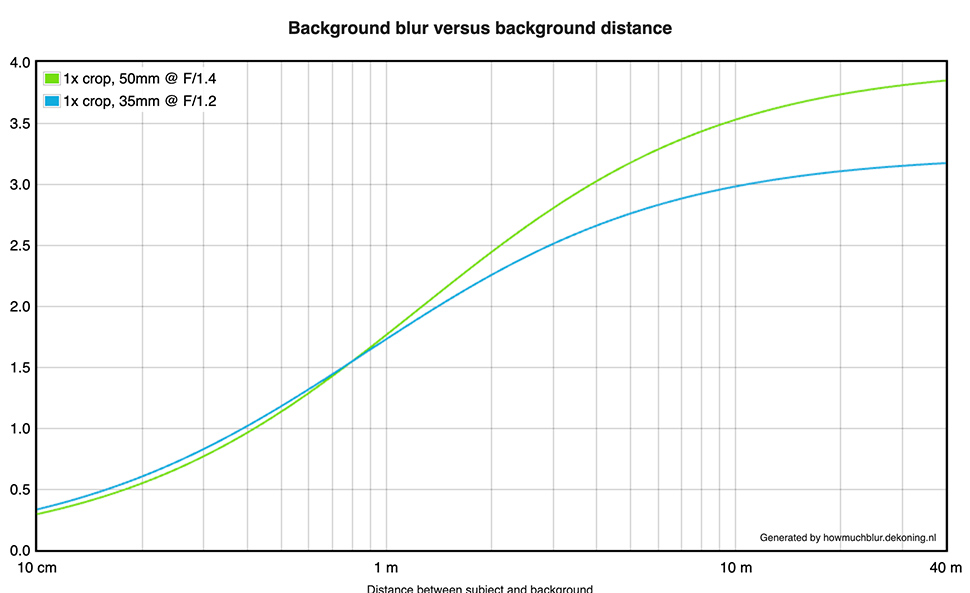
There are a few noticeable differences though. When composing subjects at the same distance with both lenses, the 50/1.4 produces visibly more background blur if the background is farther away, while the blur is about equal when the background is closer to the subject (from 0.7m to about 1.2m). The 35/1.2 also shows stronger axial CA effects, though it still outperforms virtually every other f/1.2 or most f/1.4 lenses on the market.
Leica has surely achieved a remarkable technical achievement here, especially given the size. Having said that, I would like to see this lens versus the 35/1.2 LAB and Sigma 35/1.2. Yes, those lines are auto focus and larger but drastically cheaper. In terms of sheer image qualify and rendering, I wonder how distinct or special this new Noct 35/1.2 really is versus those other two (highly corrected modern 35mm f1.2’s).
Fred Miranda wrote:
That's a good way to describe the 35/1.2 Noct "Look". From the first sample images, it immediately struck me as a 50mm f/1.4 Lux ASPH. in 35mm. If you're a fan of the 50/1.4 Lux ASPH., you will likely be drawn to the new 35/1.2 as well. It delivers that modern clean smooth look in the rendering, with very low chromatic aberration and almost no outlining in the bokeh.
There are a few noticeable differences though. When composing subjects at the same distance with both lenses, the 50/1.4 produces visibly more background blur if the background is farther away, while the blur is about equal when the background is closer to the subject (from 0.7m to about 1.2m). The 35/1.2 also shows stronger axial CA effects, though it still outperforms virtually every other f/1.2 or most f/1.4 lenses on the market. ...Show more →
That's an interesting graph, Fred! I was going to write that based on some of the closer range sample images I've seen, I probably would not have been able to discern if they were 35 or 50mm, viewed in isolation and without prior knowledge.
The 50 Lux, 50/0.95 Noct, 75 Cron AA and 75 Noct (I think) generally share very similar 'look' characteristics with the 35 Noct, making for a range of interesting combinations. That the 35 is f/1.2 keeps the size down and therefore wouldn't be an unreasonable two-lens pairing with the 75 Cron. Question is whether the Cron can keep up with it, technically.
I'm still a bit bothered by the focus ring and aperture ring proximity and lack of focusing tab, but given the girth, a tab would have made it feel even larger. And probably not sit nicely on a surface when mounted on an M camera. I can see it being somewhat of a hybrid system lens at home on traditional Ms, the EV1 and SL bodies as a fast, compact option if one is willing to give up AF.
I kind of feel this lens is aimed at photographers like Steve using both M and SL systems.
Fred Miranda wrote:
Totally fair point, and I agree that cemented groups are in basically every lens today. I'm not saying this 35/1.2 Noct is "bad" because it has so many cemented groups, or that anyone should be worried about it right now.
My only point was that cemented (optical adhesives) elements can be a potential long term failure mode in the far future, like separation, bubbles, haze, or deterioration depending on heat, humidity, and of course time. In normal use it shouldn't be a concern for many decades, but it's still a real possibility. Most companies only offer a 1 to 3 year warranty on their lenses anyway, so they're probably not too concerned about what happens 20 to 30 years from now.
Even if every lens manufacturer does it, physics is physics. Ignoring it isn't wise, and I think it's reasonable to mention it as a "maybe, way down the road" thing rather than pretending it can never happen.
And yeah, I'm with you, this 35/1.2 looks like an instant classic, at least for those who can afford it....Show more →
Fred, the newer acrylic adhesives have great optical clarity and extreme longevity in applications like this - a hundred years or more. I honestly don't think there will be an issue with that.
nehemiahphoto wrote:
Leica has surely achieved a remarkable technical achievement here, especially given the size. Having said that, I would like to see this lens versus the 35/1.2 LAB and Sigma 35/1.2. Yes, those lines are auto focus and larger but drastically cheaper. In terms of sheer image qualify and rendering, I wonder how distinct or special this new Noct 35/1.2 really is versus those other two (highly corrected modern 35mm f1.2’s).
Consider also the Voigtlander Nokton 35mm f/1.2 Aspherical IV, priced much lower and weighs only 300g.
NJPhotographer wrote:
Consider also the Voigtlander Nokton 35mm f/1.2 Aspherical IV, priced much lower and weighs only 300g.
I have owned that version a couple times and I’m very familiar with it. It does not have near the level of correction of this lens. In terms of resolution across the frame, contrast WO or CA correction. And I highly suspect the CV has more optical vignetting and less smoother bokeh. Plus, it’s not well corrected near MFD.
I’m not saying I like this new 35/1.2 Noct better, just that I don’t think they’re playing in the same league in technical terms. I think those other 1.2 lenses will be much closer.
crf59 wrote:
Fred, the newer acrylic adhesives have great optical clarity and extreme longevity in applications like this - a hundred years or more. I honestly don't think there will be an issue with that.
I don't know much about the newer adhesives, but the most commonly used one in the past was balsam, and that caused a headache over time. Still, my only point is that 'ideal' rarely covers every real-world variable ... heat, humidity, UV, mechanical stress, and tiny manufacturing tolerance differences can still create issues over very long periods. I digress; perhaps it's a non-issue, at least for many decades.
nehemiahphoto wrote:
I have owned that version a couple times and I’m very familiar with it. It does not have near the level of correction of this lens. In terms of resolution across the frame, contrast WO or CA correction. And I highly suspect the CV has more optical vignetting and less smoother bokeh. Plus, it’s not well corrected near MFD.
I’m not saying I like this new 35/1.2 Noct better, just that I don’t think they’re playing in the same league in technical terms. I think those other 1.2 lenses will be much closer.
Nehemiah,
Your description of the Nokton is spot-on!
For sure, the Leica is better corrected for color and SA. That floating element also helps maintain good contrast at close distances. The Nokton shows a noticeable onion-ring pattern in specular highlights, which seems absent on the Leica. Technically, the Leica is superior, but I'm not sure that necessarily translates to better images without a side-by-side comparison.
Here's a crop at 50% magnification showing the edges of an image shot with the Voigtlander 35mm f/1.2 Nokton IV (latest version). You can see the degree of optical vignetting, including the cat's-eye shape, as well as the onion-ring pattern. (previous versions had even worse onion ring pattern)
Leica M11: Voigtlander 35mm f/1.2 Nokton IV (50% crop showing edge of the image)
nehemiahphoto wrote:
I have owned that version a couple times and I’m very familiar with it. It does not have near the level of correction of this lens. In terms of resolution across the frame, contrast WO or CA correction. And I highly suspect the CV has more optical vignetting and less smoother bokeh. Plus, it’s not well corrected near MFD.
I’m not saying I like this new 35/1.2 Noct better, just that I don’t think they’re playing in the same league in technical terms. I think those other 1.2 lenses will be much closer.
Likely the Voigtlander is not as good in some ways, but PetaPixel's video review of the new 35/1.2 Noctilux says it "falls apart" in the corners at f/1.2 — "just a soft blurry mess". PetaPixel's reviews of the Sigma and Viltrox 35/1.2's show better corners. Corners may be the least important measure, but that's a bit of harsh reality for such a pricey lens.
NJPhotographer wrote:
Likely the Voigtlander is not as good in some ways, but PetaPixel's video review of the new 35/1.2 Noctilux says it "falls apart" in the corners at f/1.2 — "just a soft blurry mess". PetaPixel's reviews of the Sigma and Viltrox 35/1.2's show better corners. Corners may be the least important measure, but that's a bit of harsh reality for such a pricey lens.
Here are the extreme corners shot wide open with the Voigtlander 35mm f/1.2 Nokton IV, shown in comparison to the 40mm and 50mm f/1.2 Nokton versions. Not sure how the Leica would compare.
NJPhotographer wrote:
Likely the Voigtlander is not as good in some ways, but PetaPixel's video review of the new 35/1.2 Noctilux says it "falls apart" in the corners at f/1.2 — "just a soft blurry mess". PetaPixel's reviews of the Sigma and Viltrox 35/1.2's show better corners. Corners may be the least important measure, but that's a bit of harsh reality for such a pricey lens.
I am with you. That’s my original point—like always, even with cutting edge tech, we can only cheat physics so much I think the Sigma and Lab options will hold or beat the new Noct.
i like the CV 35/1.2 and for a fraction of the price, and for the use cases of a RF 35/1.2 (portrait and lowlight (city, dusk shooting, concerts)) not really sure how much difference the Noct will be…technically we already know the CV is surpassed.
And there is always the ZM 35/1.4 is we are after optical bliss in a m 35/1.4. It has some compromises, but again, in real world photos we’ll see.
I really think that Leica did some wild stuff for a this level of correction and this size and speed. Still not sold on the lens. Then again, how could I be for 10k? 🤣
nehemiahphoto wrote:
I am with you. That’s my original point—like always, even with cutting edge tech, we can only cheat physics so much I think the Sigma and Lab options will hold or beat the new Noct.
i like the CV 35/1.2 and for a fraction of the price, and for the use cases of a RF 35/1.2 (portrait and lowlight (city, dusk shooting, concerts)) not really sure how much difference the Noct will be…technically we already know the CV is surpassed.
And there is always the ZM 35/1.4 is we are after optical bliss in a m 35/1.4. It has some compromises, but again, in real world photos we’ll see.
I really think that Leica did some wild stuff for a this level of correction and this size and speed. Still not sold on the lens. Then again, how could I be for 10k? 🤣...Show more →
I agree.. my CV 35/1.2 and ZM 35/1.4 fill this category for me much the way that the 28, 35, 50mm APO Lanthars might fall short regarding size but are superb lenses. I can see where this new Leica lens is quite the engineering marvel with good/great optics in a small package.
Petapixel? I think you may need a better class of reviewer. Try this salty pom:
..
..
He at least knows hist stuff. Lots of scene-> image shots. Comparisons with the CV 35/1.2 from 4:40. 'It's like a hybrid between a Noctilux and a Summilux.' 100s of images in this one. 'CA, it looks clean as anything' (32:30) vs CV 35/1.2.
philip_pj wrote:
Petapixel? I think you may need a better class of reviewer. Try this salty pom:
..
He at least knows hist stuff. Lots of scene-> image shots. Comparisons with the CV 35/1.2 from 4:40.
Not a thorough comparison there. Jamie compares with the CV 35/1.2 but only in the center, not the corners.
Early reviews are often enthusiastic and uncritical. Forum members here spotted the potential problem with the aperture ring being so close to the focus ring, and yet none of the early reviewers have mentioned it.
It's fun to see what's new, but I'm not buying lenses at this price level.
NJPhotographer wrote:
Early reviews are often enthusiastic and uncritical. Forum members here spotted the potential problem with the aperture ring being so close to the focus ring, and yet none of the early reviewers have mentioned it.
It's also worth remembering that most of these early reviewers are hand selected by Leica. The written reviewers often receive pre production or beta gear directly from Leica, so they are naturally part of that early access circle. Even if they genuinely try to be fair, that kind of close relationship can make it hard to be fully critical, at least publicly.
And realistically, if someone is consistently harsh or overly critical, it's hard to imagine they will keep getting early gear the next time around.
NJPhotographer wrote:
Not a thorough comparison there. Jamie compares with the CV 35/1.2 but only in the center, not the corners.
Early reviews are often enthusiastic and uncritical. Forum members here spotted the potential problem with the aperture ring being so close to the focus ring, and yet none of the early reviewers have mentioned it.
It's fun to see what's new, but I'm not buying lenses at this price level.
"However, the compact length also has disadvantages. The aperture ring and the distance setting are very close together. When set to infinity, they are only one millimeter apart. This can easily lead to confusion. It takes some practice not to confuse the two rings when taking pictures."