fredmiranda.com
Login

Moderated by: Fred Miranda
Username  

  New fredmiranda.com Mobile Site
  New Feature: SMS Notification alert
  New Feature: Buy & Sell Watchlist
  

FM Forums | Lighting & Studio Techniques | Join Upload & Sell


Tabletop photogs, what LED lights would you recommend?


gregfountain
Offline
• • • • •
Upload & Sell: On
p.1 #1 · Tabletop photogs, what LED lights would you recommend?


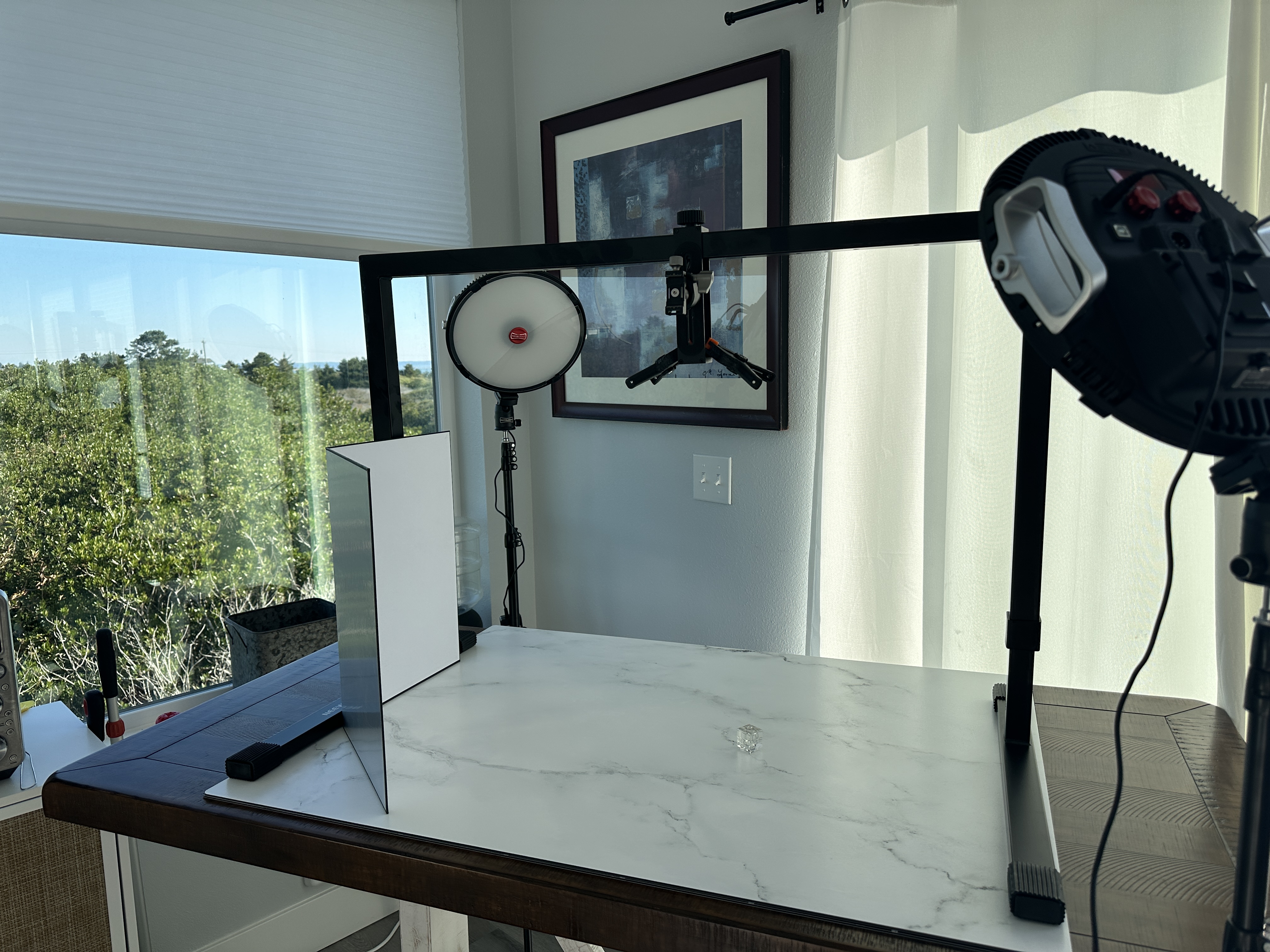
I have a pair of Rotolight AEOS that are pretty nice but don't put out the strongest light. I'd like to get a pair of something that can easily light the setup I have (shown) for some food and other projects without having to go to my 600ws strobes. Any recommendations?

Thanks,

Greg


Oct 07, 2025 at 12:51 PM
JBPhotog
Offline
• • •
Upload & Sell: Off
p.1 #2 · Tabletop photogs, what LED lights would you recommend?


I'd suggest you look for lights that have a mount Bowens mount so you can add modifiers such as soft boxes or metal reflectors.

Budget but still very good options would be the Godox line. Check your CRI and lumens of your existing lights for a comparison.


Oct 07, 2025 at 01:32 PM
jlafferty
Offline
• • •
Upload & Sell: Off
p.1 #3 · Tabletop photogs, what LED lights would you recommend?


Agreed on the Bowens mount monolight style. The two best inexpensive brands currently are GVM, and Godox Litemons line. I have no experience with the Litemons, but I've got a good bit with the GVM Pro line (red body accents) - they're fantastic.


Oct 07, 2025 at 06:10 PM
gregfountain
Offline
• • • • •
Upload & Sell: On
p.1 #4 · Tabletop photogs, what LED lights would you recommend?


Thanks guys, I'll take a look. I have a couple of the Flashpoint 600ws strobes, but my modifiers are too big for the space I'm using.


Oct 07, 2025 at 06:20 PM
JBPhotog
Offline
• • •
Upload & Sell: Off
p.1 #5 · Tabletop photogs, what LED lights would you recommend?


Get yourself a scrim with diffusion say a 4x4, a stand, grip head and arm. One LED with a metal reflector pumped through a scrim creates nice soft light. Or if you prefer side lighting, a roll of diffusion hung to the side with a light behind it is a good source of natural window light effect.


Oct 07, 2025 at 07:05 PM
CharleyL
Offline
• • •
Upload & Sell: Off
p.1 #6 · Tabletop photogs, what LED lights would you recommend?


For how to set up for table top shots, you will find many good videos on Youtube. I watch the channel "Camera Club Live" for new tips and ideas of lighting that I haven't tried yet. You don't need the expensive gear that he has. You can even start with a couple of speedlites on stands. It can be done well using just Godox lights and a camera that can be manually adjusted, and preferably one that can change lenses is all that is necessary. Most of my shots are done with a 24-70 lens and I use either one of my Canon 77D or my 90D camera for these shots. When you get deeper into this type of shooting, a 3 axes micro adjust tripod head and a very stable tripod with a crank-up center column will help. He demonstrates the use of diffusion material and small matte board or foam core reflectors that can be made to fit the project and cost very little. I like his teaching method, because he shows you a finished shot, then takes you step by step through the setup to achieve that shot.

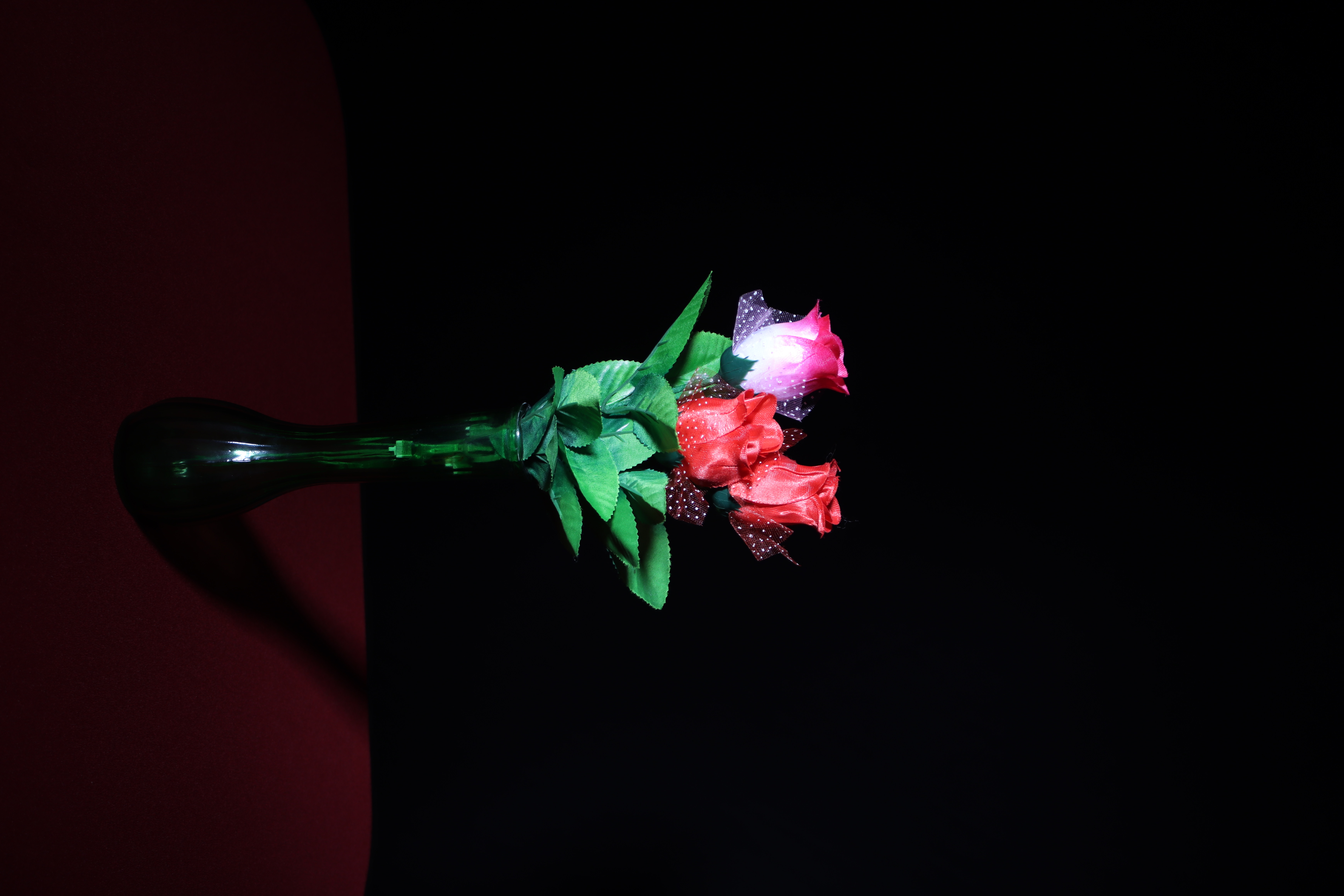
Though I have been a photographer since the early 1950's, I have not done much table top shooting, so I'm learning a lot from him. He puts out a new video every Wednesday afternoon, well at least for me since I live on the East Coast of the USA. The photo attached is one that I have done recently.

Charley


Oct 08, 2025 at 09:25 AM
jeffbuzz
Offline
• • • •
Upload & Sell: On
p.1 #7 · Tabletop photogs, what LED lights would you recommend?


gregfountain wrote:
Thanks guys, I'll take a look. I have a couple of the Flashpoint 600ws strobes, but my modifiers are too big for the space I'm using.


Godox makes double diffused 60x60cm Bowens mount softboxes that look like they'd easily fit in the space you're using. I use mine for small subjects all the time.

Do you need continuous lighting for video? Or do you just want brighter modelling light? Godox MS200-V strobes have LED modelling lights that are cool enough to use with normal strobe modifiers. They yield plenty of light for focusing and judging shadows.


Oct 08, 2025 at 11:41 AM


Search in Used Dept. 

CharleyL
Offline
• • •
Upload & Sell: Off
p.1 #8 · Tabletop photogs, what LED lights would you recommend?


My photo above was lit using a Godox SK400 II light with a 7" reflector and 10 degree grid to narrow down the flash to only light the flowers with a bit of light spilling onto the vase and table, just enough to give perspective of where the flowers are. This light was located about 5' from the flowers and camera left. I used a Canon 24-70 lens. The ceiling "work light", located almost directly above on the 8' studio ceiling was left On during the shot, but I adjusted the F-Stop setting on the Canon 77D camera high enough so as to remove this light from having any effect on the shot. If I remember correctly, it was F-8 and this gave me an adequate depth of focus too.

I have a wireless switch for the work light at the camera stand, so I can turn the work light Off when I need a lower F-Stop setting for the shot so I don't need to move around in the dark. I usually start a shoot at F-8 and work up or down from there based on my "Test Shots" without flash, which tells me if the work light or other lights are affecting the shot at this setting or not. Then I'll adjust and try again. When there is no visible light in the test shots without the flash, I then turn On the flash and begin my photo shoot without the work light or other lights affecting the shot. I then have total control of the light for the shot and I can get results like this. So, the F-stop setting does more than adjust the depth of focus, if it is used correctly when doing studio photo shoots. It's game changing when used like this, but it's a balance between the constant light and the depth of focus and somewhere in the middle solves both needs for shots like this. Having the house light switch at the camera position is mostly for safety, when there is a need for a sharper depth of focus and the house light is affecting the lighting needed for the shot. So I can switch off the work light, take the shot, and then switch the work light back on without needing to move around to reach the switch in the dark. Of course, modeling lights can be used in a work light function, but I find that this works better for me. I've never found that the Godox control of the modeling lights from the camera transmitter to suit me. It's better with the X Pro II, but still lacking a bit to suite me. I think I'll be sticking with my method as it works well for me.

Though I have and use several sized soft boxes, I frequently light my table fully for still life shoots using a Godox MS300 and a Godox 34" square soft box pointed directly down on the table from above. The MS300 is shorter than the SK series, so it fits closer to my 8' studio ceiling. Not much light is needed, so the MS300 has more than enough power, and a speedlite could likely be used in this position along with the soft box. The light from this soft box is quite even across the full table, with a very minimum of shadows that I can usually minimize or eliminate entirely using additional light at more traditional lighting angles, frequently to camera left and camera right. These may have small 14" square soft boxes on them, or 7" reflectors, probably with a diffusion material between them and the subject. The roses in vase shot above used only the one SK400 II light with reflector and a 10 degree grid (honeycomb). This makes heavy use of the inverse square law to control the light levels at the various parts of the shot.

Charley


Oct 09, 2025 at 11:34 AM
CharleyL
Offline
• • •
Upload & Sell: Off
p.1 #9 · Tabletop photogs, what LED lights would you recommend?


@jeffbuzz,

I don't have much experience using LED modeling lights, but I have occasionally needed to make short video commercials of health food products on an 8' long banquet table with 1-2 people sitting or standing around it, and products being displayed at both ends of the table. For this, and to achieve adequate light to acheve a relatively shadow TV Newsroom kind of lighting, I ended up mounting eight (soon to be ten) GVM 480 LS LED light panels spaced about 2' apart and in a kind-of wide leg "U" shape on a ceiling mounted DIY lighting support grid. I'll be adding onto the ends of the "U" for more lighted depth behind the subject. I kept adding light panels until I got the result that I wanted. LED panels have many points of light, so don't really require soft boxes. Again, they are up against the 8' ceiling, so I can do portraits, still life, etc. below, without the need to remove these light panels. This saves significant switching time when other types of photography is desired. I used wireless power control modules for every light and kind of light, so I can power on and off each kind of light from a 5 function wireless control at the camera position. I have two 6' 6" tall camera stands, one for my still camera and one for my video camera and each has wireless control transmitters for this, one button pair for LED panels, one for strobes, one for each of two 500 watt focusing spot lights (old school) that I picked up used. These produce a focused round spot about 7' in diameter on a backdrop that's pleated, much like a theater curtain. The shots taken appear to be on a stage in a theater using these.
My six backdrops are on motorized rollers, with a wireless transmitter at each camera to raise and lower each 10' wide backdrop separately. The fifth button pair has several uses. They sometimes control 6 UV LED light panels (for Halloween) which are also mounted on the ceiling lighting support system, or I sometimes use some LED light strips, that are usually oriented vertically and mounted on light stands, but are hinged in their middle to allow other orientations. I manually switch these from one use to the other by manually turning off the lights in each group group at their respective locations in order to use these group power control light buttons on the transmitters for the other purpose.
The remote power control modules and their transmitters came from Amazon and are easy to reprogram to work in groups or separately from each button pair. Five control modules and two 5 button pair transmitters come in each box and initially they each are programmed from different button pairs. Reprogramming is easy, so any number of control modules in a group can be controlled from any button pair that you wish, and without needing tools. They are amazingly versatile. I also use 14 of these modules and one transmitter in my home to turn on and off the candles that we place in the windows on the front side of the house. With just one button pair I can turn all of the window candles on and off. Another button pair is used for controlling power to the Christmas Tree, and sometimes a third button pair controls power to a miniature town snow scene near the front door. Up to 8 transmitters can be programmed to operate different groups, or different combinations of the group lights. Each module can power on and off up to 10 amps of resistive load, so just about anything, even small motor loads, and especially LED lights can be handled by these. Sorry, these are only available for 120 volt 60 Hz USA power, but they may be available for 220-240 volt 50 Hz AC power in other countries.

https://www.amazon.com/dp/B01N23GRYD/ref=sspa_dk_hqp_detail_aax_0?psc=1&sp_csd=d2lkZ2V0TmFtZT1zcF9ocXBfc2hhcmVk

I now have 8 sets of these. They are mostly used in my photo studio, but some have ended up being used at Christmas and holidays in the house too.

Charley


Oct 09, 2025 at 03:27 PM
gregfountain
Offline
• • • • •
Upload & Sell: On
p.1 #10 · Tabletop photogs, what LED lights would you recommend?


Thanks for the suggestions and tip folks. Much appreciated.

After exploring your recommendations, I've decided to just get a couple of 24" square softboxes to go with my Xplor 600ws monolights, and set up at the kitchen island, instead of the dining table, so I have room for the c-stands that I can use to get the lights situated where I need them with the boom arms. The softboxes I have are 48" hexagon and are just too big for the space. The mono's I have use an LED lamp as a modeling light to help me check for shadows, and I'll use my light meter to dial in the output of the strobes.

I think i was expecting some super economical LED light source could do what I want, but those units are basically the same size as the monolights I currently have, so going to smaller softboxes seems the right choice.

Thanks again!
Greg


Oct 13, 2025 at 09:39 AM
tcphoto
Offline
• • •
Upload & Sell: Off
p.1 #11 · Tabletop photogs, what LED lights would you recommend?


A Kino Flo Diva 201 kit worked well for me, they are a steal used and were Movie and TV Industry favorites. They are florescent tubes that are daylight and tungsten balanced and can be swapped out to fit your purpose.


Nov 17, 2025 at 10:08 AM
jlafferty
Offline
• • •
Upload & Sell: Off
p.1 #12 · Tabletop photogs, what LED lights would you recommend?


Whoa, check out these new 400w units from GVM - pack small, but work like a COB monolight - TLCI 99!

https://timurcivan.com/2025/10/an-examination-of-gvm-fh400b-flathead-400w-bi-color-led/

Pricey, but they look amazing.


Dec 01, 2025 at 10:56 PM
CharleyL
Offline
• • •
Upload & Sell: Off
p.1 #13 · Tabletop photogs, what LED lights would you recommend?


For good light control, you need to completely eliminate all other light sources from affecting your shots, and just depend solely on your added photo lights. Then you can adjust and position each light one-at-a-time, to get the desired result. Take "Test Shots" as needed to assure that you are getting what you want from each light, and repeat, if the result isn't exactly what you are expecting. Do this for each light used and when all lights have been adjusted for position and levels, then turn on all of the lights for the final shots.

I hate working in a totally black room, because it can be dangerous to try to move around in total darkness. So I do leave a "work light" (my room ceiling light) on for most of my photo shoots. To keep it from affecting the shoot, I adjust the F-Stop setting up until a "Test Shot" with just that ceiling light on produces a completely black frame, or at least nearly so except for maybe a small reflection of the light off of a shiny object in the shot. In my experience, this F-Stop setting for my studio and ceiling light is F-8, but I run this test before beginning any photo shoot. If the shoot requires a lower F-Stop setting, because of other reasons then, and only then, will I work in total darkness at the required lower F-Stop setting. But I have added wireless control of my studio ceiling "Work Light" and now have control of this light from wireless switches attached to my camera stands. Even if I'm not using a camera stand for the shots, one is always within easy reach of where I am using the camera.

For the roses shot above, my ceiling work light was located almost straight above the vase of roses, and it was "On" during the shots, but I had raised the F-Stop setting on the camera to eliminate this lower level light from having any effect on the shot, leaving only the studio strobe to illuminate the roses. To get great shots, you need full control of your lighting, and you can't do it with other sources of light affecting the shots.

Your table setup is allowing room light and Sunlight along with your photo lighting into your photo shoot . You can't possibly control your lighting this way. The room lights don't change, but the Sun is moving across the sky and will make it impossible to control the settings of any of your photo lighting. It's like chasing a rainbow to find the source.

Charley


Dec 03, 2025 at 09:51 AM


FM Forums | Lighting & Studio Techniques | Join Upload & Sell


You are not logged in. Login or Register