RoamingScott wrote:
It's not like you can retroactively process a file for HDR. That's a decision that must be made at the time of capture (though this currently feels like a software oversight, but I get that metering is a bit different because the histogram is different).
You could with bracketed images. If you do a merge to HDR in Lightroom, for instance, which creates an image that is basically a higher bit depth image with more highlight and shadow headroom in the file...it just appears as greater dynamic range in the file. Instead of editing to bring those parts into the SDR space (0-255), you could have the file run 0-1024 per channel, for instance, with 10 bit per channel, and have those areas that would be clipped unless brought up or down, now fit into the wider space and allow the brighter portions to just move into the HDR brightness level.
RoamingScott wrote:
It's not like you can retroactively process a file for HDR. That's a decision that must be made at the time of capture (though this currently feels like a software oversight, but I get that metering is a bit different because the histogram is different).
That's not really true. If you're shooting in raw you are already, potentially, capturing an image that could be processed for display HDR. Of course if the scene is low contrast then there would be limited benefit. But if your scene is filling your camera's histogram (which is typically an 8 bit histogram based on jpeg) then your single raw capture can be processed for HDR whether you had that in mind when you took the image or not.
bwcolor wrote:
Not sure what you are saying here, because I don’t understand the “tricky” part. Simply put, HDR is more capable of depicting, on an HDR monitor, what the eyes are capable of seeing. The adaptive nature of the human visual system makes human vision an ultra-HDR capable sensory system. I’ve spent so many years editing for the print that HDR can seem unnatural, but I think this is a bias given that every day vision is HDR.
The "tricky part" — which I've been trying to avoid getting into here — is about how the human vision system handles scenes with very high dynamic range. For example, consider a scene with the setting sun (bright!) and the shadows behind some objects in front of the camera position (very dark!).
The way our eyes/brains deal with things like that is by instantly (well, maybe a half second or so) adjusting our pupils to the part o the scene we are looking at. If you pay very close attention to your own vision you can see this happen.
Photographs have (necessarily) dealt with this in a very different way, and pretty successfully. That's why we dodge (or use curves, etc.) shadows to bring up some shadow detail, and why we burn (or, again, use curves, etc.) to control the brightest parts of the image. Having done that we can look at the photograph and see details in all of those places without really having to do that instant adjustment thing. (At least not anywhere near as much.)
this is basically true of just about every kind of image that we look at: billboards, movies, magazines, television, photographic prints. They are designed so that we can take in the full range of luminosity of the image, and any elements that were originally too bright or too dark are adjusted to make that work.
I actually cannot think of any common form of visual media presentation where that isn't the case. Even stage lighting is usually designed more or less that way.
Make sense?
- - -
WillR wrote:
If you're shooting in raw you are already, potentially, capturing an image that could be processed for display HDR. Of course if the scene is low contrast then there would be limited benefit. But if your scene is filling your camera's histogram (which is typically an 8 bit histogram based on jpeg) then your single raw capture can be processed for HDR whether you had that in mind when you took the image or not.
-Will
This is correct. Modern cameras' raw files can have a large enough dynamic range that you can expand it using this HDR mode. (That likely won't take full advantage of what you can do with the software's HDR capabilities when it comes to images that are merged from multiple exposures.)
Foks should give it a try before saying too much about what it can or cannot do.
WillR wrote:
That's not really true. If you're shooting in raw you are already, potentially, capturing an image that could be processed for display HDR.
-Will
My point is the simple RAW file is missing the gain map sidecar bit of data. Maybe you can emulate that to a degree, but you can't replace the missing data.
Also, for the others, AGAIN, we are not talking about multiple exposure HDR. I know it's hard to wrap your head around, but please do try.
chiron wrote:
Can anyone provide some examples of what they think are well-processed HDR images intended for HDR display, which my Macbook can do (at 1600 nits)?
Watch a modern movie on your Macbook…Dune 1 & 2 to name a couple. Those are extremely well processed HDR motion pictures intended for HDR displays.
ilkka_nissila wrote:
A display that is efficient can be used in SDR mode and, e.g., be calibrated so that it will not display more than 120 nits in any part of the image, which will, on the same display, likely consume less power than if is used to display a HDR image with highlights at 1000-1500 nits, for example.
Well its a math question right.
The SDR at 120 nits needs is backlight to produce 120/(1-.83) = 705 nits on the entire screen all the time.
the HDR display only makes those 1500 nits on a 10% window (it cant do it for the entire screen) so we have:
1500 * .1 + 120 * .9 = 270 nits. This is the calculation for the worst case, where the entire screen is white.
The SDR display is still less efficient, about 2.6x less efficient in the worst case. In the best case for the HDR display (black image) the SDR would be consuming 1000x more power
RoamingScott wrote:
It's not like you can retroactively process a file for HDR. That's a decision that must be made at the time of capture (though this currently feels like a software oversight, but I get that metering is a bit different because the histogram is different).
This is incorrect. You just shoot your raw file and don't clip your highlights the same as always. The main difference is that the raw processor needs to be HDR aware, and you need to export to jpegXL (.jxl) not .jpeg.
The SDR at 120 nits needs is backlight to produce 120/(1-.83) = 705 nits on the entire screen all the time.
the HDR display only makes those 1500 nits on a 10% window (it cant do it for the entire screen) so we have:
1500 * .1 + 120 * .9 = 270 nits. This is the calculation for the worst case, where the entire screen is white.
The SDR display is still less efficient, about 2.6x less efficient in the worst case. In the best case for the HDR display (black image) the SDR would be consuming 1000x more power ...Show more →
No, my point is that if you use the same physical display to render an SDR image at max 120 nits vs. 1500 nits, the latter will consume more power, and since it's not strictly necessary, a lot of people doing this will contribute to the total electricity consumption of the world and consume its resources faster than are returned to the natural state or renewed.
Over time the older technology displays will be phased out and recycled. More efficient, newer technology will take their place. Personally I think we should take the efficiency gains to reduce total consumption rather than make displays brighter. I have an OLED TV which allows one to select less energy-consuming settings. My laptop's OLED screen has been calibrated to max 120 nits. My desktop screen is calibrated to 90 nits actually, since I use it to make prints, so optimal print matching is a priority for that. I'm not even considering generation of files for "HDR" display as far as still photography is concerned, but for video, this is something I may experiment with.
RoamingScott wrote:
My point is the simple RAW file is missing the gain map sidecar bit of data. Maybe you can emulate that to a degree, but you can't replace the missing data.
If you were capturing the image in jpeg, your statement would be correct. A gain map is used in some jpeg formats, and maybe some other output formats, to allow one file to be displayed on both SDR and HDR monitors. A jpeg is only 8 bits. The gain map is additional information that sort of provides the extra bits needed to show a higher range on monitors that can handle it.
A raw file however already has the extra bits. Many are 14 bit, some are more. It doesn’t need a gain map. It does however need raw decoding to see. That’s what Lightroom is doing in HDR mode.
The tldr is that gain maps are for output formats, capture formats like raw don’t use them
darbo wrote:
Watch a modern movie on your Macbook…Dune 1 & 2 to name a couple. Those are extremely well processed HDR motion pictures intended for HDR displays.
Thank you, but I was talking about still images. I never shoot video except on my iPhone. If HDR diplay is mainly for video, it is irrelevant for me.
Jman13 wrote:
I have zero desire to create actual HDR image files for HDR displays, because I don't really shoot for impact on displays. Yes, I view my files on screen, and share online and such, but ultimately, my goal for my top images is print, and that will never be HDR. As such, while I will occasionally bracket for HDR tonemapping (though I generally do it to process naturally to compensate for a limited dynamic range scenario), I don't think I'll ever bother processing a file for an HDR output display.
I also think it is less effective for a still frame than for video anyway, as dynamic HDR on video works because you get the impact of bright sources, but doing so on a still image I feel would simply feel too bright and overwhelming for things like the sun in a static image. ...Show more →
I have always made one edit for SDR and another edit for print.
In the near future we will all only have HDR displays, then the workflow changes to make one edit for HDR and another for print.
Yes the print is not going to look as good next to the HDR presentation. This is nothing new though, prints from film negatives never looked as good as a positive slide through a projector, and the projector never looked as good as looking at the slide with a lightbox and loupe
The next generation wont even call them "HDR" displays anymore, they will just be... "normal" displays to them
sRGB and SDR were born out of display hardware limitations after all. A decade ago, monitors that were capable of 100% sRGB were uncommon.
Anyone with a Mac from about 2021 or later is already viewing images on HDR at 1600 nits.
The important question is whether the image has been edited for HDR qualities, how well it has been edited, and whether the image has gotten better or worse.
In the Develop Module of Lightroom Classic, there is an HDR box that one can check. If one checks this box, then LRC switches into HDR editing mode, which means it allows you to work with brightness values above SDR white (above approximately 100 nits). The HDR Highlight slider becomes available which will let you push highlights into the HDR range (e.g., 400–1000+ nits). And no tone‑mapping is applied. I assume that other post-processing apps have something similar.
I think from what I have seen so far that what people are calling HDR images are that some push the sliders so that the whites and highlights become glaringly bright and pull the eye to odd places in the picture. I have never seen an image edited that way that I thought did not destroy the image. Essentially they edit their image for extreme highlight effects because they can now go over SDR white. I think this editing destroys the images where I have seen it used.
I'm sure it must be possible, if one is primarily interested in screen display rather than prints, to edit in HDR more effectively. I just haven't seen it done. I would genuinely love to see some properly edited HDR images. This is the third time I have asked and no one has produced one without the superbright and distracting highlights that ruin rather than enhance the image.
I don't understand. If the monitor can display high dynamic range, then you would NOT have to process the image as "HDR" to actually fit the possible range of the monitor. No?
The examples earlier in the thread should only look even worse on a screen with a larger DR, if I'm not mistaken.
Makten wrote:
I don't understand. If the monitor can display high dynamic range, then you would NOT have to process the image as "HDR" to actually fit the possible range of the monitor. No?
The examples earlier in the thread should only look even worse on a screen with a larger DR, if I'm not mistaken.
There is insufficient nomenclature to describe what we are talking about properly, hence the confusion.
There are now two completely separate image processing workflows that photographers both call “HDR.”
The first workflow, which I will call “Fake HDR,” attempts to compress more high-brightness detail into the limited 8-bit JPEG range of 0–255. This is often done using some form of image stacking. The final output is still an 8-bit .jpeg file in the standard sRGB color space, and editing is performed on a monitor calibrated to sRGB.
The second workflow, which I will call “Real HDR,” involves editing the image on an HDR-capable display and exporting to a 16-bit .jxl file. The output color space is typically BT.2020, although Display P3, Adobe RGB, or ProPhoto RGB are also supported by .jxl.
All of these are significantly larger color spaces than sRGB. For this reason “Real HDR” simultaneously displays more stops of light, AND also expands the color gamut considerably
If you display an “Fake HDR” image on a “Real HDR” capable monitor, it simply does not utilize the full range of the display.
You are right that if the monitor can display “Real HDR”, then you would not need to process the image as “Fake HDR” just to fit within display limits. But you still need to process the image as “Real HDR” so the monitor knows how to interpret and display that extended range.
aCuria wrote:
There is insufficient nomenclature to describe what we are talking about properly, hence the confusion.
There are now two completely separate image processing workflows that photographers both call “HDR.”
The first workflow, which I will call “Fake HDR,” attempts to compress more high-brightness detail into the limited 8-bit JPEG range of 0–255. This is often done using some form of image stacking. The final output is still an 8-bit .jpg file in the standard sRGB color space, and editing is performed on a monitor calibrated to sRGB.
The second workflow, which I will call “Real HDR,” involves editing the image on an HDR-capable display and exporting to a 16-bit .jxl file. The output color space is typically BT.2020, although Display P3, Adobe RGB, or ProPhoto RGB are also supported by .jxl.
All of these are significantly larger color spaces than sRGB. For this reason “Real HDR” simultaneously displays more stops of light, AND also expands the color gamut considerably
If you display an “Fake HDR” image on a “Real HDR” capable monitor, it simply does not utilize the full range of the display.
You are right that if the monitor can display “Real HDR”, then you would not need to process the image as “Fake HDR” just to fit within display limits. But you still need to process the image as “Real HDR” so the monitor knows how to interpret and display that extended range....Show more →
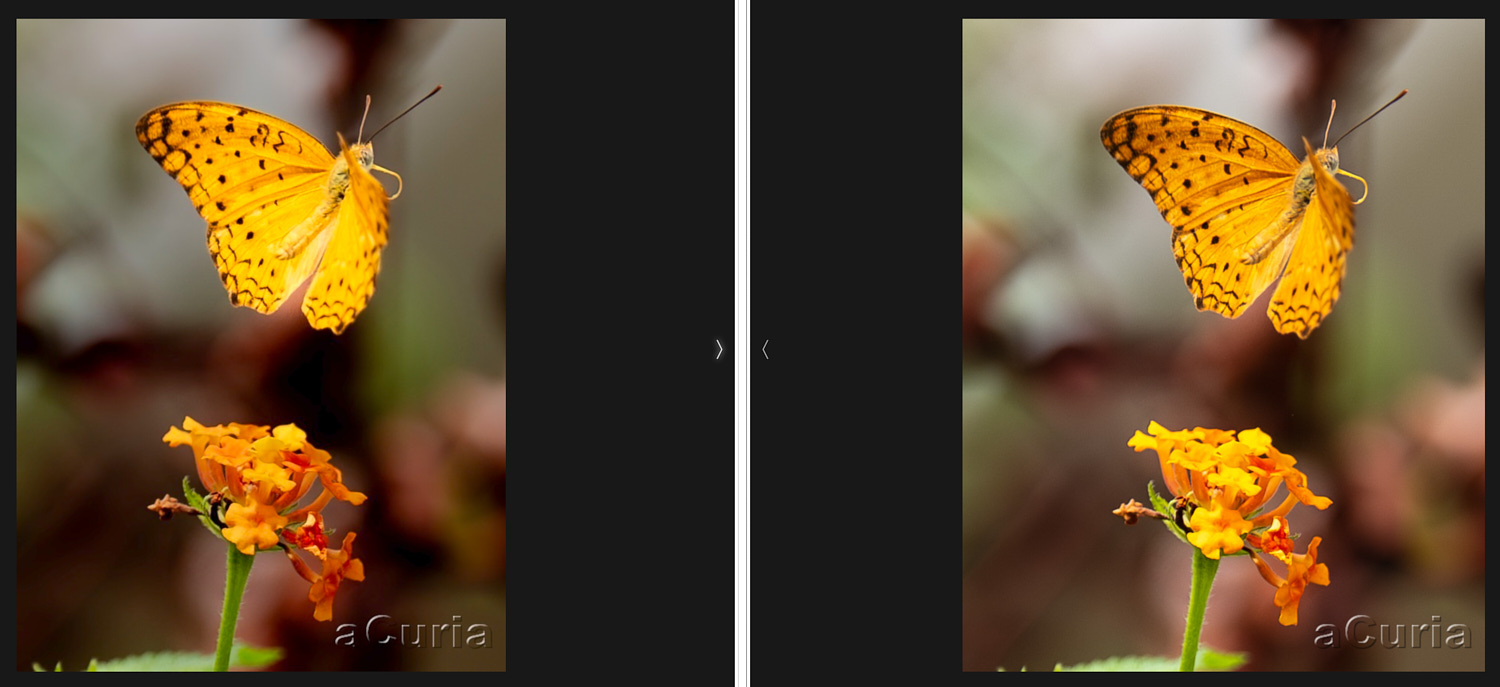
So you mean the left image is HDR, not the right one? That would make some sense...
Makten wrote:
So you mean the left image is HDR, not the right one? That would make some sense...
Yes, the original version of the left image is HDR, but to be clear to everyone when Makten took this screen shot, the screen shot itself is a SDR image.
aCuria wrote:
Yes, the original version of the left image is HDR, but to be clear to everyone when Makten took this screen shot, the screen shot itself is a SDR image.
I don't have a HDR capable monitor, but I clearly see what you mean, and that was sort of what I also meant. The image intended to be shown on a HDR monitor will have higher contrast, because the blacks won't be blocked and the whites won't be blown if the screen has a larger DR.
FYI there is no "HDR" logo on the images once they are enlarged, which is a bit confusing.
Edit: BTW, I wouldn't even consider viewing images on my phone. My iMac 27" is from 2019 though, so no HDR (that I know of at least). I have it set to sRGB anyway because otherwise everything except images with large gamut will look like crap. Not worth it.




 My iMac 27" is from 2019 though, so no HDR (that I know of at least). I have it set to sRGB anyway because otherwise everything except images with large gamut will look like crap. Not worth it.