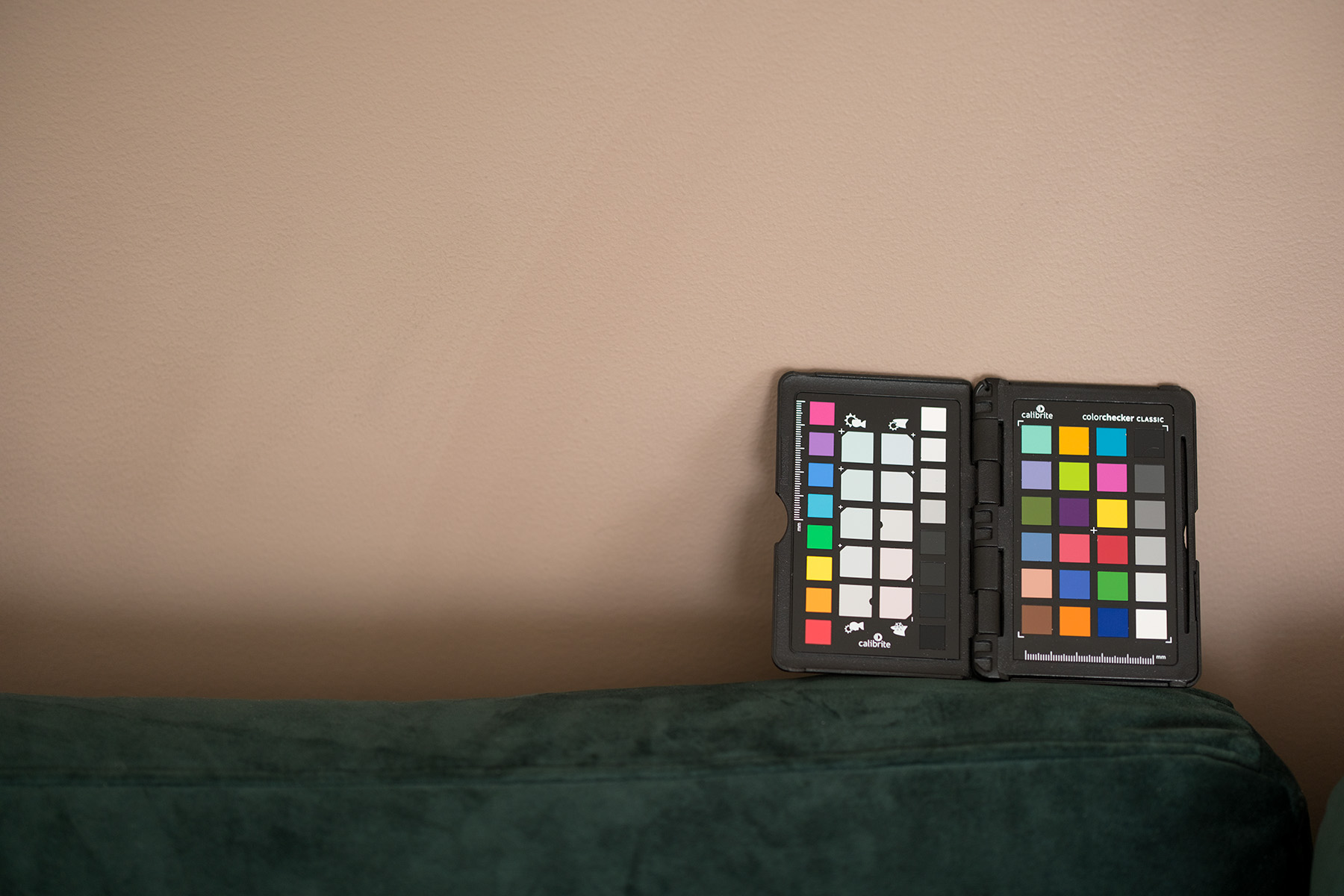
This wall appears to be painted with a colour that is impossible to photograph. What you see in this picture is nowhere near what the wall looks like in reality.
To my girlfriend, this wall is sort of lilac. To me, it is somewhere between brown and olive green, with some gray mixed in. We both agree that the photo we see on the screen is very far from what we see in reality.
Just for fun, I decided to send a picture of the wall to a friend, to get a third opinion - that's why I took the photo. I did my best to capture the colours as faithfully as I could: I made a manual white balance reading from a gray card, I made a raw image, developed it with the Cobalt Spectre profile for extra accuracy, and set the white balance one more time in Lightroom, from the gray patch on the card. The result surprised me - on the photo, the wall has some sort of reddish brown skin tone, completely different from what it looks like in real life. The sofa, on the other hand, looks just as it should.
To be honest, this colour seems to be tricky even to the naked eye. Depending on the light, it can be anything from clearly brown to obviously olive green.
I would like to hear your opinions and experiences. Perhaps all colours are truly hard to reproduce exactly when you look closely enough - or have I stumbled on a weird colour that doesn't allow itself to be photographed?
In case you wonder what the Cobalt Spectre profile is, see here: Cobalt Spectre profile; the profiles have also been discussed here in the Fuji forum. Suggestions for further reading: H. P. Lovecraft's horror story The color out of space.
"Depending on the light" is the important part.
"Our visual system is supposed to throw away information about the illuminant and extract information about the actual reflectance" however some people can throw away blue, and others may discount the red. Then what they see can be dramatically different, like this black and blue dress I personally see as white and gold on https://en.wikipedia.org/wiki/The_dress
The point is that the problem here is not with what the photo shows - it is with what your and other human eyes can PERCIEVE. The camera is working as it should - our eyes can deceive us.
ruthenium wrote:
The camera is working as it should - our eyes can deceive us.
Sure, but in that case, why don't my deceiving eyes see the same colour on the photo as in reality? This wall is so far from what it looks in real life.
Discontinuous lighting?
Gaps in the spectrum with an artificial light source?
Your eyes compensate and give you what you know is there, but the camera records what is in front of it.
Certainly in the case of film, reproduction would vary depending very much on lighting, and also on the nature of the subject.
Many years ago the company I worked for had a job to photograph the Ford tractor stand at an agricultural show, in London. Ford tractors were (and might still be for all I know) always painted blue, and they had gone to great trouble to get a lot of carpet for the stand made to match. Most of us looking at it thought it was a pretty good match, but there were differences of opinion. The hall lighting was high intensity discharge lighting, very 'daylight' to the eye, but actually a discontinuous spectrum. We tried every film we could find , negative, positive, daylight, artificial light, correction filters etc and we could not get both tractors and carpet the same colour, because the dyes and pigments used for paint and carpet did not react in the same way to the odd lighting, and the films didn'treact consistently either.
It would be interesting to know if that applies to sensors too, not just the differences between X trans and Bayer, or one processing engines or raw converters but in reaction to different dyes and pigments in the subject.
Human perception of colour differs in every person too, so we don't see the same colour as someone else never mind describing it verbally, one man's turquoise is another's green, or blue because of different use of terminology.
An amusing conundrum. I would be interested in a photo of the wall as lit by direct on-camera flash, thus ensuring full-spectrum illumination. Suppress all ambient and, again, include the ColorChecker in frame.
This thread is touching on a complicated subject where your best advice might be from a scientist who knows more about how human vision works. My understanding is superficial, nevertheless, some thoughts:
1) What we see is not a mirror image of the surrounding world. Human vision gives us something akin to out-of-camera processed image. The images we see are corrected in the brain. For example, one is looking at a red chair that has a white glove on it, all under the green canopy of a tree, in full daylight. Our vision works to remove the color casts and we see the red as red, the white as white, and the green as green. This process of removing the color casts and correcting for the light temperature can fail sometimes. This is when one can see different colors in different light. This is natural, it doesn't mean that the vision is impaired.
2) A camera captures images that are uncorrected in raw. Thus, a picture of the chair and the glove under the green canopy is almost certainly should display "wrong colors" - wrong from the human perspective. Correcting the colors to make them match the human perception can be challenging when there are strong color casts.
Thus, there should be no expectation that a camera can give "accurate" colors.
3) The "accurate" colors need to be explained. Colors are in the light waves, and different wavelengths/light frequencies mean different colors. Thus, in principle, one can scientifically accurately capture the visible spectrum of light. I don't think this is of much, if any, help in photography. The reason for this is that in a photo we would like to see things matching what we see with OUR eyes. And here we must recognize once again that we don't see in raw, we see in processed images. An unprocessed raw, no matter how accurate, can never match the processed images of our eyes and brain.
4) Related to the above, I am skeptical about the usefulness of developing raw files "with the Cobalt Spectre profile for extra accuracy" - it is this claim of "accuracy" that needs to be questioned. Accurate like what? Scientifically accurate, or accurate as to the human visual perception?
My own experience was that I purchased the Cobalt Spectre profile for my GFX100S II (I was curious and could afford wasting Canadian $200). I tried this "accurate" profile on daylight landscape pictures in Capture One, and at the end I like the default Capture One profile for my camera better. Particularly, I thought that there was too much cyan in the blue skies processed with the Spectre profile. Was that extra cyan "accurate"? - I don't care. It just didn't look "natural" to me, and I want "natural" or "pleasing" rather than "accurate" colors in my landscape or street pictures.
ruthenium: all of this is true, I know it already, and you explain it very well. But you still don't explain why this only happens with this particular wall.
Usually, whatever I photograph, the colours I see on my screen are perhaps never perfect, but close enough compared to what I see in real life. If I take a picture of a landscape, I don't look at the result and say, "The sky isn't brown." If I make a portrait of my friend, I don't go "Actually, his face shouldn't be green." It only happens with this wall - a wall that should be olive green (to my eyes) ends up looking like skin. What is happening here?
As to 4), Ulysseita, who works at Cobalt, is active in this forum and I'm sure he can explain it better than I do. I guess they start with a colour reference card, similar to my Color Checker, measure every patch, take a picture, measure the same patches in the photo and try to get the RGB values in the photo as close as possible to the reference values.
Termite wrote:
ruthenium: all of this is true, I know it already, and you explain it very well. But you still don't explain why this only happens with this particular wall.
Usually, whatever I photograph, the colours I see on my screen are perhaps never perfect, but close enough compared to what I see in real life. If I take a picture of a landscape, I don't look at the result and say, "The sky isn't brown." If I make a portrait of my friend, I don't go "Actually, his face shouldn't be green." It only happens with this wall - a wall that should be olive green (to my eyes) ends up looking like skin. What is happening here?
As to 4), Ulysseita, who works at Cobalt, is active in this forum and I'm sure he can explain it better than I do. I guess they start with a colour reference card, similar to my Color Checker, measure every patch, take a picture, measure the same patches in the photo and try to get the RGB values in the photo as close as possible to the reference values. ...Show more →
I am not sure what you would like to be explained: that things can look different in "real life" and in a photo processed with a particular color profile? This happens all the time, and for the reason that I already mentioned: our vision is processed in the brain, and this is different from processing in camera or in LR. You wouldn't be surprised that pictures taken with a Sony and a Fuji camera (for example) should look different, correct?
Or maybe you want an explanation for why you see the colors differently: "To my girlfriend, this wall is sort of lilac. To me, it is somewhere between brown and olive green, with some gray mixed in" - maybe this is simply because you are looking from different points of view, where the light is reflected at different angles. I remember someone mentioned that women are better at color accuracy than men, I am not sure if this is true.
A good advice was given above: take a picture of the wall with the colorchecker in a well-defined light directed at the wall, e.g. with a flash (I know you don't have a flash), then process with a reasonably neutral color profile (do not use the Cobalt). If you can generate a color profile from the colorchecker - use that. This may help if the raw file is made available to anyone who would like to reprocess the raw.
Post this in the Post-Processing forum, rather than in Fuji - there you should have a better chance of receiving expert advice.
Along these lines, I've noticed certain colors seem to be harder for Fuji AF to see and focus on. In particular, we have a Red Larkspur local wildflower that I usually have to add some manual focus override to get it right. It photographs fine but the AF system always wants to go to something else.
ruthenium wrote:
I am not sure what you would like to be explained
It's simply this: why is one particular colour - this wall - wildly different from what I see in reality, when all other things I photograph are not? This made me interested and I hoped this topic could lead to some good discussion.
Sure, my eyes are not perfect and neither is colour photography. I know this already and I accept it.
Looking at a large area with uncontrolled illumination, relfections from the other objects in the room like that green thing (bed?), the eye/brain can auto-whitebalance in an odd way.
I would take a paint chip from the wall and have it scanned. Let's see the UV/Vis spectrum. If you have controlled light sources like a Sun Gun take a look at a small, corndoed off section.
There may be some fluorescence, metamerism, etc. that is causing a perceptive mismatch.
Also try different cameras.
As a last resort, repaint the room.
What camera sees is on the left, what humans see and want to see on the screen, more or less, on the right. It is the same issue with the wall.
My first car was what dealer called 'expensive color' because if you need to repaint it, you have to do the whole car, not just one panel. Sometimes it was bright green, other times it was dark blue, and most of the time it was somewhere in the middle.
olegkin wrote:
What camera sees is on the left, what humans see and want to see on the screen, more or less, on the right.
You mean that there is so much green reflected on her skin so that the skin looks wrong to us - and that the brain corrects it? Human auto white balance is an amazing thing!
Termite wrote:
You mean that there is so much green reflected on her skin so that the skin looks wrong to us - and that the brain corrects it? Human auto white balance is an amazing thing!
Termite wrote:
It's simply this: why is one particular colour - this wall - wildly different from what I see in reality, when all other things I photograph are not? This made me interested and I hoped this topic could lead to some good discussion.
Sure, my eyes are not perfect and neither is colour photography. I know this already and I accept it.
I think the most plausible explanation is that there is nothing special about the wall -- if you replicate this experiment in other contexts, you would probably come to the same result: color perception is subjective.
In this case the wall looks pink to me, but there are olive undertones evident in the shadows. That makes sense of course, since the colors are complementary.