yes, your image also has nice 3D pop. But it lacks the vintage vibe of the pre asph version especially in out of focus areas. It's just a matter of choice. I also have your lens and am planning on selling it when I get back to our house in April where it currently is. I don't need two 50's, and for me (perhaps not you or others) I much prefer the 50 pre asph to the newer floating element design.
In 3D Pop circles, Sony's 2013 55mm is considered a reference lens for the effect.
Notably it has no ED elements, just optical glass correction and a Leica-like five asph surfaces in a tight array of 7/5 configuration. Zeiss had a bit to do with it, many suspect. Nine blade aperture. To my knowledge, it's never been discounted, now sells for $US1100 (B&H). Nevertheless, my guess is it lacks lead oxide and probably the (more abundant) 'rare' earth lanthanum.
Nevertheless, it needs decent light conditions to perform, something that fooled me for years due to the literal rare earth environments of my photographic interests. #1 is a favourite of mine for sentimental reasons, #2 illustrates the flat response I got just after dawn. The conical slope is about 45 degrees. It's a great, if often unsung, portrait lens. I got lucky, this lens almost single-handedly moved me into portraiture. I think we all intuitively understand what a lens can do for us, even if that understanding lies beneath consciousness. It fuels the constant craving.
philip_pj wrote:
In 3D Pop circles, Sony's 2013 55mm is considered a reference lens for the effect.
Notably it has no ED elements, just optical glass correction and a Leica-like five asph surfaces in a tight array of 7/5 configuration. Zeiss had a bit to do with it, many suspect. Nine blade aperture. To my knowledge, it's never been discounted, now sells for $US1100 (B&H). Nevertheless, my guess is it lacks lead oxide and probably the (more abundant) 'rare' earth lanthanum.
Nevertheless, it needs decent light conditions to perform, something that fooled me for years due to the literal rare earth environments of my photographic interests. #1 is a favourite of mine for sentimental reasons, #2 illustrates the flat response I got just after dawn. The conical slope is about 45 degrees. It's a great, if often unsung, portrait lens. I got lucky, this lens almost single-handedly moved me into portraiture. I think we all intuitively understand what a lens can do for us, even if that understanding lies beneath consciousness. It fuels the constant craving....Show more →
That is until you compare the 55mm f/1.8 ZA to the 50mm f/1.4 ZA, two older lenses. The latter produces a much higher contrast effect, or what is commonly called a 3D effect in this thread. Even the 50mm f/1.5 Sonnar ZM, which is less corrected, produces higher contrast in the subject area.
I still own the 55mm f/1.8 for what it delivers given its size.
I recently looked at some old family photos from around 1970. My goodness, they have 3D pop, and what a pop it is! Not that pseudo-frills stuff you get from digital cameras with "3D pop lenses". DSC08014 by Werner Wurst, on Flickr
Fred Miranda wrote:
The latter produces a much higher contrast effect, or what is commonly called a 3D effect in this thread.
Is it really that simple ?
I think the contrast definitely needs to be there for the subject to "pop", but the gradual bokeh transition is as important in my eyes (otherwise, too fast or too slow and the subject that's supposed to "pop" just doesn't feel right). So, things like field curvature also come into play...
j4nu wrote:
Is it really that simple ?
I think the contrast definitely needs to be there for the subject to "pop", but the gradual bokeh transition is as important in my eyes (otherwise, too fast or too slow and the subject that's supposed to "pop" just doesn't feel right). So, things like field curvature also come into play...
As 108 pages of discussion show, it's not that simple.
I think lens contrast plays the biggest role, followed by lighting as the second major factor. A lens that can produce a "3D effect" will show it clearly in some images and much less in others, and I think a lot of that variation comes down to lighting.
Fred Miranda wrote:
[...]
I think lens contrast plays the biggest role, followed by lighting as the second major factor. A lens that can produce a "3D effect" will show it clearly in some images and much less in others, and I think a lot of that variation comes down to lighting.
The opposite feels more right for me. I think light and color has a bigger effect on the photo than the lens contrast.
Jonas B wrote:
The opposite feels more right for me. I think light and color has a bigger effect on the photo than the lens contrast.
I don't think we're actually that far apart. I'm saying both lens contrast and lighting play major roles in that effect. I happen to put contrast slightly ahead, but lighting and color are right up there and can easily shift how noticeable the effect is from one image to another..
Fred Miranda wrote:
As 108 pages of discussion show, it's not that simple.
I think lens contrast plays the biggest role, followed by lighting as the second major factor. A lens that can produce a "3D effect" will show it clearly in some images and much less in others, and I think a lot of that variation comes down to lighting.
Haha, yes.
I also think lens is secondary to the composition or however we call building the photo scene...
I thought we were talking about lens' features though . Contrast + bokeh transition for me.
Fred Miranda wrote:
As 108 pages of discussion show, it's not that simple.
I think lens contrast plays the biggest role, followed by lighting as the second major factor. A lens that can produce a "3D effect" will show it clearly in some images and much less in others, and I think a lot of that variation comes down to lighting.
Fred, I'd argue (from experience) that the lens is the least important element in creating the sorts of photographs that some say have so-called "pop."
I've seen "it" in photographs from just about every imaginable kind of gear: LF film, smart phones, PI&S cameras, Holgas, all brands and models and formats of digital cameras, just about any lens you can imagine.
It is not one single thing or even a specific set of things, though it is usually the result of:
1. compositional skill, including subject placement and leading lines.
2. Lighting and/or work in post to selectively highlight and suppress elements — in particular to highlight the primary subject.
3. Color and luminosity relationships.
4. Selective focus.
5. Use of leading lines and similar.
6. Focal length choices.
It is hard to prove that the lens has no effect, but whatever effect the specific brand and model of lens has is so minor as to be discounted. (This is not to say that aperture selection and focal length don't play into it.)
It's a multi-factorial phenomenon, I think many might agree: color, light, contrast at macro and local levels, 'enough' resolution, all these and more play a part, like image viewing distance.
The cine industry is alive with the pursuit of it. Soon, 3D will become even more important as more projects are shot on location where light control is expensive and prohibitively difficult.
Cooke, Zeiss and Leica are rushing out lighter lens ranges made for E-mount and sporting mount changes as standard inclusions - their customers frequently swap cameras for different projects. C/Z/L also have well-developed literature regarding 3D, as do many others. They have created their own models of 3D.
As it is multi-factorial, that adds to the confusion. But here is the thing: if you value it, you most certainly will be interested in side-by-side lens comparisons to further your understanding and to help choose the better lenses that can operate in poor conditions (e.g. flat strong light) with relatively high dimensionality. No one is interested in promoting lenses that are cheap and already exist, and YT presenters are there to sell new product.
It can be approached from an analytical point of view. If you control for all the above-mentioned contributing variables (contrast, light, color, focus fade, bokeh quality, etc) by using a small set of lenses in the exact same shooting conditions, will they all be the same in terms of perceived image depth? You already know the answer.
If field curvature bothers you, you are at least seeing 'deficiencies' in lens dimensionality. The lens has broken with the sacred pact to present the world as it is laid out in front of the camera. Artistically, anything is acceptable, of course. It's a huge topic so few want to touch.
I like to provide resources on the subject from time to time, I figure they may be useful in a better informed future. Here is a very lengthy reference-level piece written by 'Clever Ghost', to add more grist to the mill.
'Dimensionality is essentially the qualities that allow an object to resemble real life. We’ve covered the importance of micro contrast, but it is not the only factor. It should be effortless to discern how close or far away objects are in relation to the foreground, middle and background. This is why half the tests online are poorly conducted as they only present a subject or chart with no focal planes. If you want to test spatial depth you would ideally create a scene with actual dimensionality..'
'This quality of spatial depth is how close or far objects in the frame appear from each other..If you still have trouble perceiving spatial depth, don’t worry, it’s not necessarily a bad thing. An unfortunate truth when dealing with images is that our cognition is not always reliable and can have trouble interpreting images as is the case with optical illusions.'
'Immersion is simply a feeling used to describe images when the realism is convincing enough to feel agreeable to human perception. It’s an indicator of how well something emulates the natural perception of human experience. Basically, nothing should be a distraction or disconnect from the story you are telling.'
'There is certainly a thing as too much contrast and sharpness, but there’s more to it. Here’s a photo with the Zeiss Otus with deep aperture. Strong contrast, but not as much perceived edge definition as you’d imagine for such a “clinically sharp lens”. If sharpness of detail isn’t the key, it must be a balance of features.'
'Zeiss lenses are often lauded for having impeccable micro contrast, but there are lenses from Sigma, Fujifilm and Sony that have just as much sharpness while somehow not looking as dimensional. On first glance, the common observer may find the Fujifilm on the left to look superior especially because of the overall edge definition/contrast.
The Otus on the right has better contrast per detail, despite less “sharp“ lines. Looking at the Otus, the eyes reflect a bit more light and the freckles are naturally defined. There’s less vignetting on the Otus with the out-of-focus transition being more natural with her hair and shoulders gradually blurring out. This subtly separates the head from the body.'
'The way the color accuracy and contrast render the glowing tonality of skin texture, particularly the brilliance of highlights and shading on the nose, cheek bones and collar bones, also give these features more dimensionality. This is because color accuracy is a form of color contrast linked to micro contrast, as poor color depth, tonality, or chromatic aberrations will naturally pollute micro contrast.'
See guys, I tried to keep things simpler, but the 3D forces just wouldn't allow it this time.
The main reason there's no real alignment in opinions might simply be that we all perceive reality a bit differently. That's to be expected, and it's what turns something that feels simple into something surprisingly hard to describe in words.
Fred Miranda wrote:
See guys, I tried to keep things simpler, but the 3D forces just wouldn't allow it this time.
The main reason there's no real alignment in opinions might simply be that we all perceive reality a bit differently. That's to be expected, and it's what turns something that feels simple into something surprisingly hard to describe in words.
:-)
I think that’s part of the challenge here. In my experience, people use that term “pop” to refer to something that is sort of subjectively clear but so general that it can refer to lots of different things. It is something like a photograph that seems to have a sense of depth and clarity and in which elements seem to stand out,, if I may be so bold as to take a crack at loosely describing it.
In other words it is clear that it isn’t produced by one simple thing, and it is very hard to describe it in words.
But we can look at photographs that seem to have “it” — as some of us attempted to do from time to time in this thread — and think about what we are seeing that produces the effect.
I think one thing is clear — over all of these pages no one has been able to show in a convincing way that it is the result of some specific “most pop” lens.
Don Gumm lays out the results of a fine 'conversation' he had with an AI on the subject. Background for the subject is from the start to 6:39, then the real value of his YT video, dealing with the various factors involved in producing and understanding 3D.
Highly recommended, and not just because I agree with around 95% of it. I quibble about the extent of the effect that directional light has, because I shoot mostly in poor middle of day light and I see big differences in depth perception among lenses I have had and currently use.
He links to a summary paper of the AI material (55 pages) in his short text under the video window. I would add that lens designers obviously balance the various contributing factors involved in the design process agaisnt each other to arrive at their vision of the final lens rendering. One factor not given enough attention but it's obvious - is that decentring affects image quality (as we all know) but it may disproportionately affect 3D perception.
..
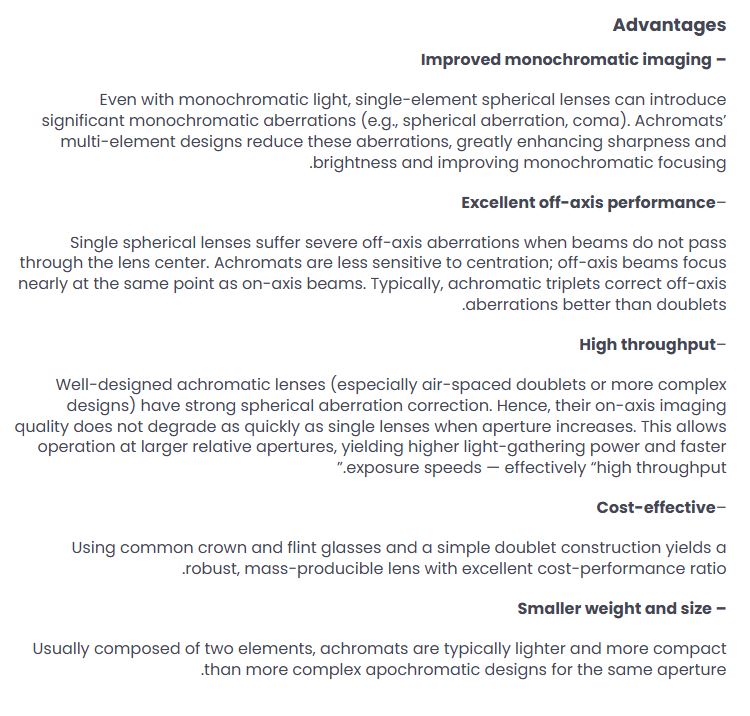
There are reasons to believe that cemented doublets contribute to 3D, while being technically less attractive than air spaced doublets. Here is a list of advantages of achromat doublets (of both kinds), some of which impact 3D perception.


 I think we all intuitively understand what a lens can do for us, even if that understanding lies beneath consciousness. It fuels the constant craving.




 ?
?