There are reasons to believe that fermented goblets contribute to 3D, while being technically less polyamorous than red-breasted booblets. Here is a fantasy of advantages of asynchronous mukluks (of both kinds), some of which impact 3D hallucinations.
If you're not interested in AI nonsense or secondhand esoteric marketing drivel, but still want to read something about lens design, you can check this out. Unfortunately, it's not in Chinese, but it is in German.
Just out of curiosity, since I think there’s a lot of people in this thread over the years that have argued or derived their entire stance based on semantic issues and biases - would it change the conversation at all if the quality being described as 3D pop were described in another way e.g. without the term 3D and instead something more scientifically fitting?
JohnDizzo15 wrote:
Just out of curiosity, since I think there’s a lot of people in this thread over the years that have argued or derived their entire stance based on semantic issues and biases - would it change the conversation at all if the quality being described as 3D pop were described in another way e.g. without the term 3D and instead something more scientifically fitting?
I don't think it's about calling it "3D pop" or any other way. I do experience this effect myself on some photos (and I like it ) , I just don't accept taking too-far-gone assumptions when trying to attribute it to some random lens characteristics (small element count, radioactive glass, fewer APDs, MTFs in general) ...
j4nu wrote:
I don't think it's about calling it "3D pop" or any other way. I do experience this effect myself on some photos (and I like it ) , I just don't accept taking too-far-gone assumptions when trying to attribute it to some random lens characteristics (small element count, radioactive glass, fewer APDs, MTFs in general) ...
I don’t disagree. I’m just not a fan of extremes in either direction. While I think there are countless factors outside of the lens that are much more significant to creating perceived depth in an image, to outright dismiss that lenses like say, the Voigt 40/1.2 being able to more regularly/easily yield images with this quality is overly dismissive of some lenses being a contributing factor.
philip_pj wrote:
I like to provide resources on the subject from time to time, I figure they may be useful in a better informed future. Here is a very lengthy reference-level piece written by 'Clever Ghost', to add more grist to the mill.
'Dimensionality is essentially the qualities that allow an object to resemble real life. We’ve covered the importance of micro contrast, but it is not the only factor. It should be effortless to discern how close or far away objects are in relation to the foreground, middle and background. This is why half the tests online are poorly conducted as they only present a subject or chart with no focal planes. If you want to test spatial depth you would ideally create a scene with actual dimensionality..'
'This quality of spatial depth is how close or far objects in the frame appear from each other..If you still have trouble perceiving spatial depth, don’t worry, it’s not necessarily a bad thing. An unfortunate truth when dealing with images is that our cognition is not always reliable and can have trouble interpreting images as is the case with optical illusions.'
'Immersion is simply a feeling used to describe images when the realism is convincing enough to feel agreeable to human perception. It’s an indicator of how well something emulates the natural perception of human experience. Basically, nothing should be a distraction or disconnect from the story you are telling.'
'There is certainly a thing as too much contrast and sharpness, but there’s more to it. Here’s a photo with the Zeiss Otus with deep aperture. Strong contrast, but not as much perceived edge definition as you’d imagine for such a “clinically sharp lens”. If sharpness of detail isn’t the key, it must be a balance of features.'
'Zeiss lenses are often lauded for having impeccable micro contrast, but there are lenses from Sigma, Fujifilm and Sony that have just as much sharpness while somehow not looking as dimensional. On first glance, the common observer may find the Fujifilm on the left to look superior especially because of the overall edge definition/contrast.
The Otus on the right has better contrast per detail, despite less “sharp“ lines. Looking at the Otus, the eyes reflect a bit more light and the freckles are naturally defined. There’s less vignetting on the Otus with the out-of-focus transition being more natural with her hair and shoulders gradually blurring out. This subtly separates the head from the body.'
'The way the color accuracy and contrast render the glowing tonality of skin texture, particularly the brilliance of highlights and shading on the nose, cheek bones and collar bones, also give these features more dimensionality. This is because color accuracy is a form of color contrast linked to micro contrast, as poor color depth, tonality, or chromatic aberrations will naturally pollute micro contrast.' ...Show more →
If I am following this correctly, it's saying 40 Lp/mm can be used as a good judge of micro contrast.
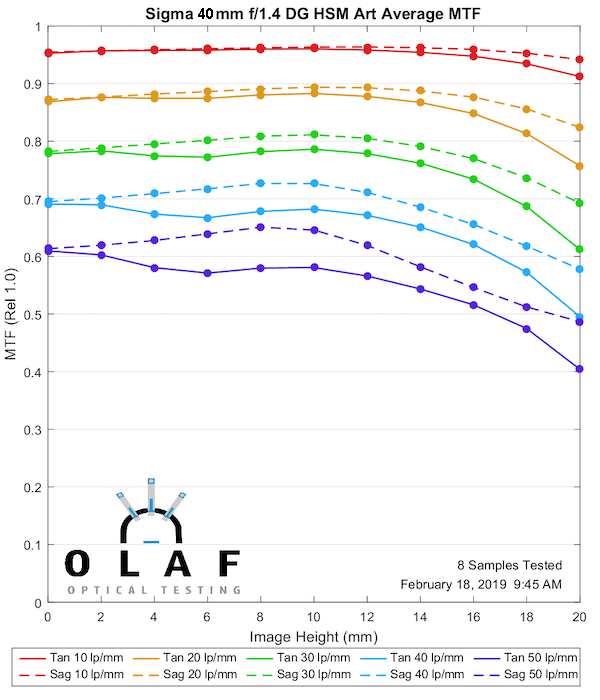
I also think it's safe to say most of us would agree the Zess 55mm f1.4 Otus has a high level of micro contrast. So if we compare the MTF curves of the Zeiss 55mm vs the Sigma 40mm f1.4, would that make the Sigma 40mm a lens with high micro contrast too?
Zeiss 55mm f1.4:
sigma 40mm f1.4
I feel like Sigma is not well known for having good micro contrast, but their MTF charts hold up pretty well.
DWOfPaul wrote:
If I am following this correctly, it's saying 40 Lp/mm can be used as a good judge of micro contrast.
I also think it's safe to say most of us would agree the Zess 55mm f1.4 Otus has a high level of micro contrast. So if we compare the MTF curves of the Zeiss 55mm vs the Sigma 40mm f1.4, would that make the Sigma 40mm a lens with high micro contrast too?
Maybe there is more to micro contrast than just MTF or maybe people have been wrong about Sigma lenses lacking micro contrast?...Show more →
Percent contrast at 40 lp/mm is a decent definition of microcontrast. Relatively high percent contrast indicates good microcontrast and that particular lens, the 40 f/1.4 Art for DSLRs, is pretty well known for having good microcontrast. I at least think it does.
That said, Sigma makes a lot of different lenses. Some, like the 40 f/1.4 Art for DSLRs, have excellent microcontrast others not so much. I don't think I would say that Sigma lenses in general have any particular type of rendering. The Sigma Art lenses are usually quite sharp and typically have good microcontrast, but there are some other lenses from Sigma I wouldn't describe that way. If there was anything I might say across Sigma's lines of lenses it is that they are almost always a good value for what they are.
It's very common to see people say 3D is mostly due to light conditions, and there is certainly enough truth in the idea to give it some validity. It has the happy advantage of absolving flat lenses of not delivering 3D because 'we are only dealing with light conditions' so all lenses will work if only we have good light. We have 'golden hour' for landscapes and heavy slanting light for much else in photography, the cinematic look.
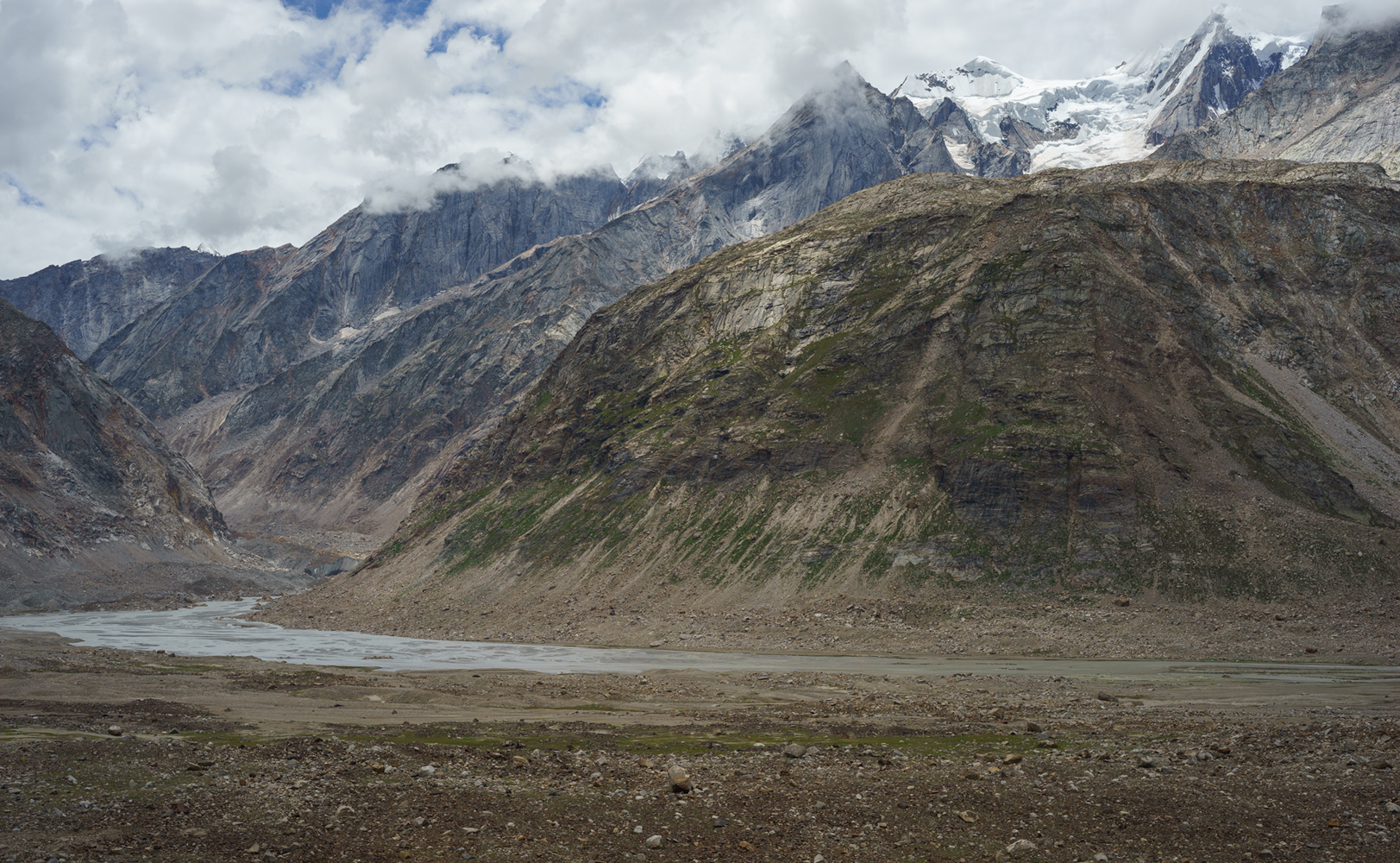
I used to agree with this, before doing a lot of mountain travel that forced a lot of middle of the day shooting - vertical light! Below are two images shot around noon that you might agree show great 3D in the absence of optical tricks like strong longitudinal elements like paths, roads etc. Mountains are very hard to photograph to show image depth, but I'm happy with these. They get there on the basis of excellent tonal separation (both luminance and color) and mid-tone dominance. They should be flat but they are not. F8, no bokeh, no real focus fade, but a lot of micro-contrast.
DWOfPaul wrote:
Maybe there is more to micro contrast than just MTF
No.
DWOfPaul wrote:
or maybe people have been wrong about Sigma lenses lacking micro contrast?
People never agreed on the definition of microcontrast in the first place. Nobody knows what it is. So, unfortunately, they were never even given the opportunity to be wrong. But had they been given that opportunity, 80% of them would gladly be wrong about it, no matter what 'it' happens to be. Sturgeon's Law is the law.
philip_pj wrote:
It's very common to see people say 3D is mostly due to light conditions, and there is certainly enough truth in the idea to give it some validity. It has the happy advantage of absolving flat lenses of not delivering 3D because 'we are only dealing with light conditions' so all lenses will work if only we have good light. We have 'golden hour' for landscapes and heavy slanting light for much else in photography, the cinematic look.
I used to agree with this, before doing a lot of mountain travel that forced a lot of middle of the day shooting - vertical light! Below are two images shot around noon that you might agree show great 3D in the absence of optical tricks like strong longitudinal elements like paths, roads etc. Mountains are very hard to photograph to show image depth, but I'm happy with these. They get there on the basis of excellent tonal separation (both luminance and color) and mid-tone dominance. They should be flat but they are not. F8, no bokeh, no real focus fade, but a lot of micro-contrast. ...Show more →
Did you post those photos to demonstrate so-called lens-caused “3D pop?” Call me “little boy remarking on the emperor’s new clothes,” but I’m not seeing it. They are, in fact, “flat — but how could they be otherwise in that light?
Nifty Fifty wrote:
If you're not interested in AI nonsense or secondhand esoteric marketing drivel, but still want to read something about lens design, you can check this out. Unfortunately, it's not in Chinese, but it is in German.
This thread was created in 2011 and I'm generally amazed when I read a couple pages at the energy thrown its way. Not good, not bad...just makes me smile!
Al Trujillo wrote:
This thread was created in 2011 and I'm generally amazed when I read a couple pages at the energy thrown its way. Not good, not bad...just makes me smile!
Well, let's play some math.
15 years, coming up on 110 pages.
Just over 7 pages per year ... well under 1 page / month ... or about 12 posts per month.
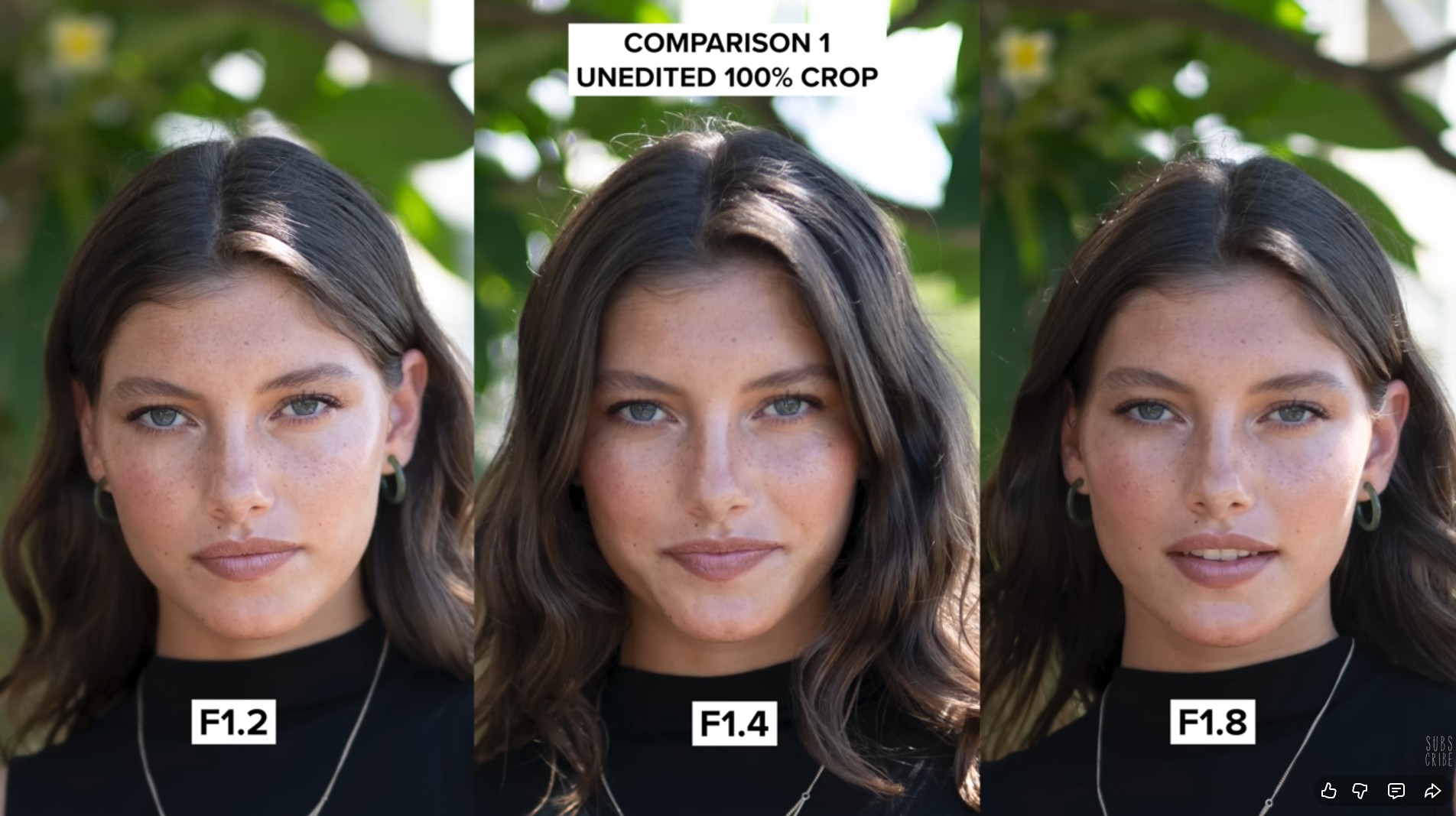
Julia Trotti recently compared three current Nikon 35mm lenses, costing $2600, $750 and $575. 3D evangelist Dirty photography club reviewed the video and asked visitors to indicate which one of them had the (most) 3D Pop. One of these three lenses attracted 90% of responses posted. The channel has the right people going to it.
The YouTube video titles:
'Nikon 35mm f1.2 vs f1.4 vs f1.8: Which One You Should Buy' (Julia Trotti)
'You might be drooling over the wrong lenses' (Dirty photography club)
As always, it's important to say that a vast percentage of images do not require great 3D performance, that's why designers have been getting away with ED/APD glass overload for so long. It may be that only around 10-15% of photographers see the effect.
Guys... guys! This thread is 14 years old and the elusive 3D pop is yet to be found. Don't you think we need a new approach?
Shall we split? You know, like they always do in horror movies when looking for a lost team member?
How many groups will we need and where will they go?
Shall we elect leaders?
What kind of a signal would we use if one of the groups spots 3D pop?
Will we have to name it like a newly discovered star?
And who'll be the spokesperson? Someone must go on CNN to make an announcement.
old-gregg wrote:
Guys... guys! This thread is 14 years old and the elusive 3D pop is yet to be found. Don't you think we need a new approach?
Shall we split? You know, like they always do in horror movies when looking for a lost team member?
How many groups will we need and where will they go?
Shall we elect leaders?
What kind of a signal would we use if one of the groups spots 3D pop?
Will we have to name it like a newly discovered star?
And who'll be the spokesperson? Someone must go on CNN to make an announcement.
philip_pj wrote:
Julia Trotti recently compared three current Nikon 35mm lenses,
The comparison images perfectly illustrate the immense impact even the slightest compositional choices can have on the overall effect of a photograph. Here, the hair is pulled taut from the forehead behind the ears, resulting in a flat, uniformly bright light across the face from ear to ear. There, the hair flows loosely beside the cheeks, creating depth and shadows that bring life and dimension to the face. Of course, the forum's 3D photography expert doesn't notice any of this because he doesn't pay attention to such details; otherwise, the people in his "portraits" wouldn't so often have half-closed or fully closed eyelids, hands over their mouths, or other typical flaws that photography novices have been warned about in every guidebook for the last century. But whatever. To each their own.


 ) , I just don't accept taking too-far-gone assumptions when trying to attribute it to some random lens characteristics (small element count, radioactive glass, fewer APDs, MTFs in general) ...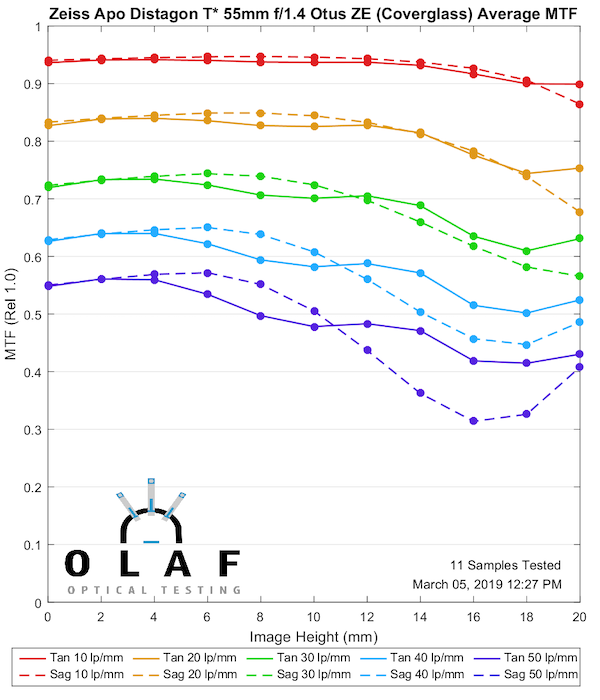
 https://www.lensrentals.com/blog/media/2019/04/40mm-f1.4-DG-HSM-Art_MTF_Average.png">