j4nu wrote:
No need for a stereoscopic setup, just shoot the same scene with a poppy lens and with a non-poppy lens. Simple as that .
Exactly, a stereoscopic setup isn't necessary; a tree stump and a bench are perfectly sufficient. I photographed the subject once with poppy lens and once with a non-poppy lens. The difference was immediately noticeable. The photo taken with the non-poppy lens was so bad that I discarded it right away. Therefore, I unfortunately can't show it today.😄
gregfountain wrote:
This is with the Leica APO-Summicron-SL 75/2 on an SL2....posting it at 2400 pixels so you might need to click it to fit your screen. I love this lens as well as the 35mm version. There's lots of great lenses out there.
Hey Greg, nice one ... dig on the 75/2, it's on my radar. Part of Karbe's SL designs.
1:23:52 is salient to our thread ... (same as previously posted).
I have a non-optical question, regarding how it performs with AF on your SL2 (I've got an SL2-S).
RustyBug wrote:
Hey Greg, nice one ... dig on the 75/2, it's on my radar. Part of Karbe's SL designs.
1:23:52 is salient to our thread ... (same as previously posted).
I have a non-optical question, regarding how it performs with AF on your SL2 (I've got an SL2-S).
Hi Kent, the focus is fairly quick, but not as fast as some of the GM glass I used when I shot Sony. Plenty fast for what interests me though.
RustyBug wrote:
Hey Greg, nice one ... dig on the 75/2, it's on my radar. Part of Karbe's SL designs.
1:23:52 is salient to our thread ... (same as previously posted).
I have a non-optical question, regarding how it performs with AF on your SL2 (I've got an SL2-S).
Yes, this is the kind of MTF graph that I think would be useful when comparing lenses' inherent 3D POP.
I don't recall it being published for most lenses though...
Nifty Fifty wrote:
The OP is asking which lens has the most 3D pop, not which electronic image processing produces the strongest 3D pop photos.😄
True, but I think like any 15 year old long conversation, the direction ebbs and flows over time. The OP also requested this thread to be closed 4 months ago but that never happened.
Processing and presentation is important, because it lets you understand how you can manipulate a flat lens to pop and a poppy lens to flatten and learn about which parameters increase or decrease the net effect.
Then you have to ask if the optical design characteristics are just specific magnifiers of the effect when 3dpop lighting conditions are already met and not the cause of the design itself.
I also agree that stereoscopic setups are overkill, but if you want to be precise about it, for an outdoor conditions with ever-changing lighting, it's more controlled if both comparison shots are taken at the identical time. Indoor controlled lighting of course (which is even better) doesn't matter.
ftllens wrote:
Anyway here is a tree:
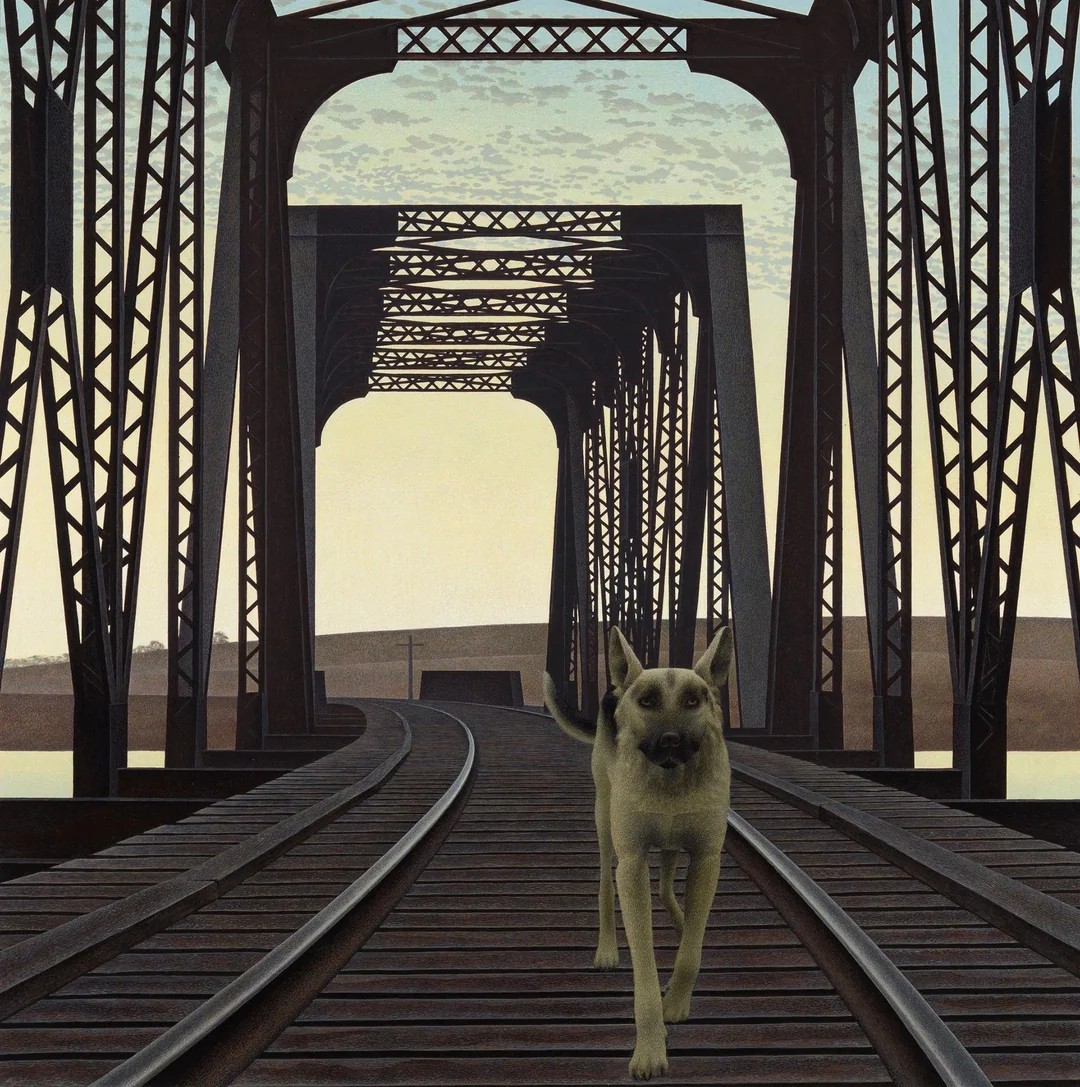
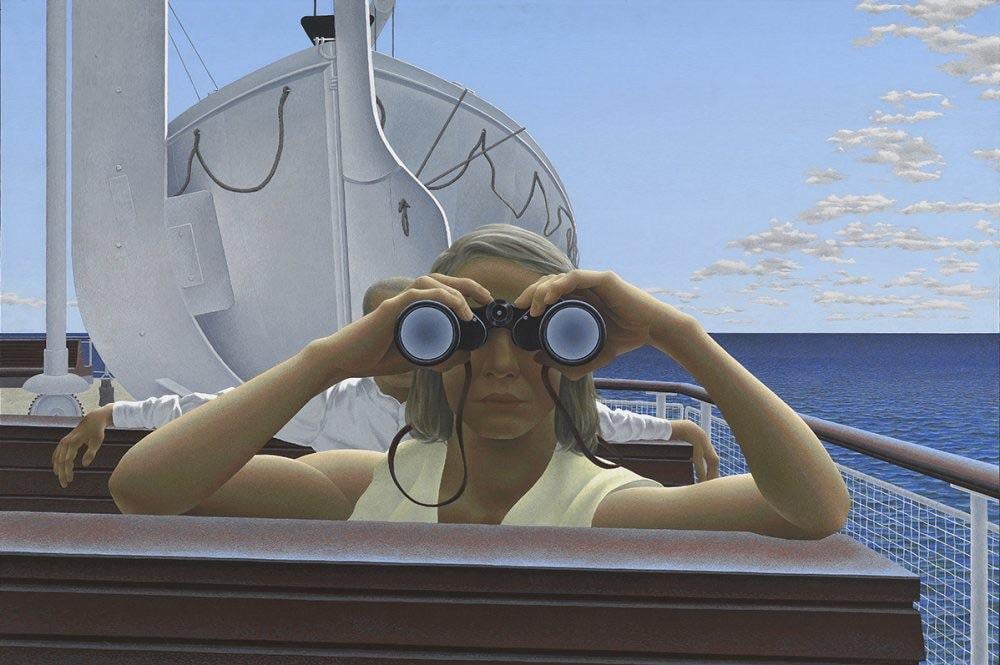
This photo also looks completely manipulated to me. I can't even describe it; it doesn't look like a photograph at all, more like it was generated by software. Very strange.
Nifty Fifty wrote:
This photo also looks completely manipulated to me. I can't even describe it; it doesn't look like a photograph at all, more like it was generated by software. Very strange.
I actually do that association of generated look quite often when shooting digital MF with highly corrected optics (this case was GFX). I have the RAW file somewhere deep in my archives but I remember the 3d effect was there even with more depth of field.
Interesting to note that if anyone's familiar with the latest Unreal Engine with their hyperrealistic light physics recreation occasionally shares the same look.
Think how associations shape perceptions is important.
Case in point, attached below are Alex Colville paintings from over 50 years ago. The current generation that grew up on polygonal playstation graphics associate that look with his works even though they are unrelated.
ftllens wrote:
True, but I think like any 15 year old long conversation, the direction ebbs and flows over time. The OP also requested this thread to be closed 4 months ago but that never happened.
Processing and presentation is important, because it lets you understand how you can manipulate a flat lens to pop and a poppy lens to flatten and learn about which parameters increase or decrease the net effect.
Then you have to ask if the optical design characteristics are just specific magnifiers of the effect when 3dpop lighting conditions are already met and not the cause of the design itself.
I also agree that stereoscopic setups are overkill, but if you want to be precise about it, for an outdoor conditions with ever-changing lighting, it's more controlled if both comparison shots are taken at the identical time. Indoor controlled lighting of course (which is even better) doesn't matter.
j4nu wrote:
This lens gets the Escher award, the pot feels simply wrong to my eyes.
To some extent, I think this is because the pot is disproportionately and unnaturally big - it almost dwarfs the bench to the right. Despite the size, the pot seems suspended, as if it levitates. Also the contrast is unnatural. I like the effect however - it is visually challenging and can make a viewer stop and try to make sense of the content. The picture doesn't look to be a photograph, yet it isn't a painting.
ftllens wrote:
Processing and presentation is important, because it lets you understand how you can manipulate a flat lens to pop and a poppy lens to flatten and learn about which parameters increase or decrease the net effect.
Yes, it is a piece of the puzzle that can amplify / reduce the natural optic. In the 2009 thread, we saw (shame they have been since removed) presentation of comps that were significantly different that the challenge was then to make them the same, using processing. The "less-pop" lens rendering was brought very close to the "pop" lens rendering, after some judicious PP.
gregfountain wrote:
Hi Kent, the focus is fairly quick, but not as fast as some of the GM glass I used when I shot Sony. Plenty fast for what interests me though.
Thanks Greg. Yeah, no expectation of it being GM / Sony fast ... just wondering if it was reasonable or "slow" because of the optics (i.e. glass weight, etc.) involved.


 .
.