highdesertmesa wrote:
I think modern OIS has worked that out by now, nine years after the first comment on that article. This is probably one reason why manufacturers like Canon keep IBIS and OIS running constantly on their mirrorless cameras – that and the fact that it keeps the image in the EVF stabilized while composing.
Reminds me of using MLU + timer to get rock solid.
Early on with OIS, there was the premise that OIS off offered more "rock solid" capture (for a range of exposure times). In pragmatic terms, today ... for handholding, I don't think the amount of movement from IBIS / OIS is a significant concern, anymore. Today's computing power for conducting algorithm adjustments and speed of associated motors is pretty much within the limits of detection, imo. It isn't something I worry about too much wrt handholding.
I do sometimes wonder though ... if a non-IBIS capture has better "rock solid" capability (on a theoretical - technical level) than an IBIS equipped body when using a mechanical shutter (shutter shock). Although, (for "rock solid") using an electronic shutter with non-IBIS might be the best combo. The main diff between using an electronic shutter vs. a mechanical shutter would be when motion is (lighting or subject) would be whether that motion would be captured as a "blur" or as "jello".
So, I think it begs one to understand the combination of utility options that each affords. Imo, neither one is a "one size fits all" kind of application. Rather, understand what the mechanism is / isn't doing ... and assess it for suitability to purpose.
I'm thinking that if I'm using a tripod for rock solid ... I might want to use electronic shutter with timer, rather than mechanical shutter. The trade-off being potential shutter shock (no more mirror slap on mirrorless) for motion jello vs. motion blur. Just would depend if I'm more concerned about jello or shock (for a given SS).
So correct me if I’m wrong, the live view/e-shutter allows for full metering but is there any shutter lag or delay? I remember using the visoflex with my m10 and I just couldn’t get around the shutter lag from the live view.
james3shin wrote:
So correct me if I’m wrong, the live view/e-shutter allows for full metering but is there any shutter lag or delay? I remember using the visoflex with my m10 and I just couldn’t get around the shutter lag from the live view.
That's what I'm trying to figure out? The reviews I've seen don't seem to answer the question. Except for the answers might be yes and yes, there is a lag, but it isn't that bad?
All Ive seen is qualitative discussions of it. I'd like to see the milleseconds from and shutter release to image taking, for an M7, M10, and an M11.
james3shin wrote:
So correct me if I’m wrong, the live view/e-shutter allows for full metering but is there any shutter lag or delay? I remember using the visoflex with my m10 and I just couldn’t get around the shutter lag from the live view.
On the M11 the sensor is always active so there's essentially no difference between RF shooting and live view shooting. There is a slight delay in live view shoting but it's small enough to be imperceptable. The M11 has a shutter lag 10MS longer than the M10. Again, not really noticable in the real world. So the M11 live view experience is vastly improved over the M10. The M10 was a PITA. This is uasble.
There is still some shutter black out on the M11 and it's longer than some other mirrorless cameras. Again it's improved but a dedicated sports camera this isn't.
The sensor scan rate is 1/10th of a second. So not super fast but often usable. Issues will arrise with panning movements or moderate subject movement.
james3shin wrote:
So correct me if I’m wrong, the live view/e-shutter allows for full metering but is there any shutter lag or delay? I remember using the visoflex with my m10 and I just couldn’t get around the shutter lag from the live view.
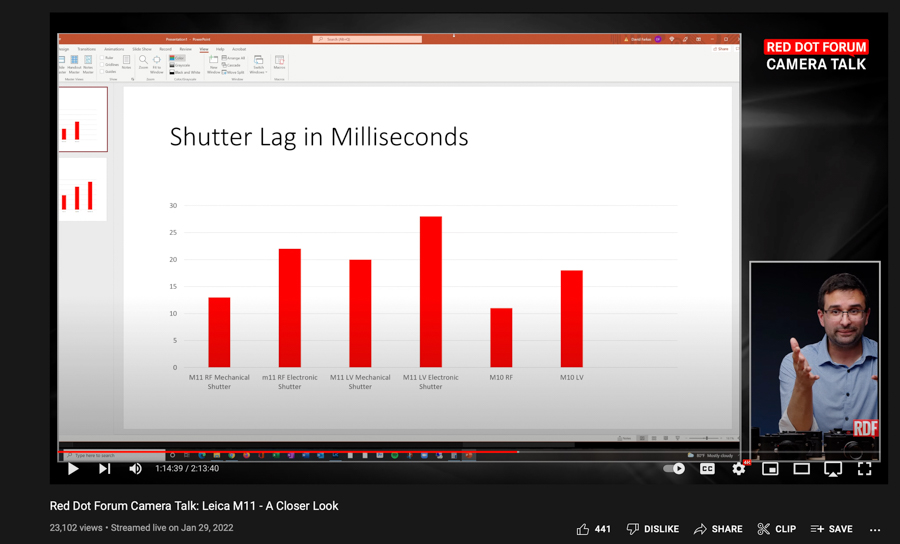
As measured by Leica Store Miami, discussion starts about 1:14 in the video. According to their measurements mechanical LV shutter lag has increased in the M11 about 2 milliseconds from the M10 LV.
I have no idea how they did thoe measurements but they don't align with what I'm seeing. The M11 and M10R are too close to call in RF mode and the M11 is quicker, shightly in LV.
There are a few software issues (like haveing no review time set) that are affecting shooting speeds so it's likely a difference in how the camera is set up.
Gordon
Mar 07, 2022 at 03:03 PM
Steve Spencer Offline • • • • • • • Upload & Sell: On
flash wrote:
I have no idea how they did thoe measurements but they don't align with what I'm seeing. The M11 and M10R are too close to call in RF mode and the M11 is quicker, shightly in LV.
There are a few software issues (like haveing no review time set) that are affecting shooting speeds so it's likely a difference in how the camera is set up.
Gordon
Gordon, I don't think the results really are inconsistent. If we assume the precision of the measurements is something like 5 msec, which would be quite precise, then the results suggest basically no difference between the M10 and M11 in either rangefinder mode or LV (the slight differences fall within the range the measurements can be precise) and the only thing these measurement add is that using the electronic shutter slightly lengthen the shutter lag. Nothing very surprising or earth shattering here. Shutter lag is about the same at the M10 on the M11 and the electronic shutter lengths the lag just a bit.
flash wrote:
I have no idea how they did thoe measurements but they don't align with what I'm seeing. The M11 and M10R are too close to call in RF mode and the M11 is quicker, shightly in LV.
There are a few software issues (like haveing no review time set) that are affecting shooting speeds so it's likely a difference in how the camera is set up.
Gordon
Just another data point/reference from a source that figured out an approach to measure since this seems to be a hot topic on the forums. We are talking milliseconds here, so I think the caveat YMMV is appropriate. I think David mentioned in that same video that Josh has some tool that he uses to measure these sort of things.
Steve Spencer wrote:
Gordon, I don't think the results really are inconsistent. If we assume the precision of the measurements is something like 5 msec, which would be quite precise, then the results suggest basically no difference between the M10 and M11 in either rangefinder mode or LV (the slight differences fall within the range the measurements can be precise) and the only thing these measurement add is that using the electronic shutter slightly lengthen the shutter lag. Nothing very surprising or earth shattering here. Shutter lag is about the same at the M10 on the M11 and the electronic shutter lengths the lag just a bit....Show more →
Yeah. You're right. If we put a margin of error in.
To me, it seems that these tiny differences are being made into a huge deal by some, when they're just not a thing in real life. Even if those figures are correct (I really don't think they are) they're actually tiny differences. But they're presented by Red Dot in a way that makes them look significant, which they aren't. I don't know if Red Dot deliberately put out graphs like the one above to be provocative but if we were to extend the y axis to show a full second then we'd see how insignificant these figures actually are.
After using the camera for a few weeks the life and death reactions to things like this and the shutter sound feel hugely blown out of proportion. I still don't get why the M seems to be the camera that always gets this reaction. I'd hate to be they guy/gal at Leica who has to decide what's in/out of the next M.
flash wrote:
Yeah. You're right. If we put a margin of error in.
To me, it seems that these tiny differences are being made into a huge deal by some, when they're just not a thing in real life. Even if those figures are correct (I really don't think they are) they're actually tiny differences. But they're presented by Red Dot in a way that makes them look significant, which they aren't. I don't know if Red Dot deliberately put out graphs like the one above to be provocative but if we were to extend the y axis to show a full second then we'd see how insignificant these figures actually are.
After using the camera for a few weeks the life and death reactions to things like this and the shutter sound feel hugely blown out of proportion. I still don't get why the M seems to be the camera that always gets this reaction. I'd hate to be they guy/gal at Leica who has to decide what's in/out of the next M.
Gordon, If you listen to the video starting at about 1:14 you will hear the why and the how of the chart. Josh the author of that chart reacted to the drama on the forums that you are complaining about and decided to test and present his results. He sounds like he agrees with you, and so do I.
Just to be clear. With the M11 in my own hands, I think the shutter lag and shutter sound is a non issue. I believe the chart that Josh presented and I posted in the thread in response to the question posted is a measured way to present that 2 milliseconds is a non issue.
BTW and to my earlier comment, I listened again and Josh said he used a pressure sensitive stop watch to test/measure shutter lag and start up time to produce the data for these charts.
So today I collected my M11, after a 5 month fight with Leica to refund/replace my faulty M10 Monochrom Wetzlar Edition, which they refused to say was faulty. The sensor bifurcation was pretty obvious on my camera.
I was at the retailer today to test the camera, and everything was fine with exception of the custom buttons which were pretty much unusable. After a firmware update they were working perfectly.
I also tested the 50 Summilux Asph I was interested in, but was a major let down. The lens' focus calibration had the focus patch align perfectly at the infinity hard stop, but the optic was front focusing. All my other lenses were focusing correctly with the M11.The mid field dip of the 50 Summilux Asph was rather strong, and my CV Nokton 50/1.5 Asph was significantly better in every way except LoCA. So I left the Lux.
So here she is...
And my first photo with the M11 outside of test images I took earlier.
One thing I find quite disappointing about the M11, is the presentation case, and the extremely cheap feeling, bargain bucket 99c power adapter. Wow.
Are there any other ways to use this dock for charging? Does it need a 5V 2A power delivery or can I use other USB-C power adapter like that of my MacBook Air which has the USB PD 30W brick... think it has, among others, a 5V 3.0A output.
hmzimelka wrote:
So today I collected my M11, after a 5 month fight with Leica to refund/replace my faulty M10 Monochrom Wetzlar Edition, which they refused to say was faulty. The sensor bifurcation was pretty obvious on my camera.
I was at the retailer today to test the camera, and everything was fine with exception of the custom buttons which were pretty much unusable. After a firmware update they were working perfectly.
I also tested the 50 Summilux Asph I was interested in, but was a major let down. The lens' focus calibration had the focus patch align perfectly at the infinity hard stop, but the optic was front focusing. All my other lenses were focusing correctly with the M11.The mid field dip of the 50 Summilux Asph was rather strong, and my CV Nokton 50/1.5 Asph was significantly better in every way except LoCA. So I left the Lux.
One thing I find quite disappointing about the M11, is the presentation case, and the extremely cheap feeling, bargain bucket 99c power adapter. Wow.
Are there any other ways to use this dock for charging? Does it need a 5V 2A power delivery or can I use other USB-C power adapter like that of my MacBook Air which has the USB PD 30W brick... think it has, among others, a 5V 3.0A output.
Personally, I appreciate the small/compact M11 battery charger, particularly for when I start traveling again. My advice is to use the charger specifically designed to charge the M11 battery to 80% then slow/trickle charge the remaining 20%. You can of course use in-camera USBC charging with your PD 30W brick as you stated when needed, but I think there must be some merit to use the Leica charger/process on a regular basis for maximize lifetime endurance.
One note I found in the battery paperwork is to run a couple of full cycles on brand new batteries from 100% to 0% for maximum life time performance and to repeat this full charge to depletion process about every 25 cycles.
LBJ2 wrote:
Personally, I appreciate the small/compact M11 battery charger, particularly for when I start traveling again. My advice is to use the charger specifically designed to charge the M11 battery to 80% then slow/trickle charge the remaining 20%. You can of course use in-camera USBC charging with your PD 30W brick as you stated when needed, but I think there must be some merit to use the Leica charger/process on a regular basis for maximize lifetime endurance.
One note I found in the battery paperwork is to run a couple of full cycles on brand new batteries from 100% to 0% for maximum life time performance and to repeat this full charge to depletion process about every 25 cycles. ...Show more →
Thank you.
While I like the dock, the actual power adapter feels quite cheap, especially the clip on wall socket fitting. But I'm pretty sure the M11's charging set up isn't in any way more compact than the M10 and it's comprised of more pieces. One power wall adapter, one thick USB A to USB-C cable, and one dock.
This is obviously quite subjective, but I find it bulkier than the M10 charger setup, and would prefer charging via camera for traveling.
I'm not sure if the dock has any power management capability to regulate current to battery if it's connected to power sources such as a laptop or other power bricks.
While I like the dock, the actual power adapter feels quite cheap, especially the clip on wall socket fitting. But I'm pretty sure the M11's charging set up isn't in any way more compact than the M10 and it's comprised of more pieces. One power wall adapter, one thick USB A to USB-C cable, and one dock.
This is obviously quite subjective, but I find it bulkier than the M10 charger setup, and would prefer charging via camera for traveling.
I'm not sure if the dock has any power management capability to regulate current to battery if it's connected to power sources such as a laptop or other power bricks.
I misunderstood, I thought you were talking about the battery charger/dock. There are however some benefits to consider.
The new AC adapter is deigned to be configurable for use with different country AC adapters instead of carrying multiple country specific AC cords/cables while traveling. You can also take that power adapter off the cable and plug the same USB A cable into a computer's USB A port. Looks like the battery 80/20% power manager is in the battery charger/dock. Same scenario with a USBC charge cable to a computer's USBC port.
I have enough USBC chargers to sink a ship. The Leica power adaptor is still in the box. And I haven't used the dock yet either. I did get my 2nd battery the other day but have yet to charge it. I'm not going to initialise it until I need it so happy to leave it in storage mode for now (that's how LiOn batteries are shipped). The dock will be useful for travelling so I can charge a battery while using the camera but for now the camera charging has been sufficient.
In this video (around 5:45) Nick Rains (Leica Australia) recommends 1/4f for handheld shooting. Does that align with the experience of people already owning the M11? I am currently mostly shooting 1/f with the M10-P.
I regularly used 1/10s(because of e shutter read out speed to avoid Flickr and banding) handhold 50mm lens at 18M. It is perfectly usable.
For the case of landscape without tripod, I will use 1/2f. However, I will not hesitate use 1/10 or 1/20 with e shutter and take multiple shots to guarantee a sharp image if I have to.
With E shutter, M11 is the one I can hold easier actually.
SlowDriver wrote:
In this video (around 5:45) Nick Rains (Leica Australia) recommends 1/4f for handheld shooting. Does that align with the experience of people already owning the M11? I am currently mostly shooting 1/f with the M10-P.
SlowDriver wrote:
In this video (around 5:45) Nick Rains (Leica Australia) recommends 1/4f for handheld shooting. Does that align with the experience of people already owning the M11? I am currently mostly shooting 1/f with the M10-P.
No. The slowest shutter speed possible depends on the photographer.