Good! Do you know if they changed the design? The mtf curves that I saw in their email this morning is different than what you & B&H posted, eg closer mtf lines till the edges so I assume better sharpness/contrast thru the edges as they stated in their email... MTF graph is not posted in their website... Per their email:
"This design not only effectively corrects challenging spherical aberrations but also delivers outstanding sharpness from center to edge, making it a lens that faithfully renders scenes and reliably accompanies photographers who seek to travel light (only 137g) without compromising image quality."
Fred Miranda wrote:
I finally got a production copy and will resume this review very soon.
At the risk of stating the obvious, it would be great to see comparisons with the Voigtlander Color-Skopar, as the Skopar seems to be the most direct competitor in terms of size, weight, and affordability.
I've now received a production version of the lens, which includes some optical tweaks over the prototype, and will be resuming the review using the improved version.
dan98 wrote:
At the risk of stating the obvious, it would be great to see comparisons with the Voigtlander Color-Skopar, as the Skopar seems to be the most direct competitor in terms of size, weight, and affordability.
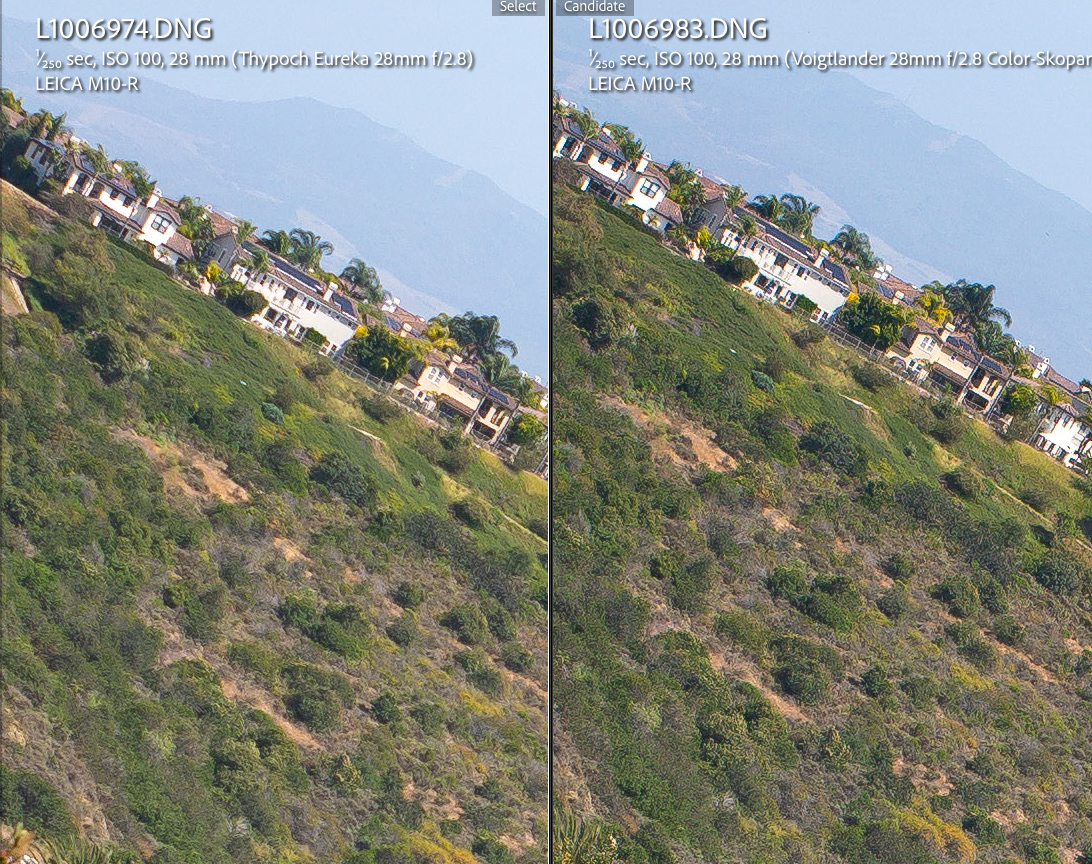
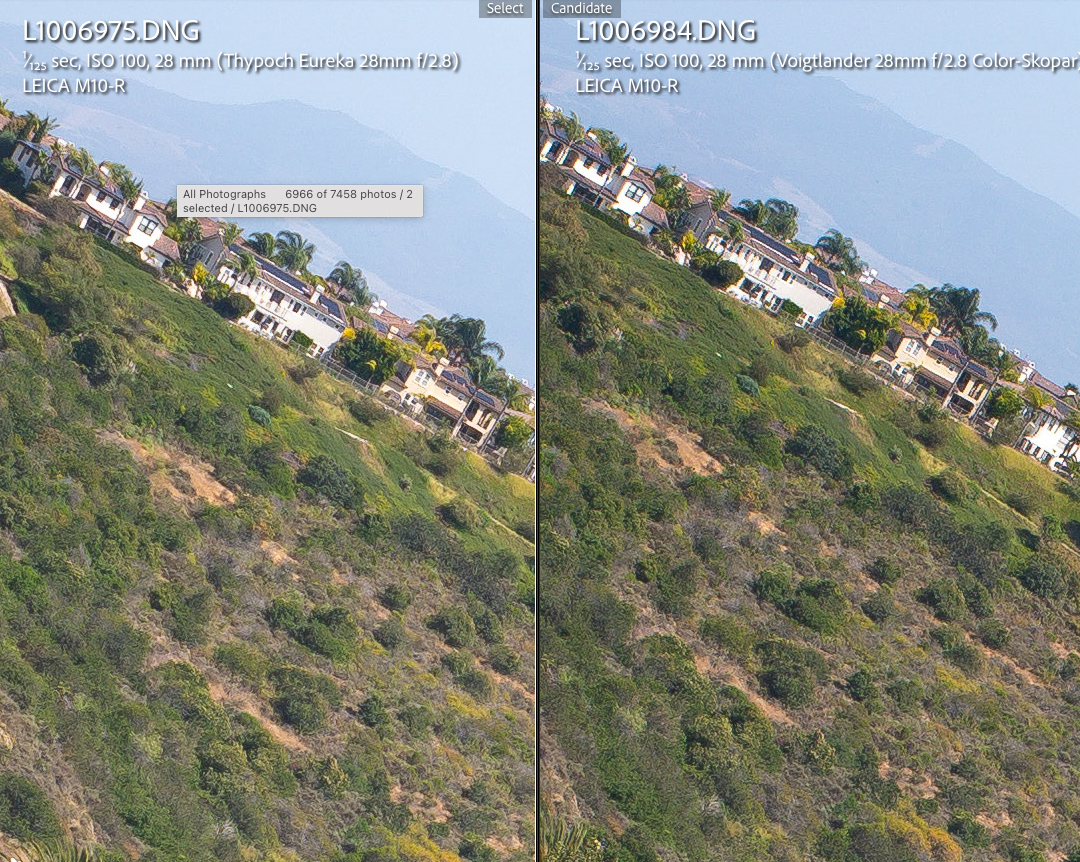
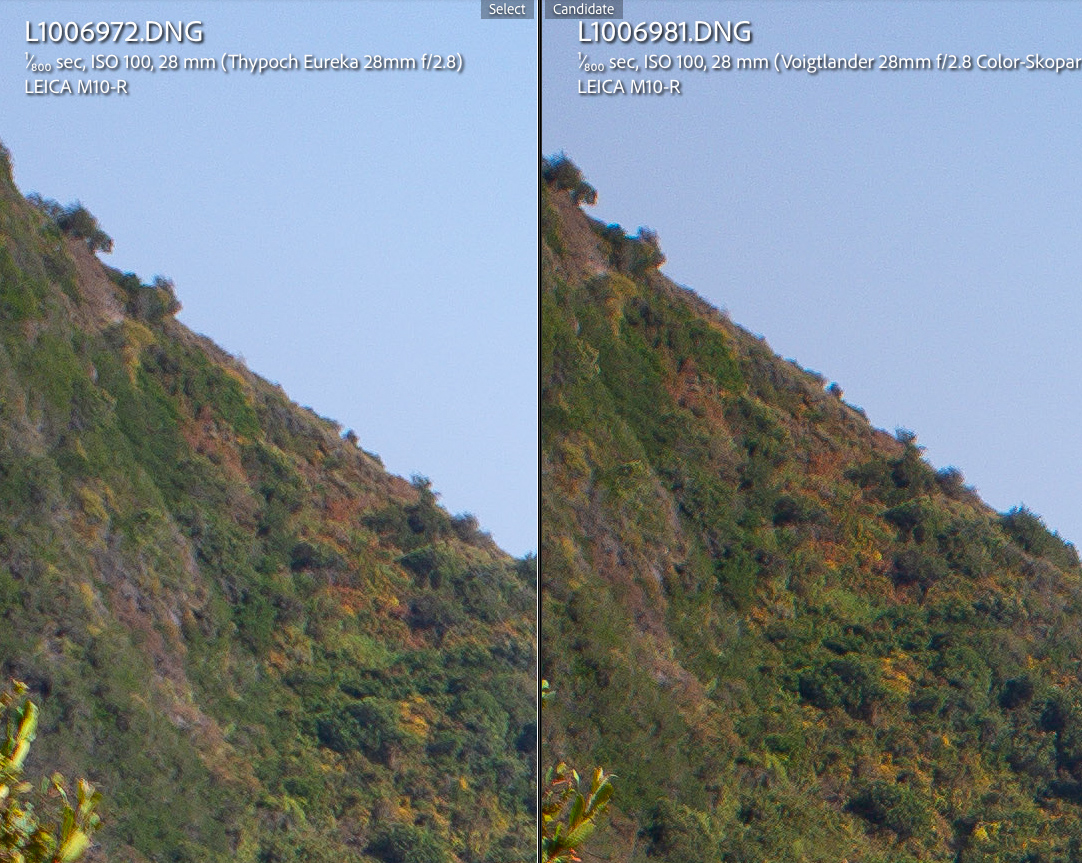
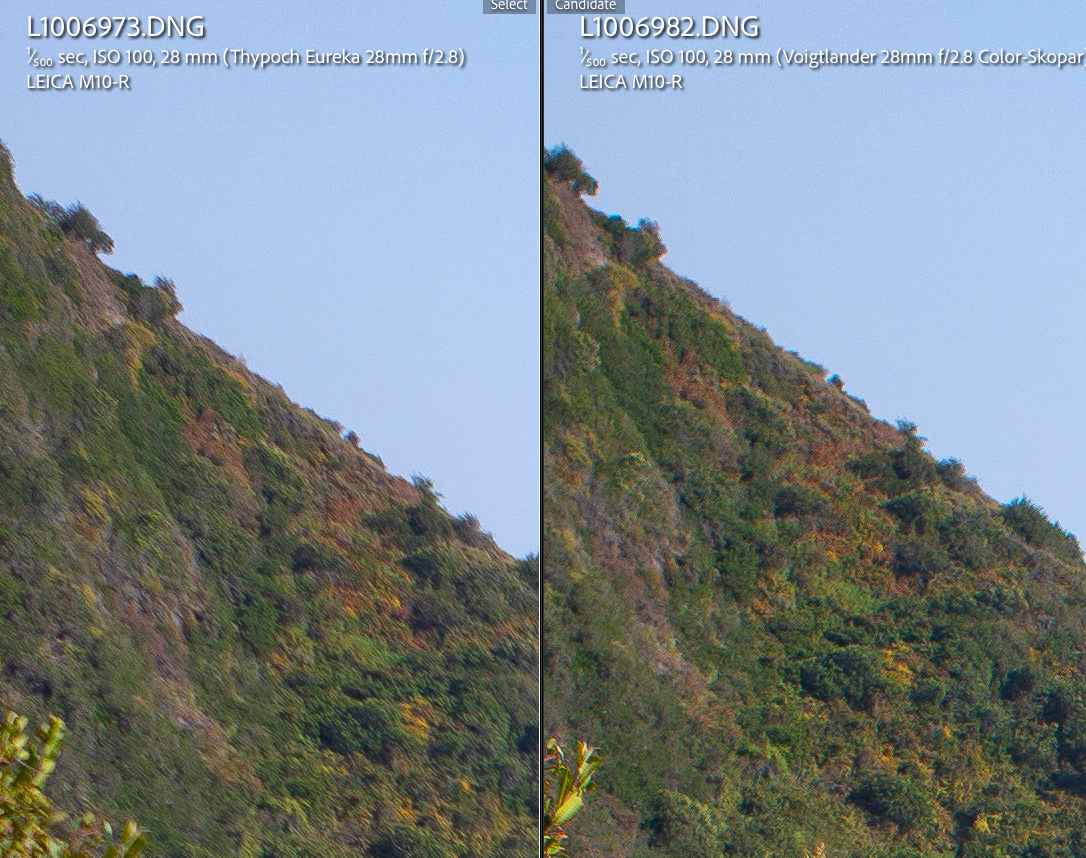
Yes, that's my plan, to compare the Thypoch Eureka 28mm f/2.8 directly against the Voigtlander 28mm f/2.8 Color-Skopar in terms of resolution, contrast, rendering, and chromatic aberration correction.
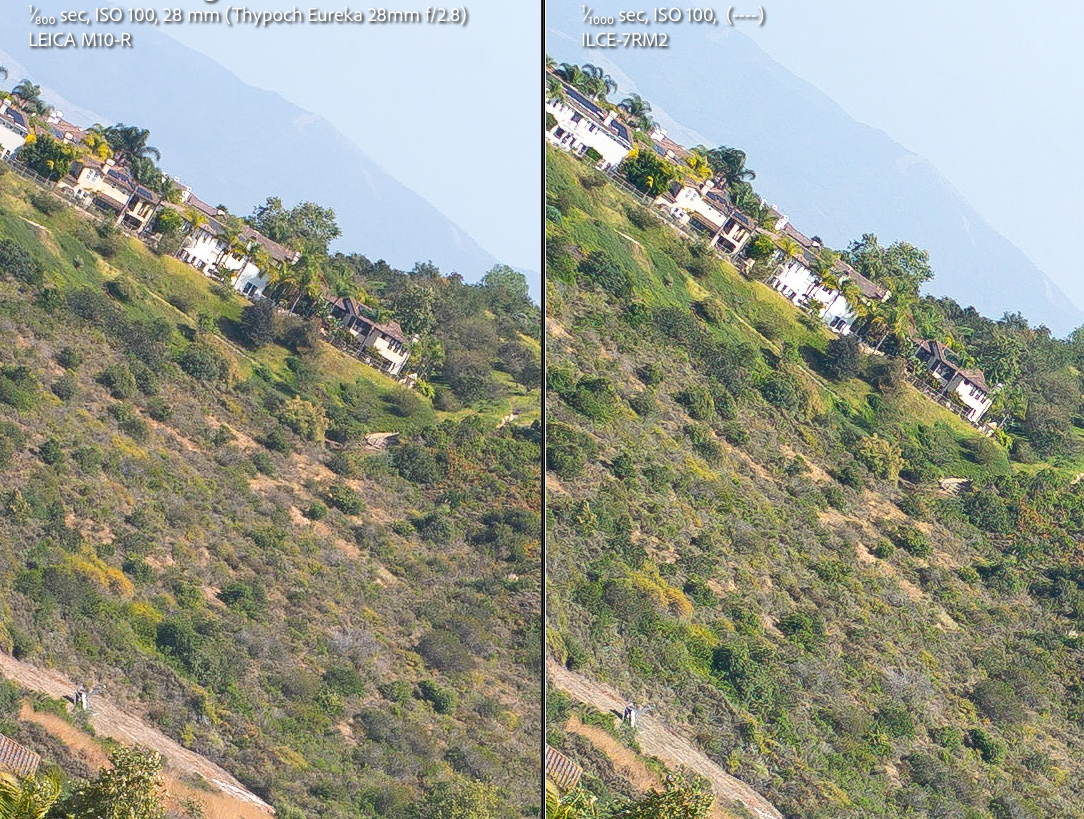
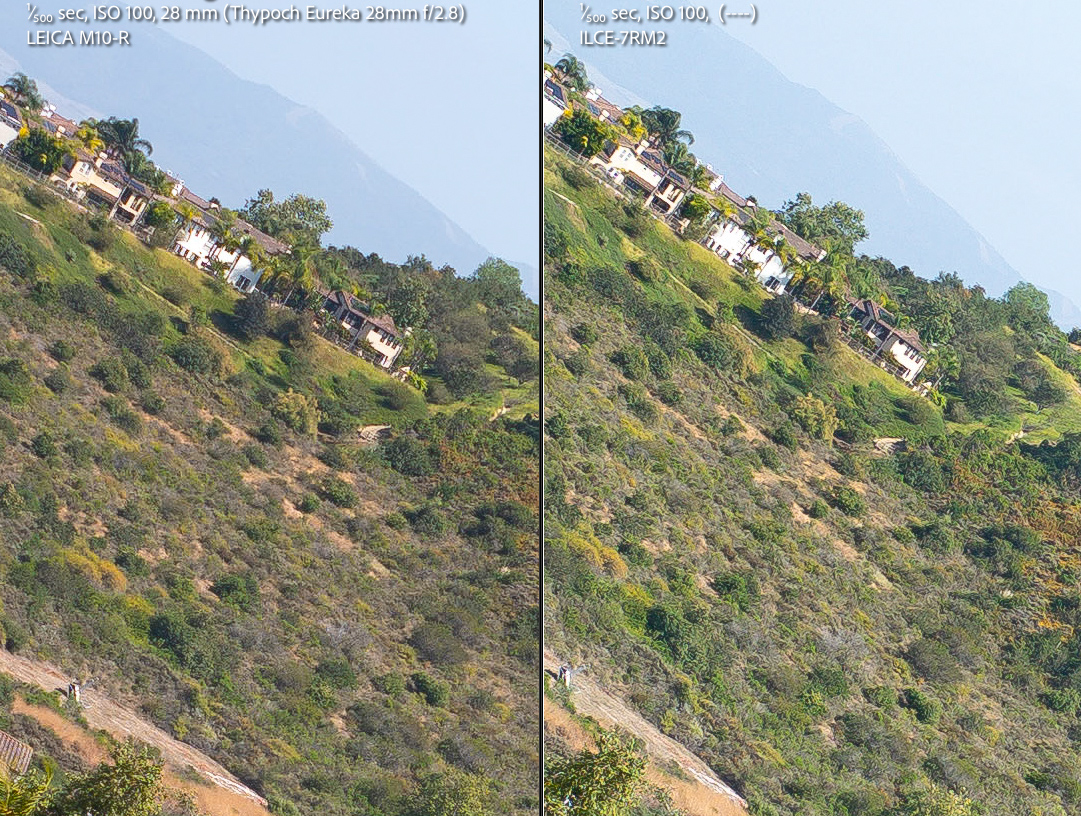
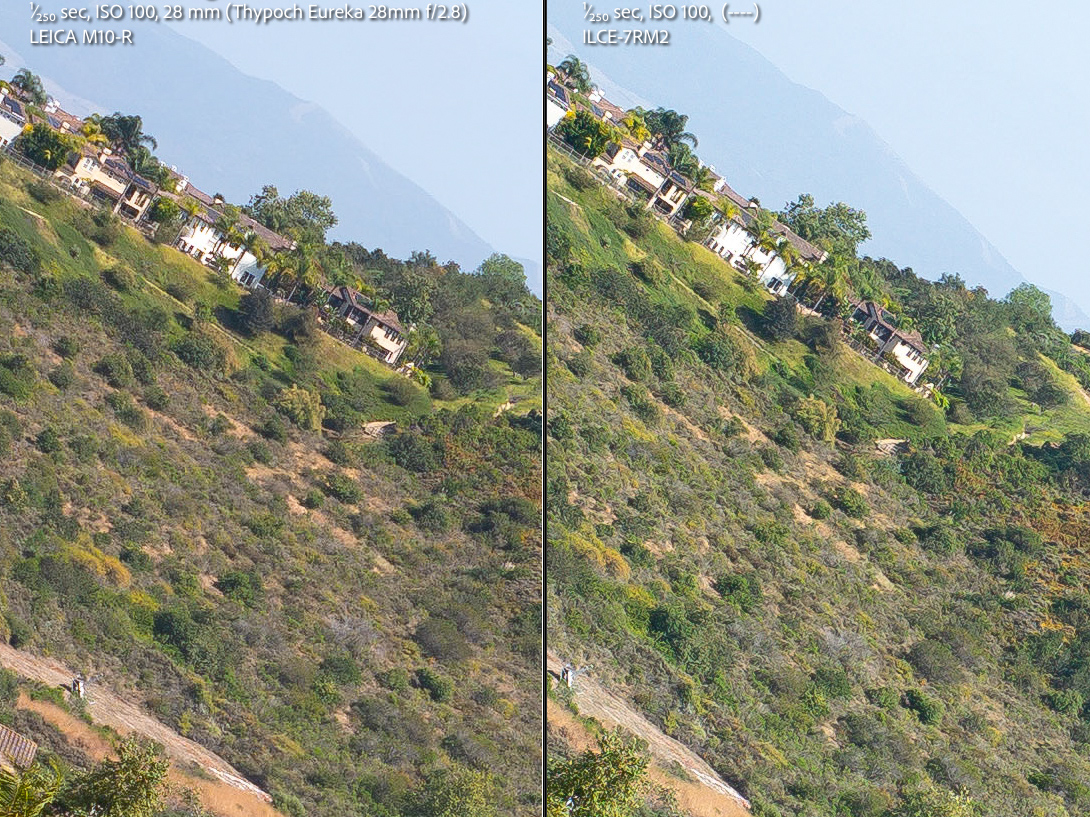
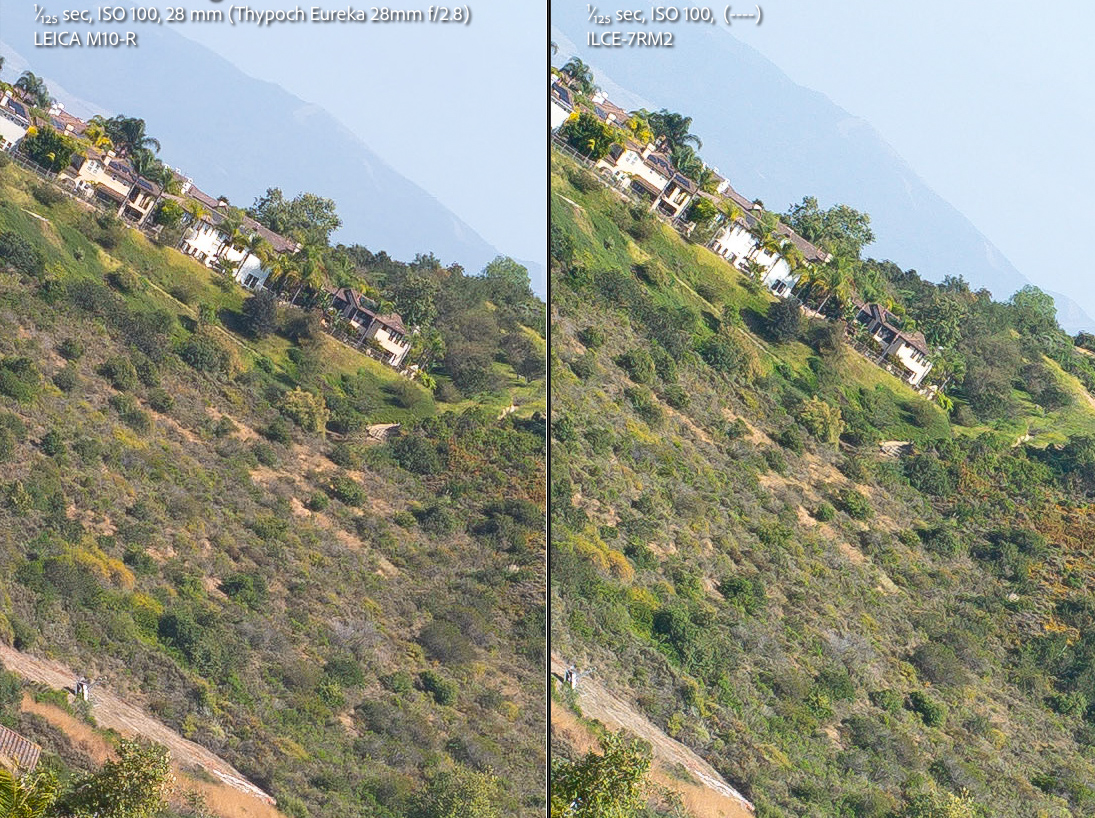
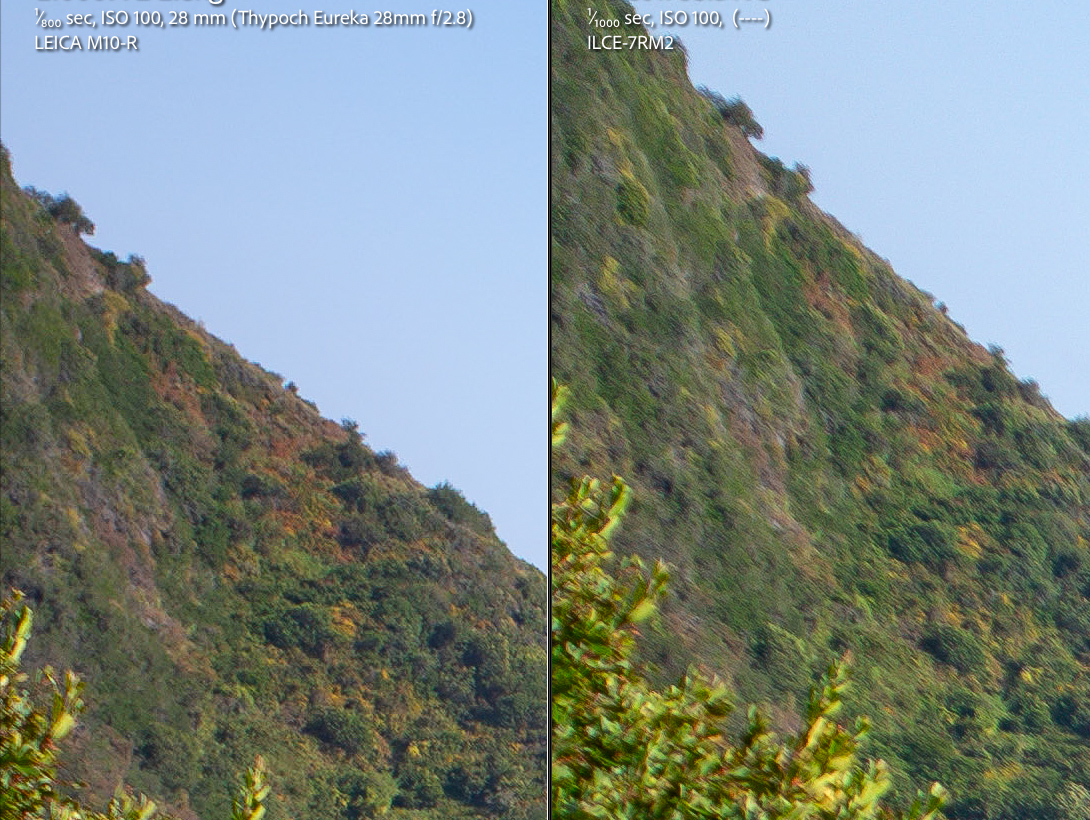
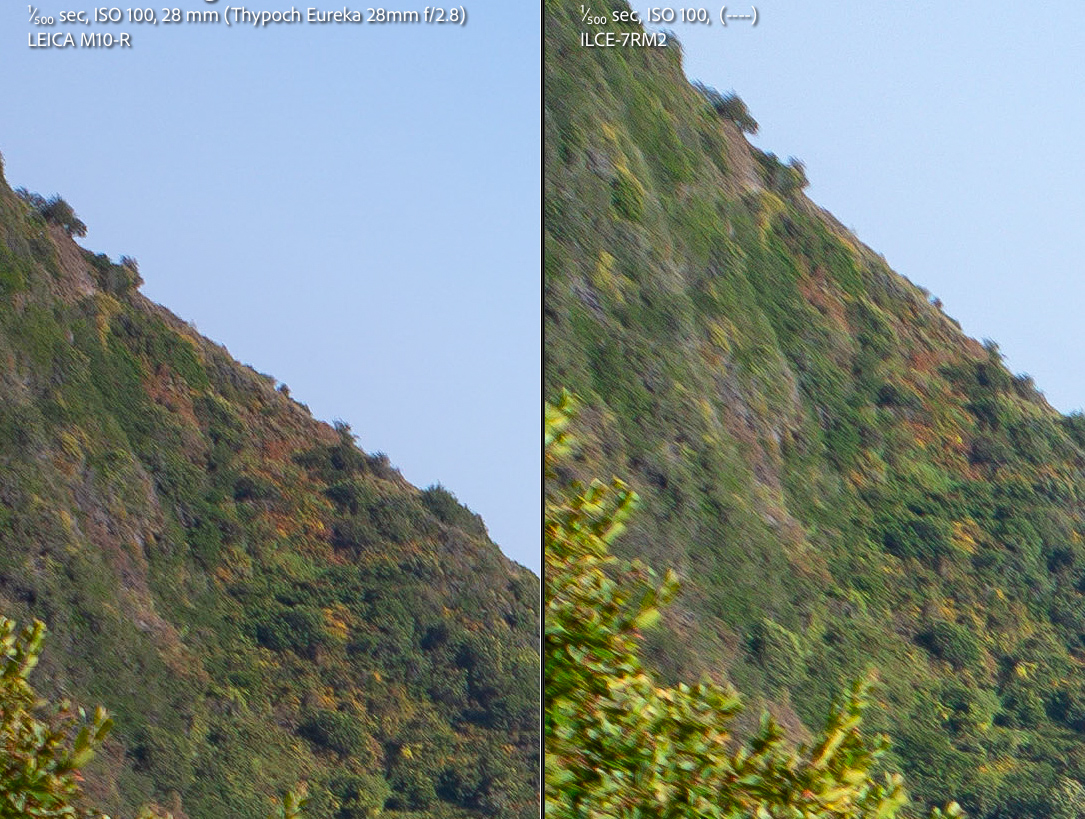
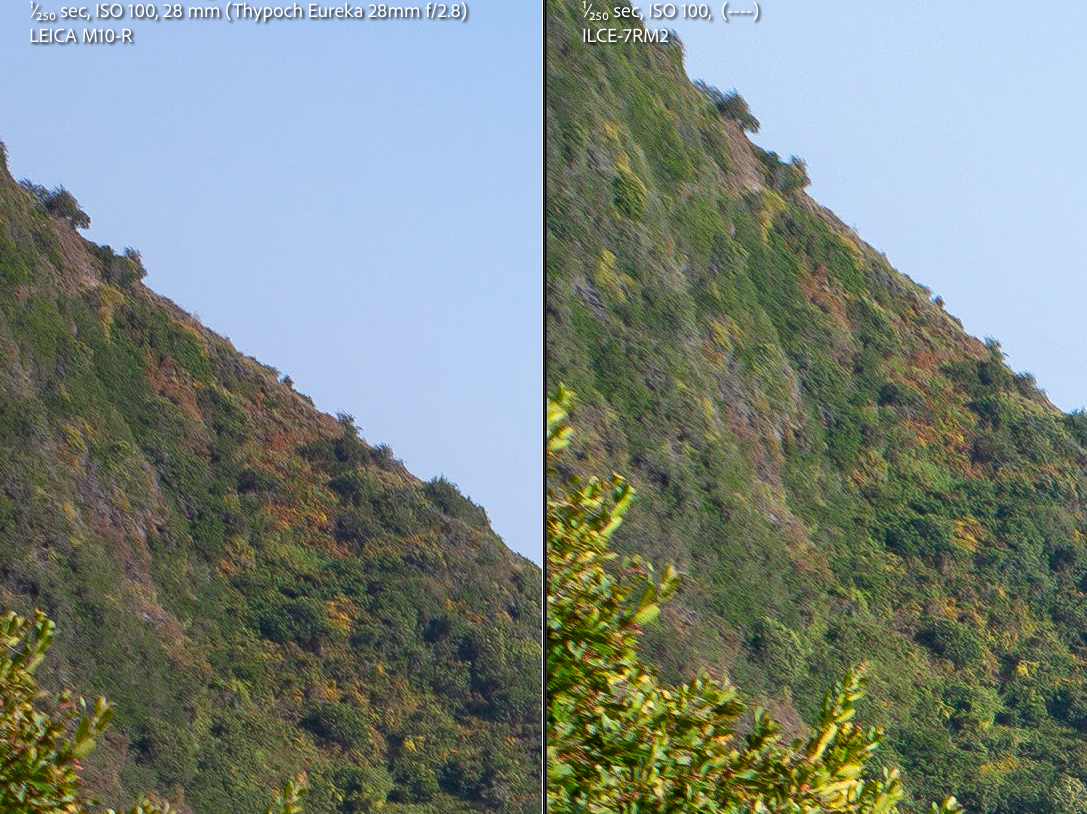
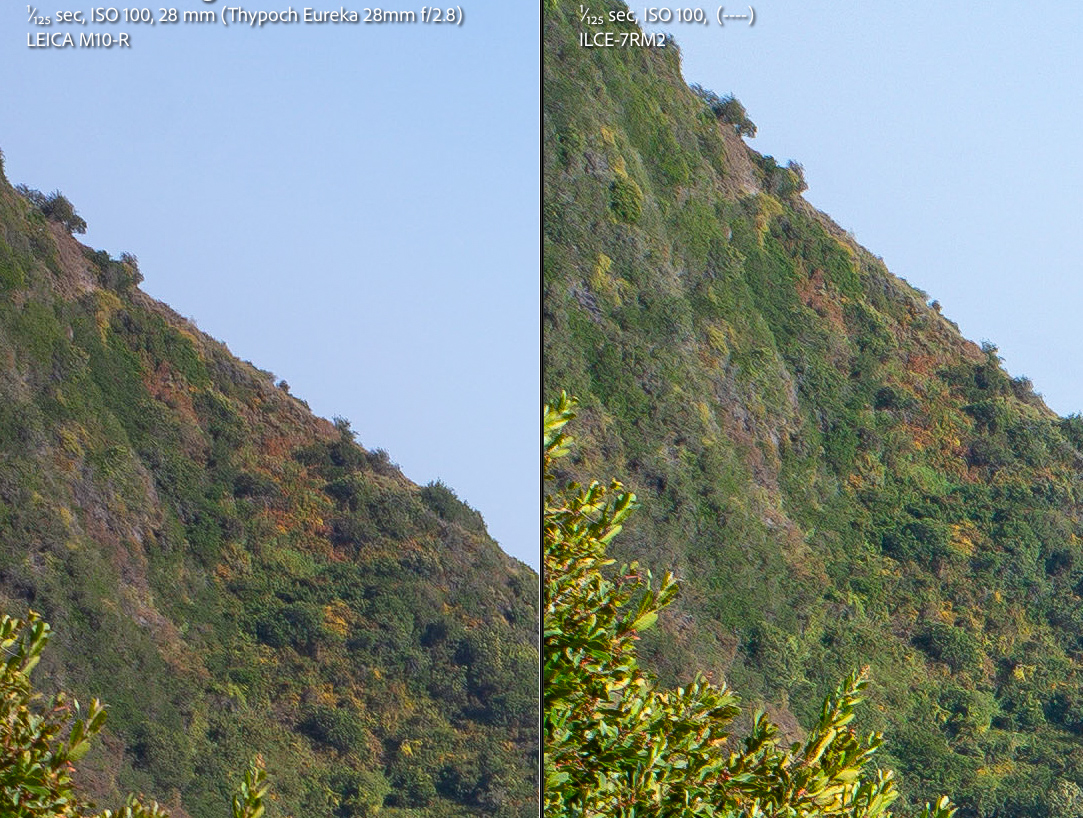
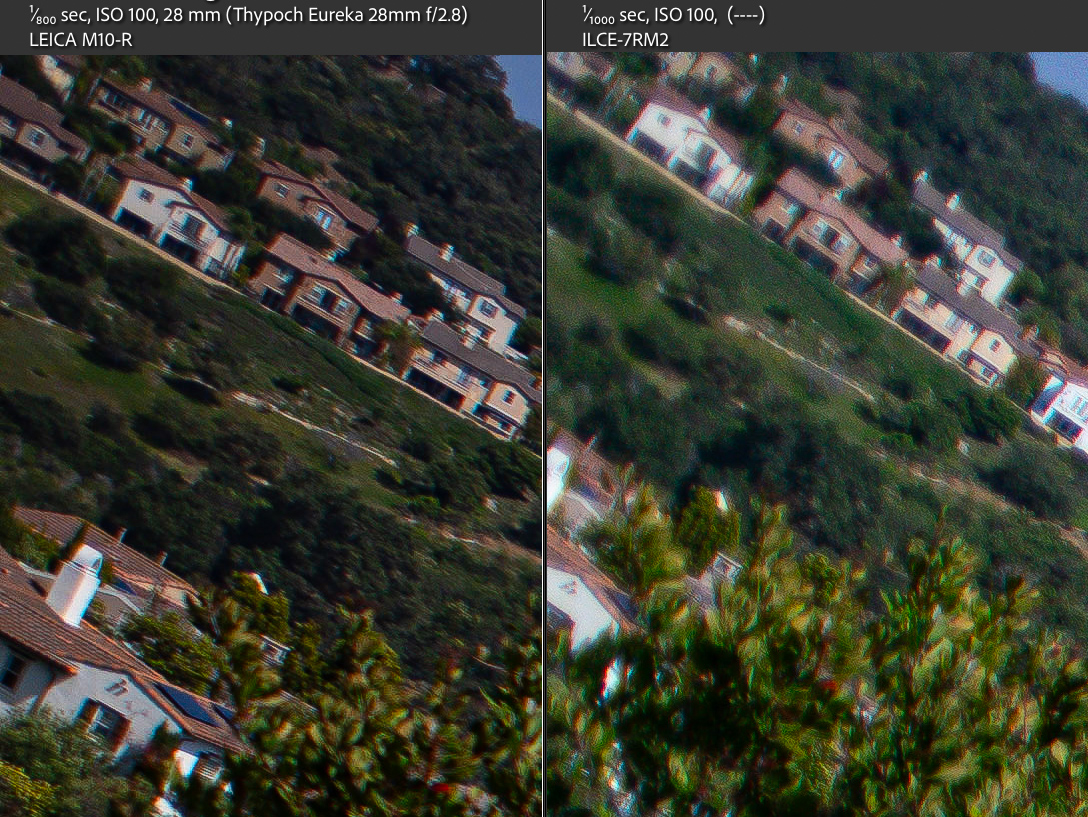
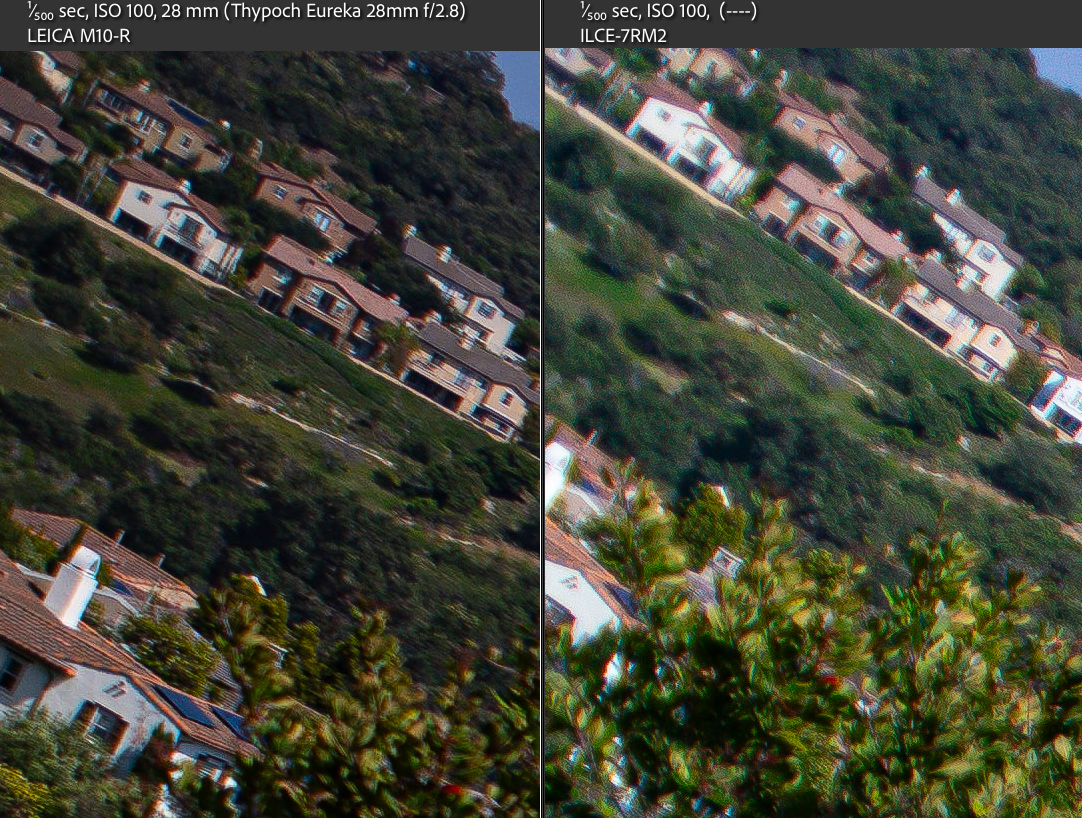
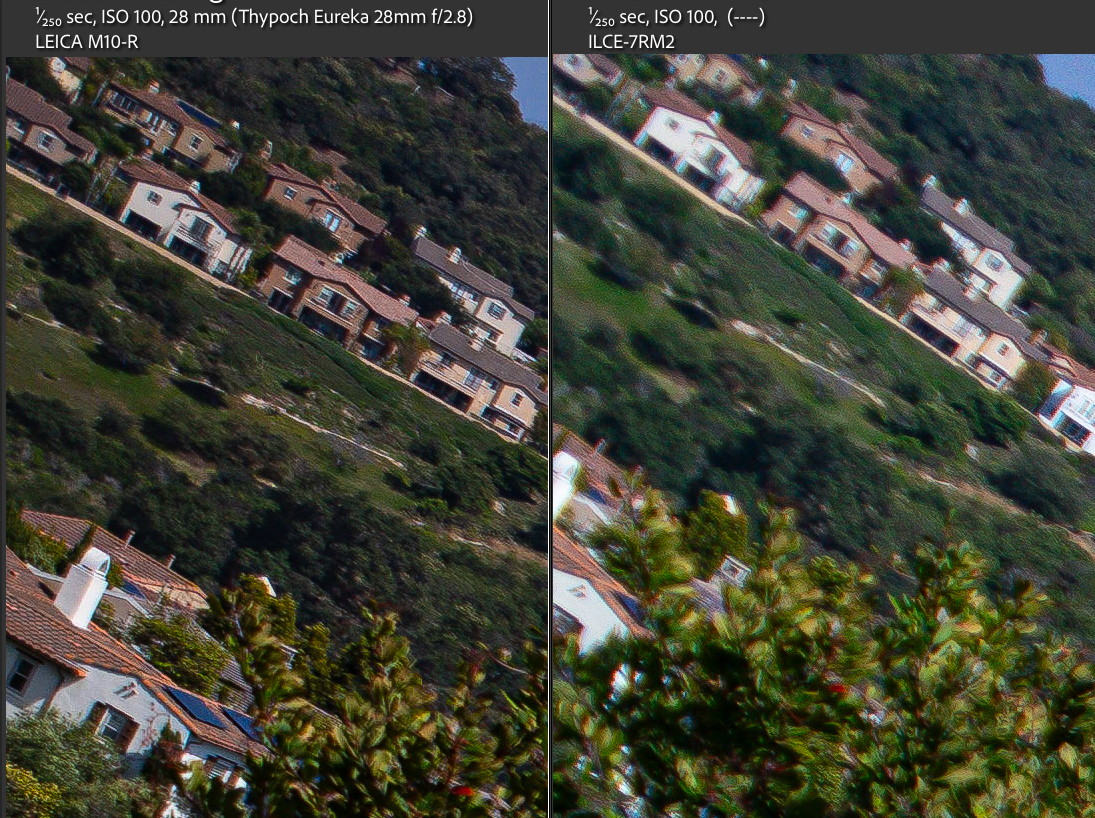
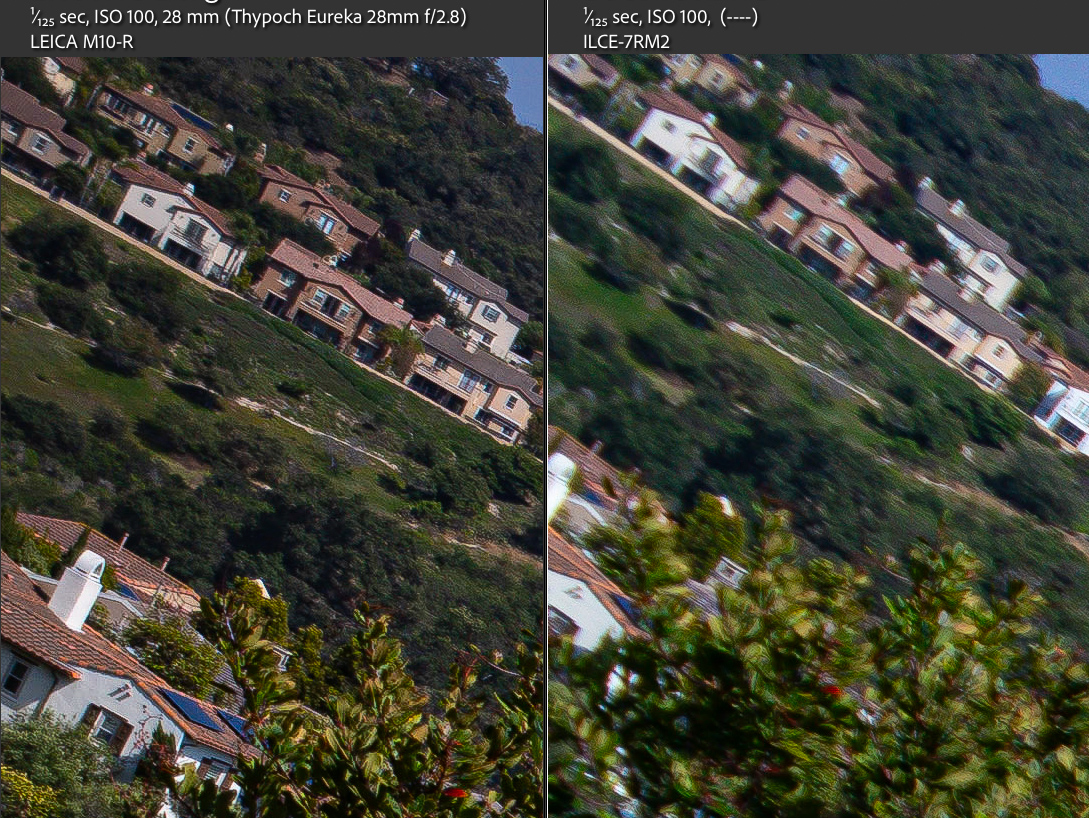
Resolution and Contrast at infinity: Leica M10-R vs Sony A7R II
Considering the Thypoch Eureka 28mm f/2.8 lens' compact size, I was not expecting exceptional performance across the entire image field, and the results largely matched those expectations. The lens delivers excellent resolution and contrast at center, while mid-field performance is less impressive and the corners are good, but not remarkably strong.
After comparing the lens on the Leica M10-R and then adapting it to the Sony A7R II, both using roughly 40MP sensors, it became clear to me that the optical design was optimized for the thinner sensor stack found in the Leica M system. In direct comparisons, center performance remains very similar between both cameras, which is expected, but resolution and contrast fall off noticeably away from center on the Sony due to induced field curvature from the thicker sensor stack.
What surprised me is that while many lenses recover from this behavior when stopped down, that is only partially the case with the Eureka. The mid-field does improve noticeably at smaller apertures, but even at f/8 the extreme corners on the Sony still remain relatively weak. Because of this, I would not recommend adapting this lens to Sony bodies if optimal image quality is the goal. It is clearly a lens designed around the Leica M platform.
Below is a series shot at f/2.8, f/4, f/5.6, and f/8 showing center, mid-field, and corner crops on both the Leica M and Sony sensors.
Distance: Infinity
Focus: Center - Best of three shots at maximum magnification
White Balance: Daylight
Both lenses are perfectly centered, as verified with my decentering test.
Software used: Lightroom with FM Default Landscape Sharpening; all other settings are at default.
PS: Vignetting, Chromatic Aberration (CA), and distortion were not corrected either in post-processing or in-camera.
Center Resolution and Contrast Resolution and Contrast at infinity: Leica M10-R vs Sony A7R II
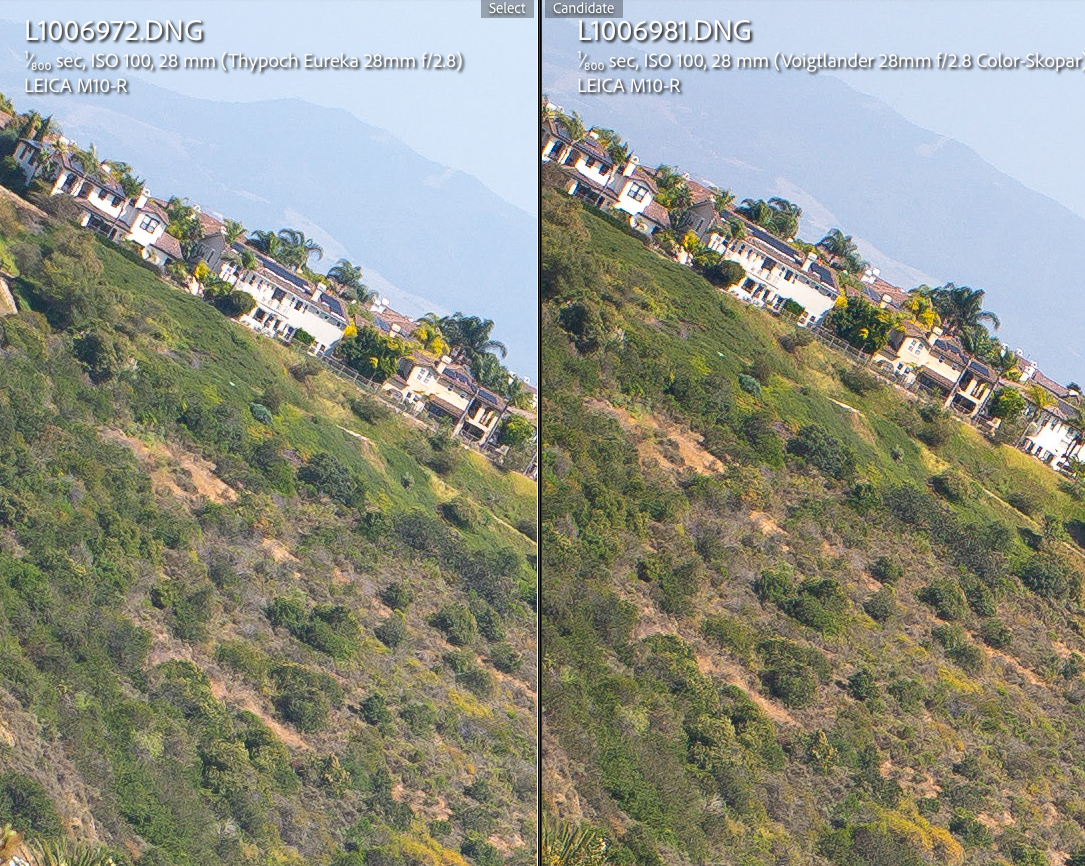
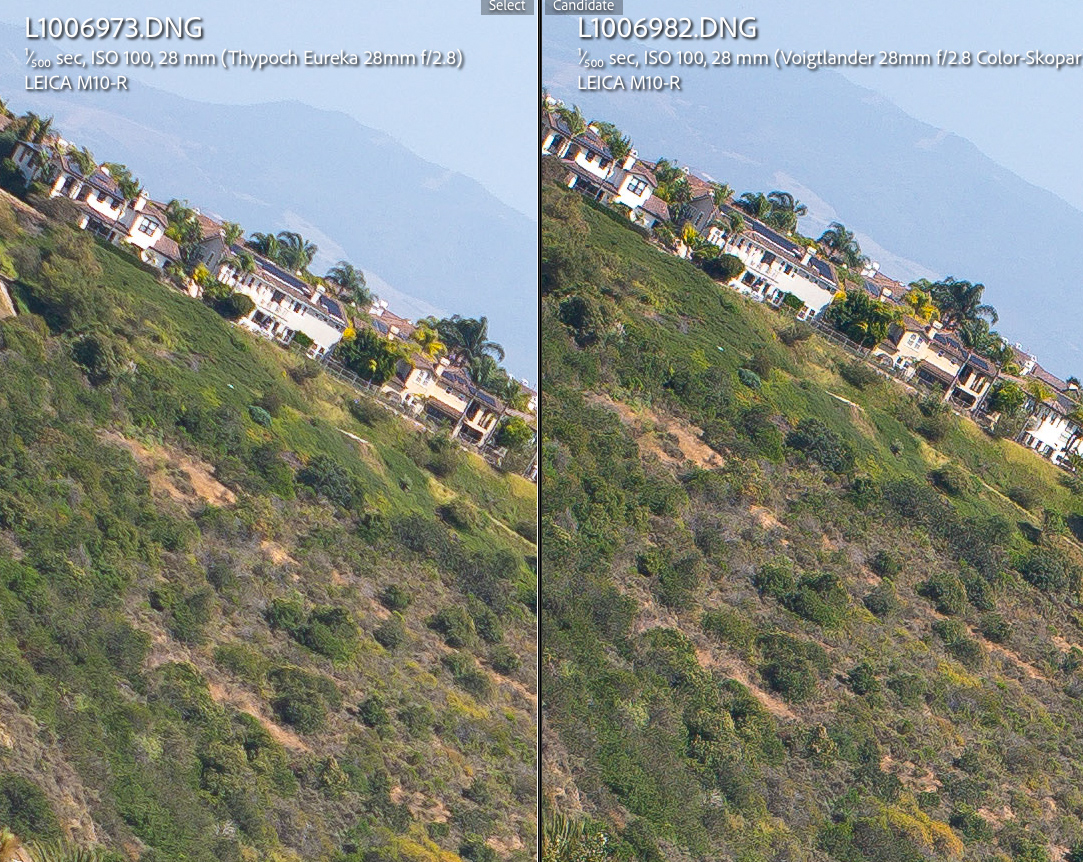
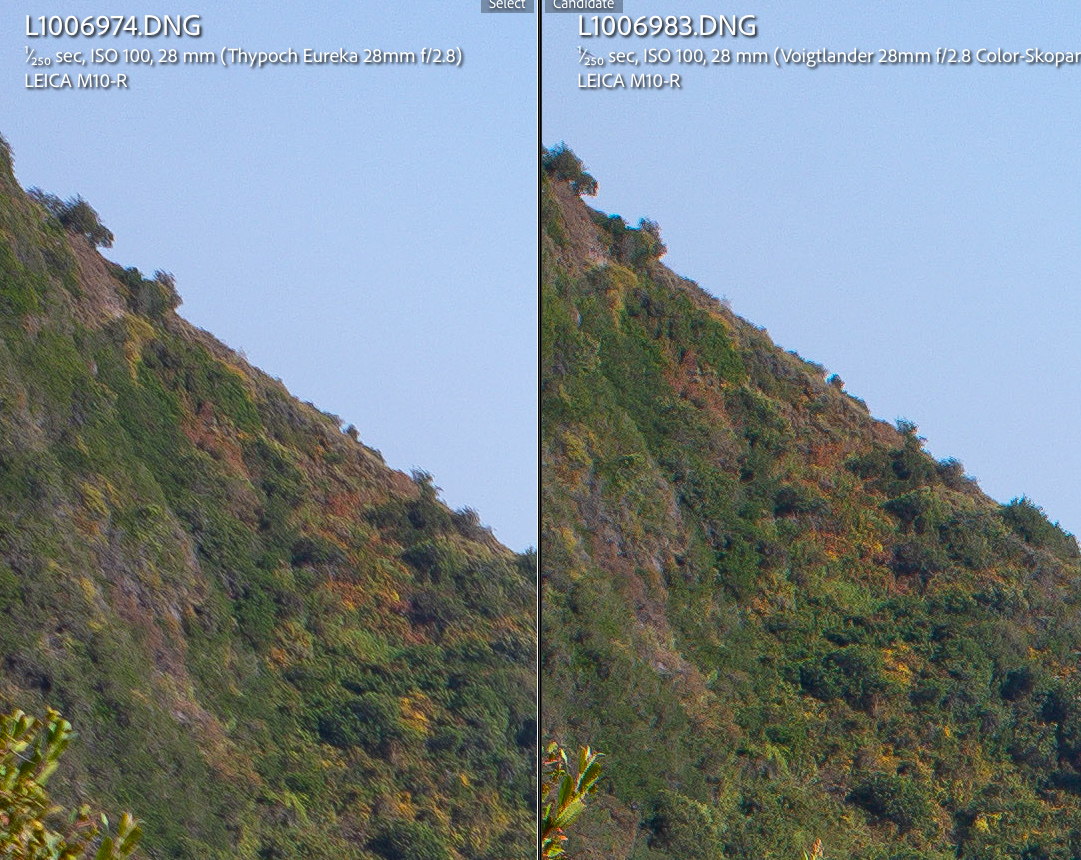
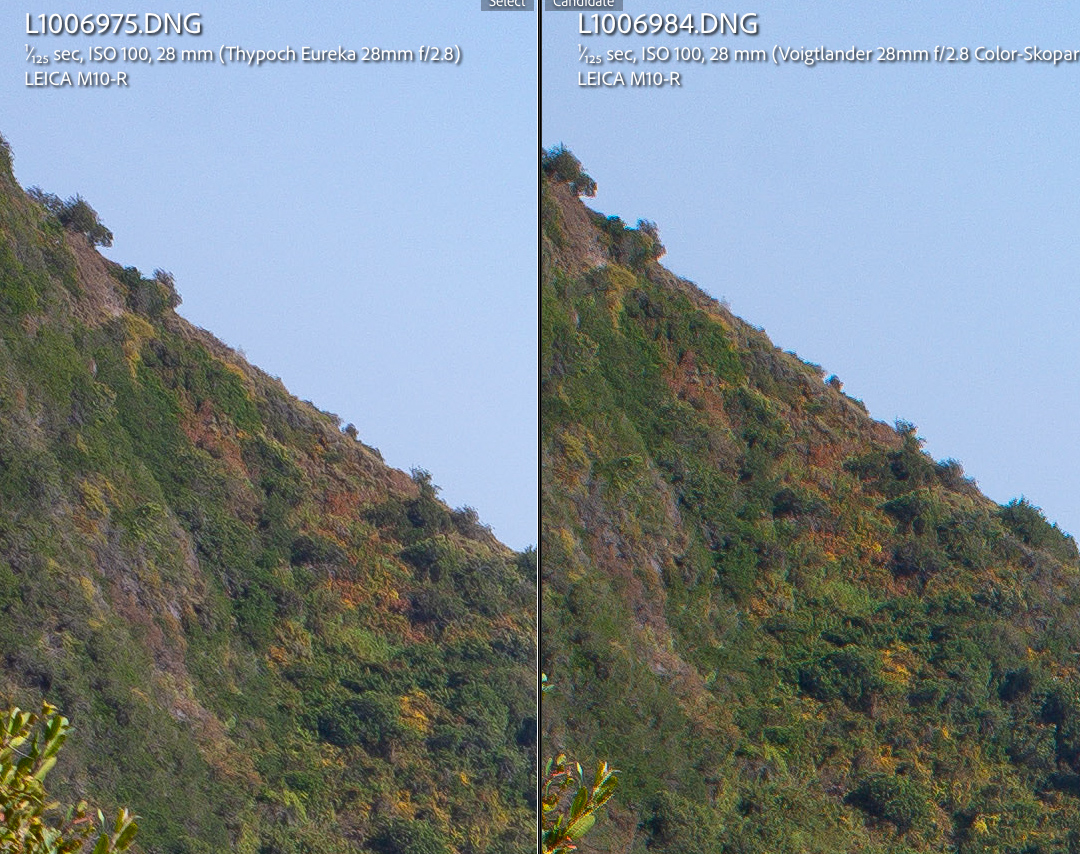
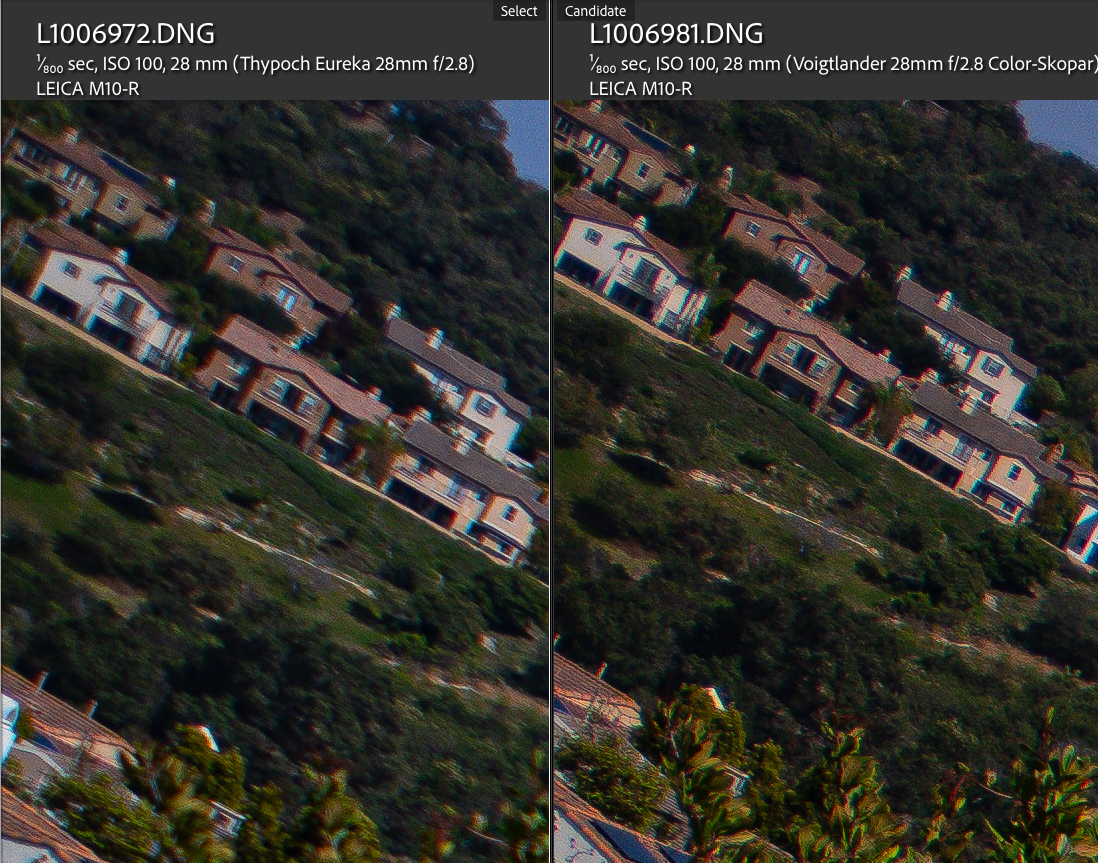
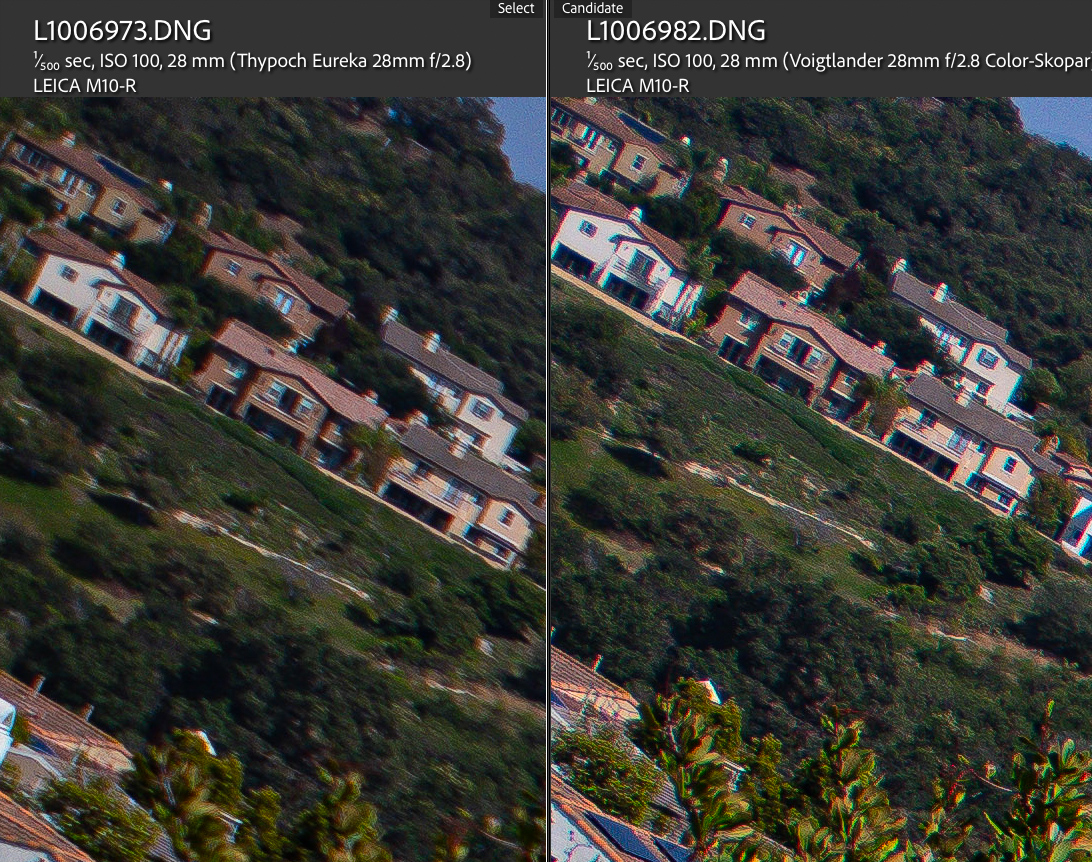
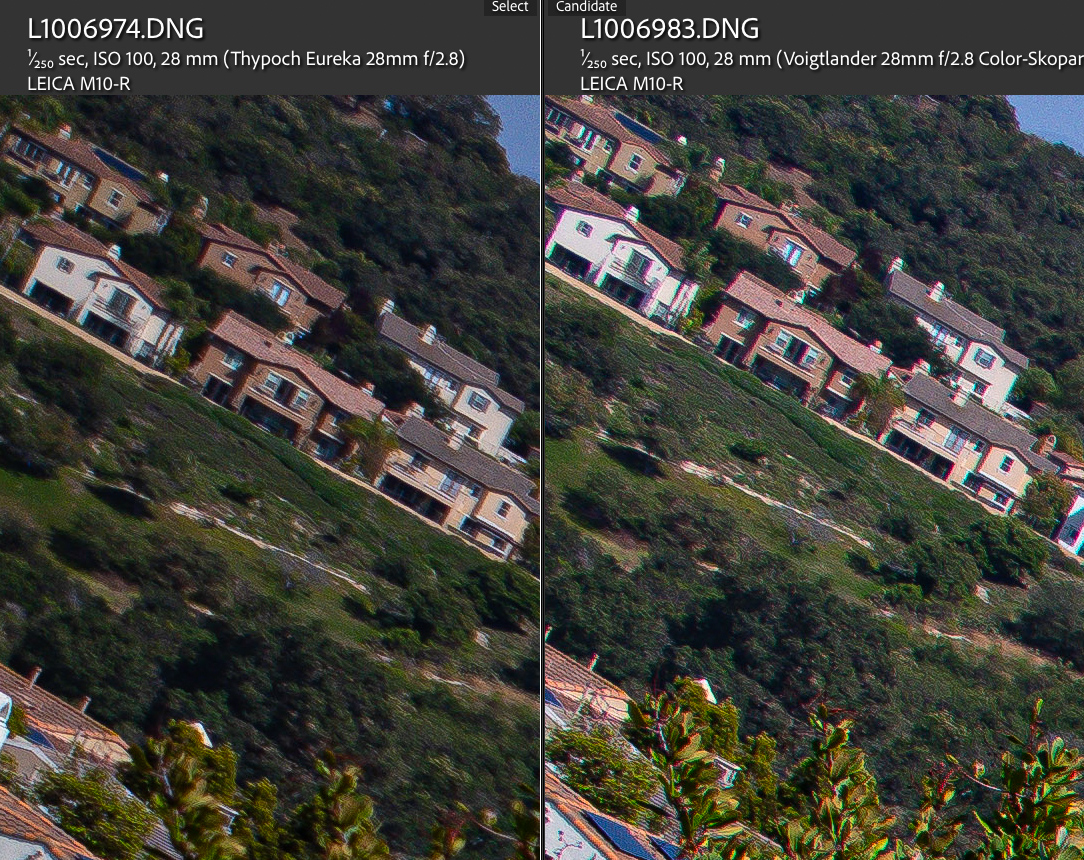
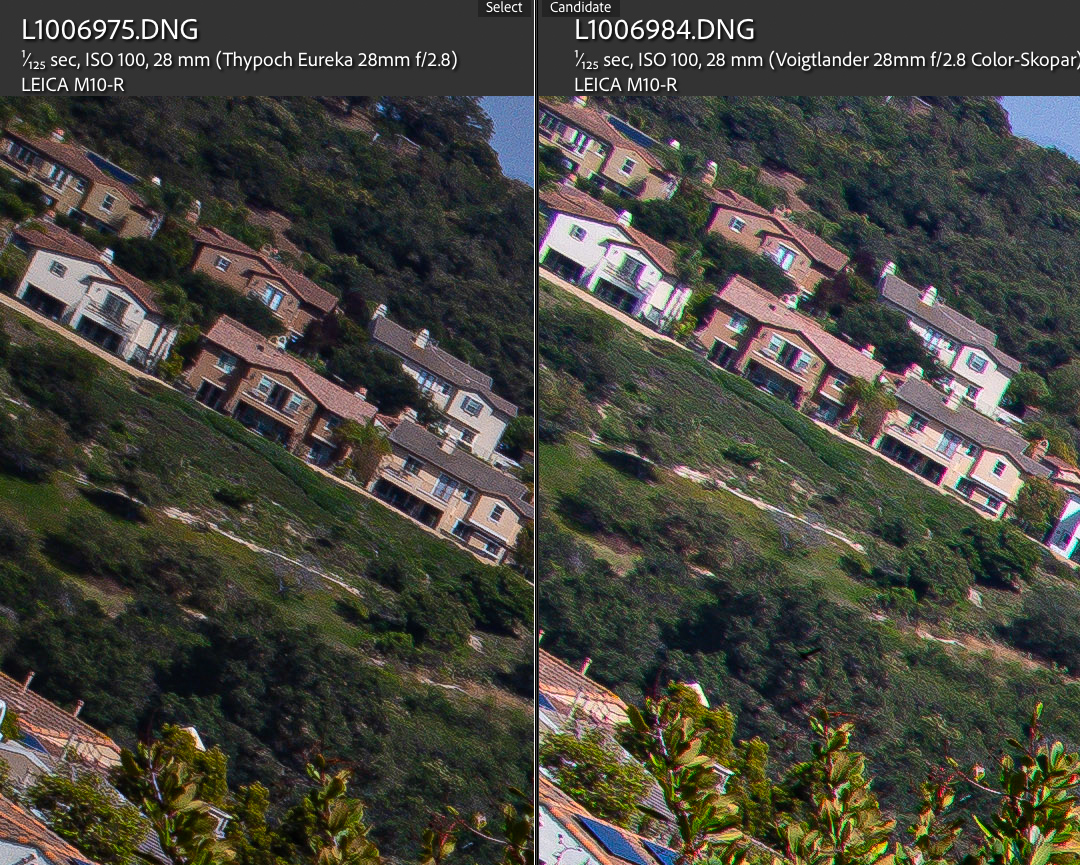
Resolution and Contrast compared to Voigtlander 28mm f/2.8 Color-Skopar
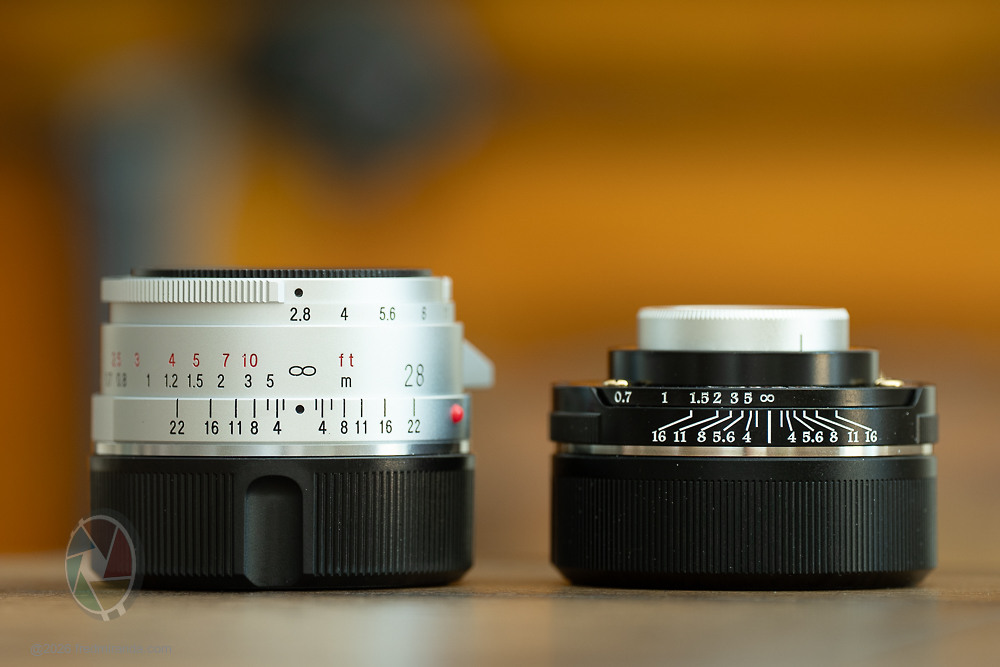
Many people want to see how the tiny Eureka 28mm f/2.8 compares to another similarly compact 28mm f/2.8 lens. The Voigtlander 28mm f/2.8 Color Skopar fits that role well. It is slightly less compact, but it is actually lighter than the Eureka, making it a very fair comparison.
The results were largely as expected, since the Voigtlander 28mm f/2.8 Color Skopar is a strong performer. I never hesitate to shoot the Color Skopar wide open, but stopping down slightly to f/3.2 or f/4 brings a clear and noticeable improvement. In this comparison, it already shows better mid-field and corner performance than the Eureka. Center sharpness is similar, although the Voigtlander still maintains a slight edge there as well.
Overall, the Voigtlander delivers higher resolution and contrast across the frame. That said I think the Eureka performed well but I'll let the crops below speak for themselves so you can judge the differences directly.
Below is a series shot at f/2.8, f/4, f/5.6, and f/8 showing center, mid-field, and corner crops.
Distance: Infinity
Focus: Center - Best of three shots at maximum magnification
White Balance: Daylight
Both lenses are perfectly centered, as verified with my decentering test.
Software used: Lightroom with FM Default Landscape Sharpening; all other settings are at default.
PS: Vignetting, Chromatic Aberration (CA), and distortion were not corrected either in post-processing or in-camera.
Center Resolution and Contrast Resolution and Contrast compared to Voigtlander 28mm f/2.8 Color-Skopar
That's a very disappointing performance on the Sony, even at the midfield. The Thypoch lens also comes up a bit short on the Leica body in its comparison against the Skopar, at least in terms of sharpness and contrast. Of course with some images there are characteristics that are more important than sharpness. While a (somewhat slow) 28mm may be viewed primarily as a landscape lens, sometimes out-of focus rendering matters, as does the flare and sunstar performance. It will be interesting to see if it excels in those other areas.
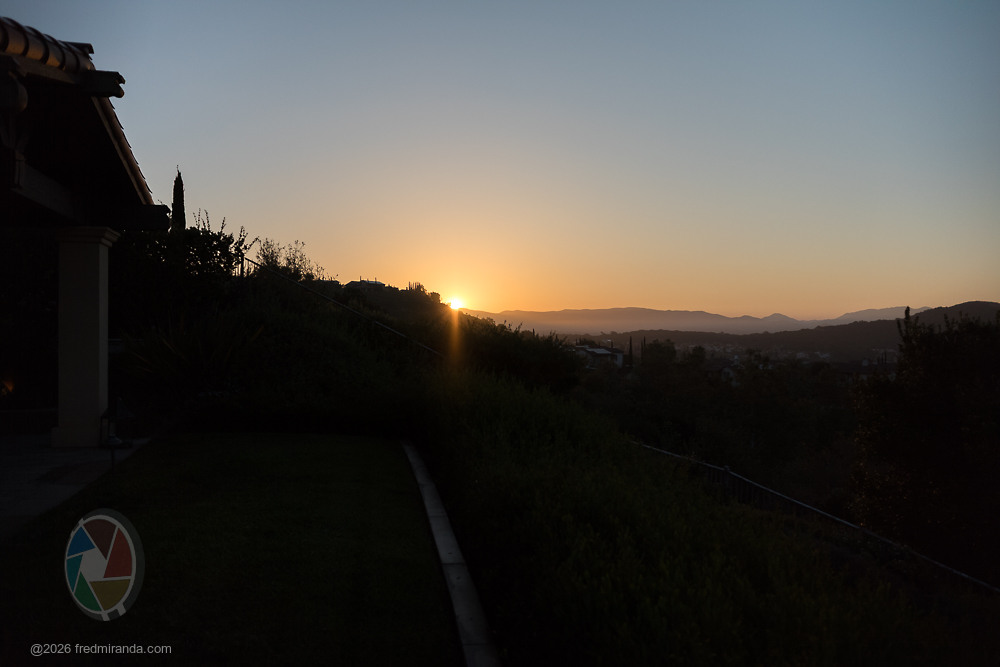
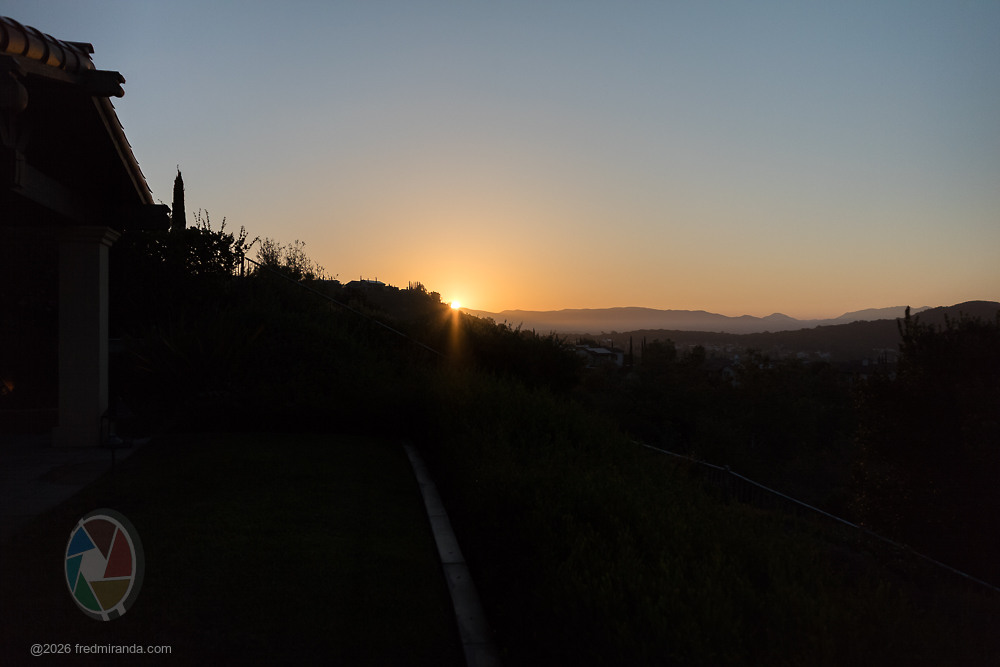
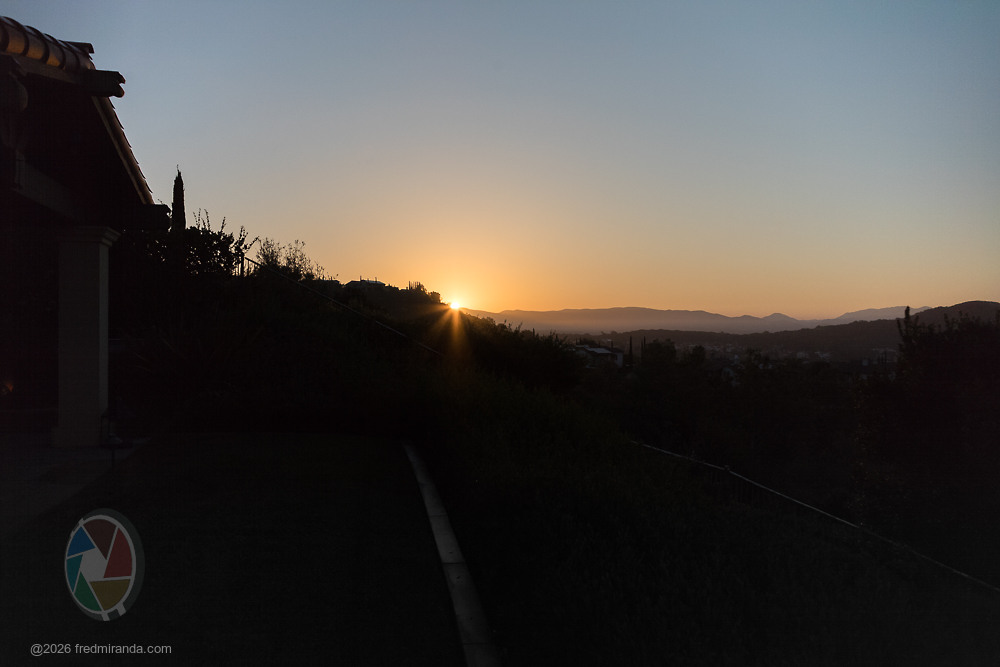
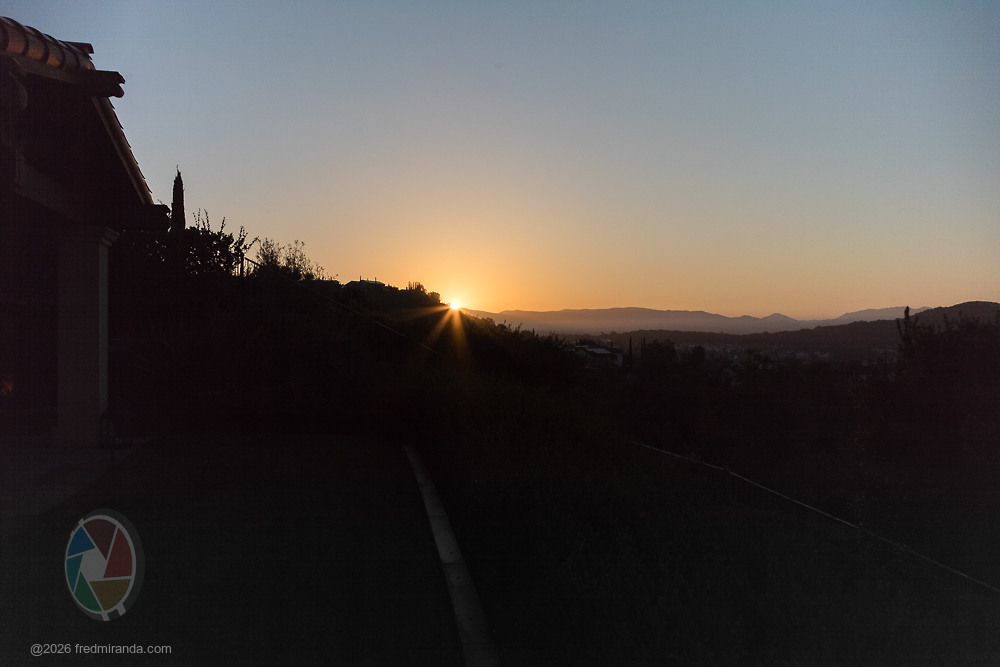
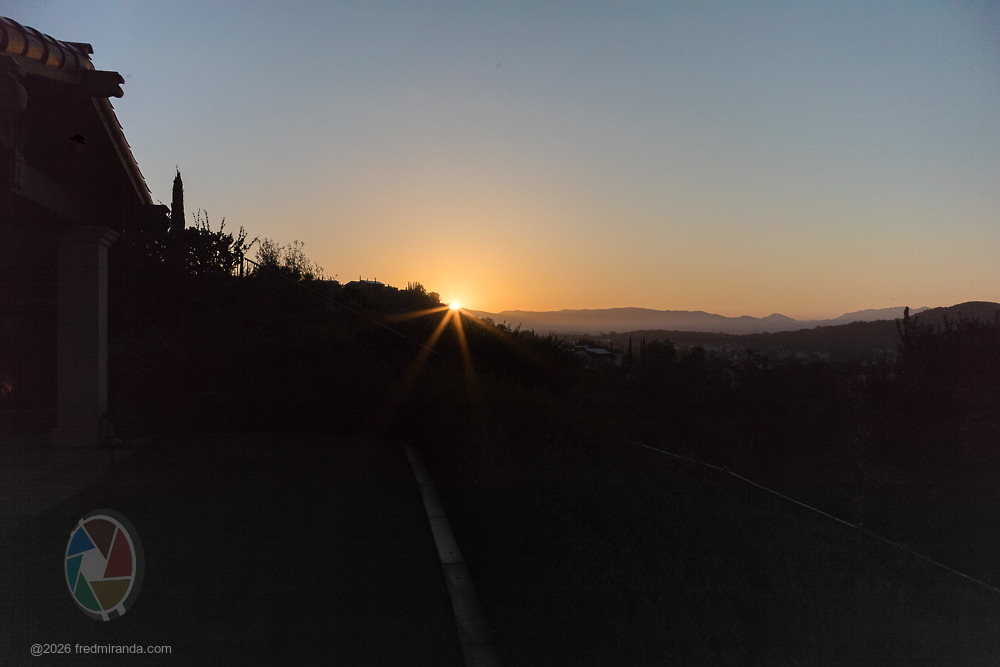
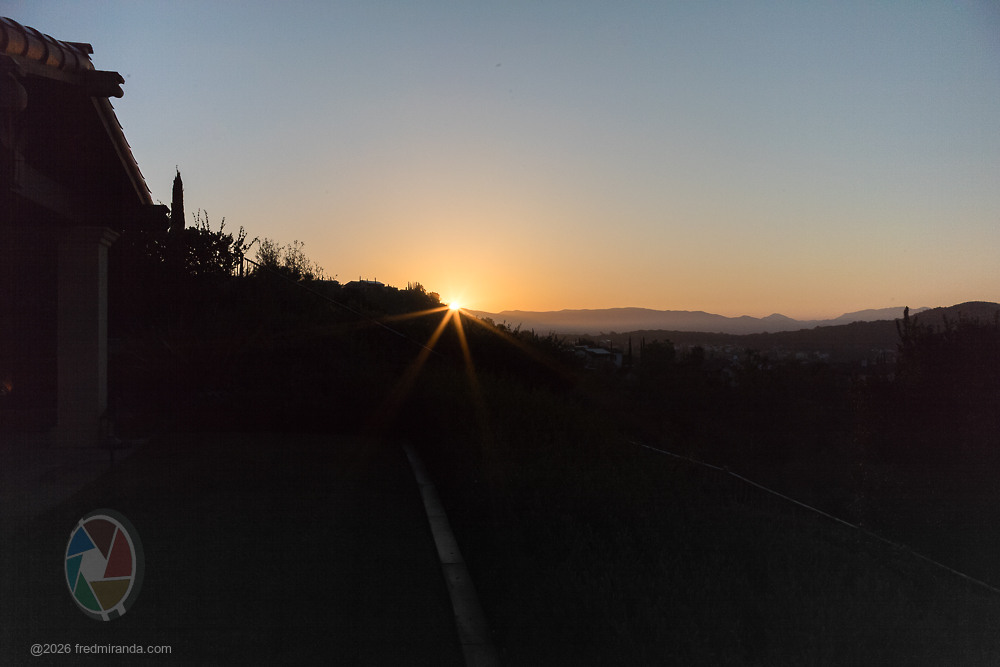
The Thypoch Eureka 28mm f/2.8 produces well defined sunstars when stopped down, with increasing definition becoming noticeable around f/8 and reaching its strongest rendering at f/11 through f/16. The aperture uses more rounded blades, which in practice helps preserve smoother, more circular highlight bokeh rather than strong sunstar formation at wider apertures. Manufacturing tolerance appears solid, with clean symmetry and evenly spaced rays.
From f/2.8 through f/5.6, the sun rays remain soft, smooth, and largely undefined. Starting at f/8, they begin to take shape more clearly and become progressively more defined through the rest of the aperture range. They are not overly defined like some lenses with uniformly straight blade geometry, which many will actually prefer for its more natural rendering. At f/16, the sunstars remain surprisingly clean and well defined, avoiding the chaotic breakup often seen at very small apertures, and this is actually where definition peaks.
Below is a sequence showing the transition from f/2.8 to f/16 in one stop increments. With 8 aperture blades, the lens produces 8 pointed sunstars with good symmetry, though I would personally prefer 10 blades, likely a trade off for compactness.
Also included in this series is uncorrected vignetting across the full aperture range.
The Thypoch Eureka 28mm f/2.8 shows a surprisingly neutral field curvature profile for such an ultra-compact 28mm lens. Compact designs at this focal length typically show noticeable outward field curvature, and while there is a slight outward tendency at close distances, it is subtle enough that it is unlikely to be visible in real-world rendering or across-the-frame performance. At longer focusing distances, the field curvature becomes even more neutral and well controlled.
Below is a GIF animation showing the focus transition from close distance to infinity in multiple steps. Field curvature is harder to visualize with a slow ultra wide lens like this, but the sequence still provides a useful sense of how the curvature behavior shifts with subject distance.
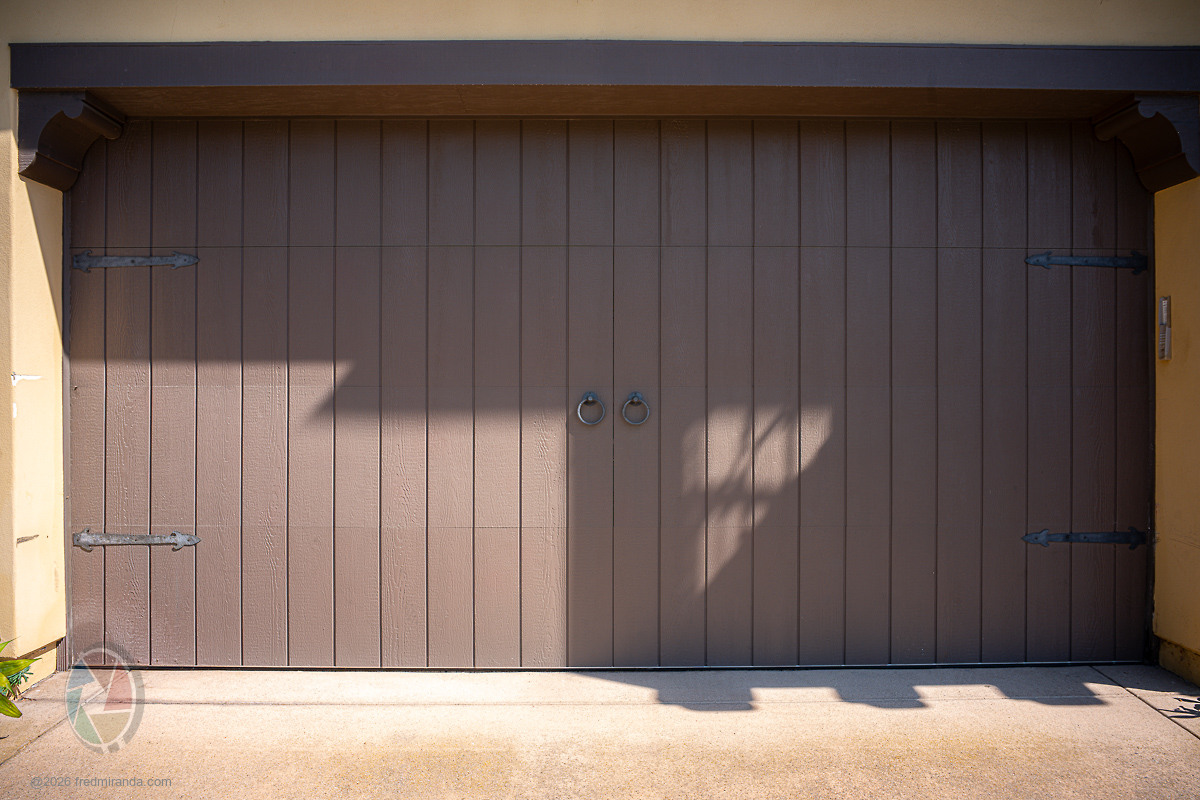
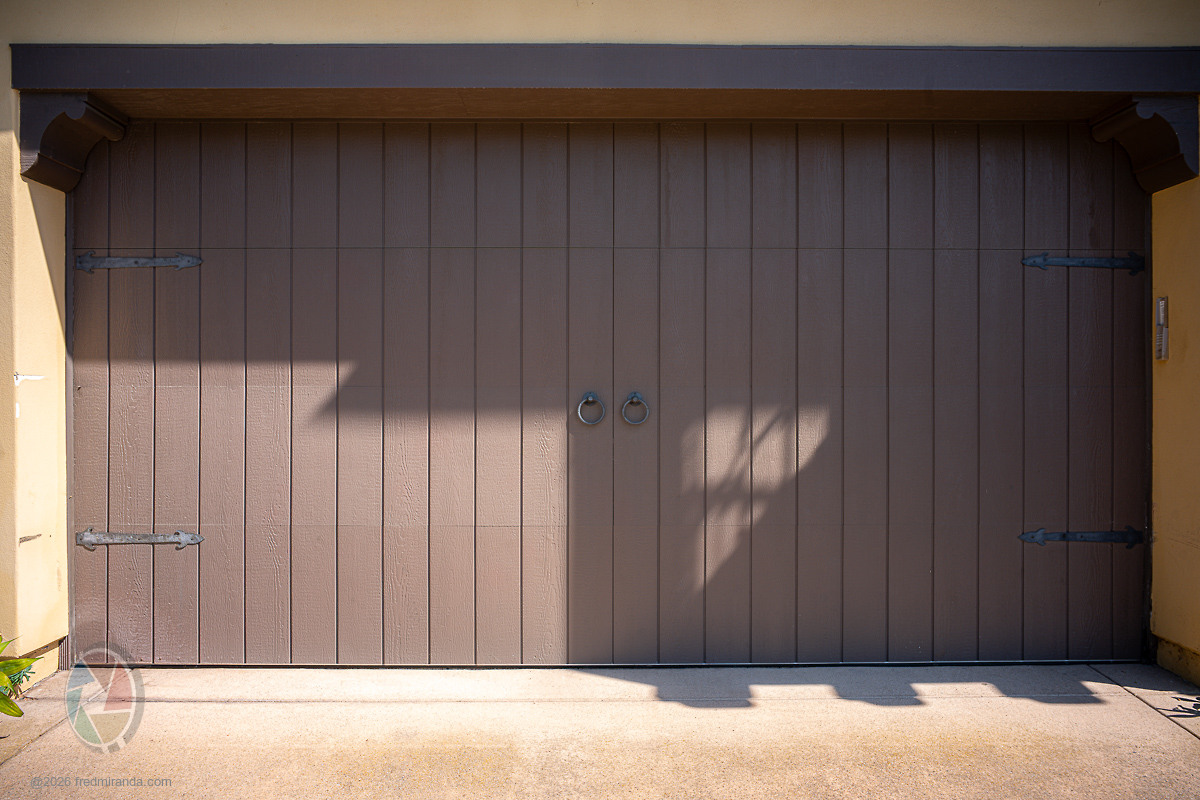
The Thypoch Eureka 28mm f/2.8 shows mild barrel distortion. While Lightroom profiles are not yet available, the distortion is easy to correct manually using the distortion slider set to +3, as shown in the samples below.
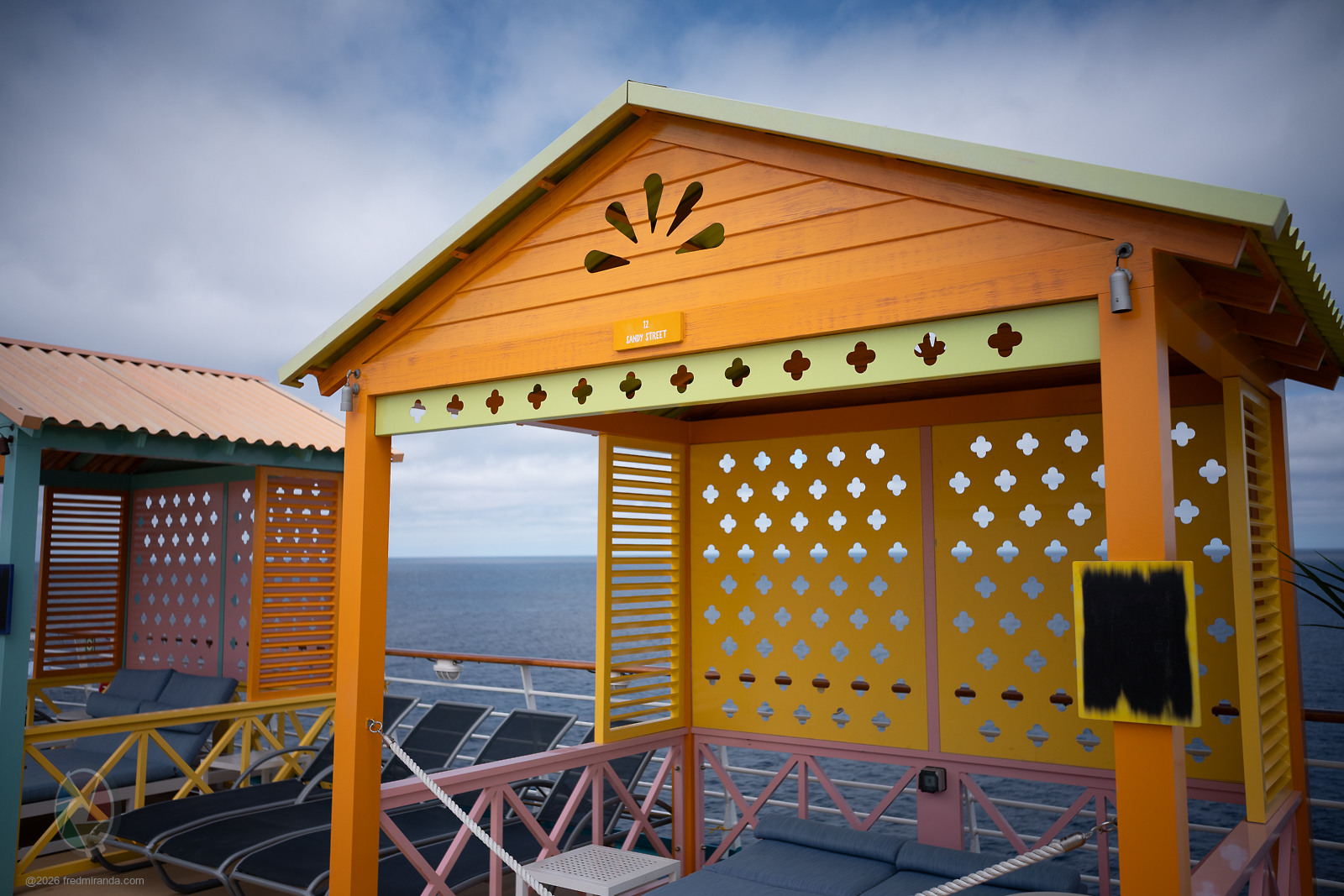
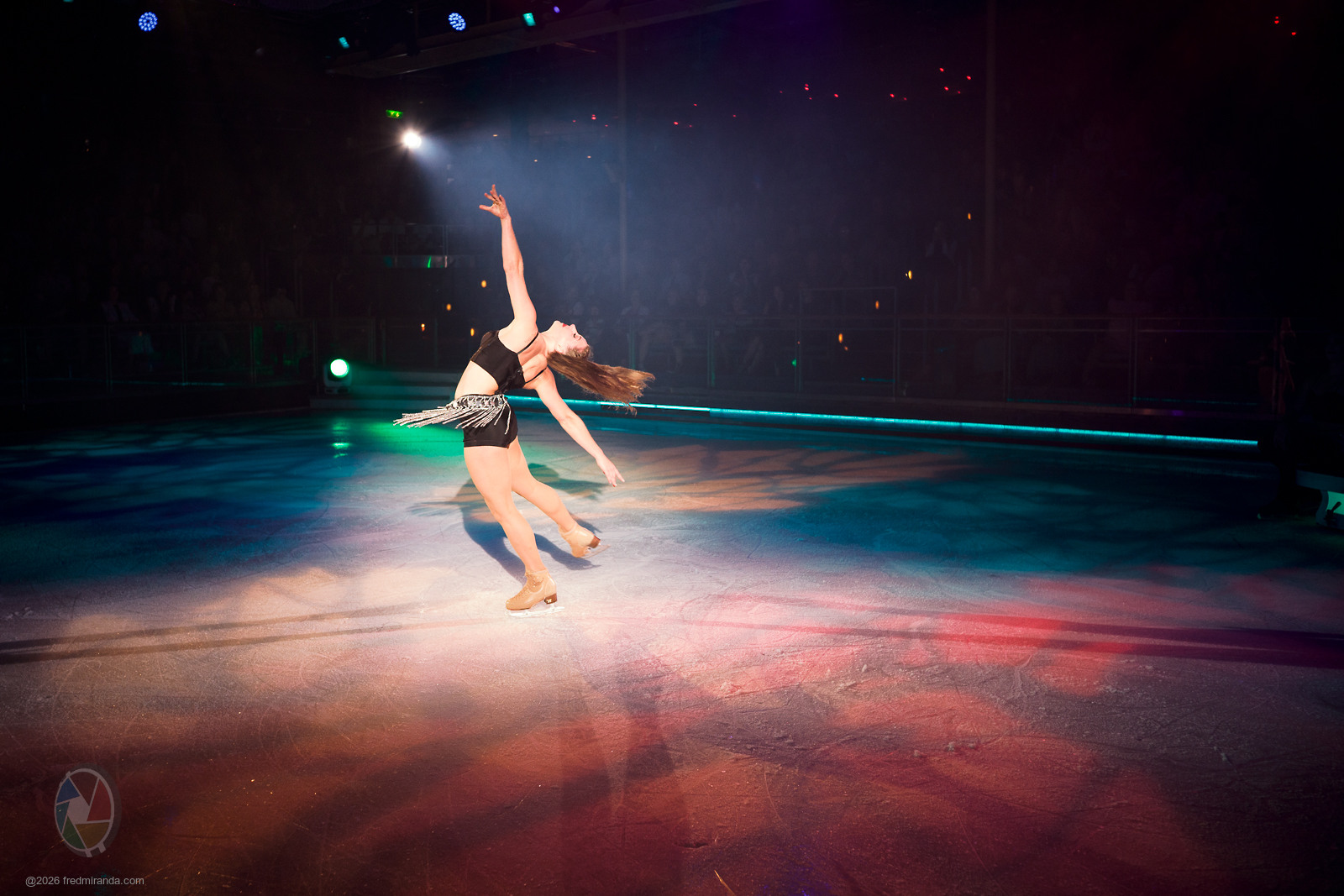
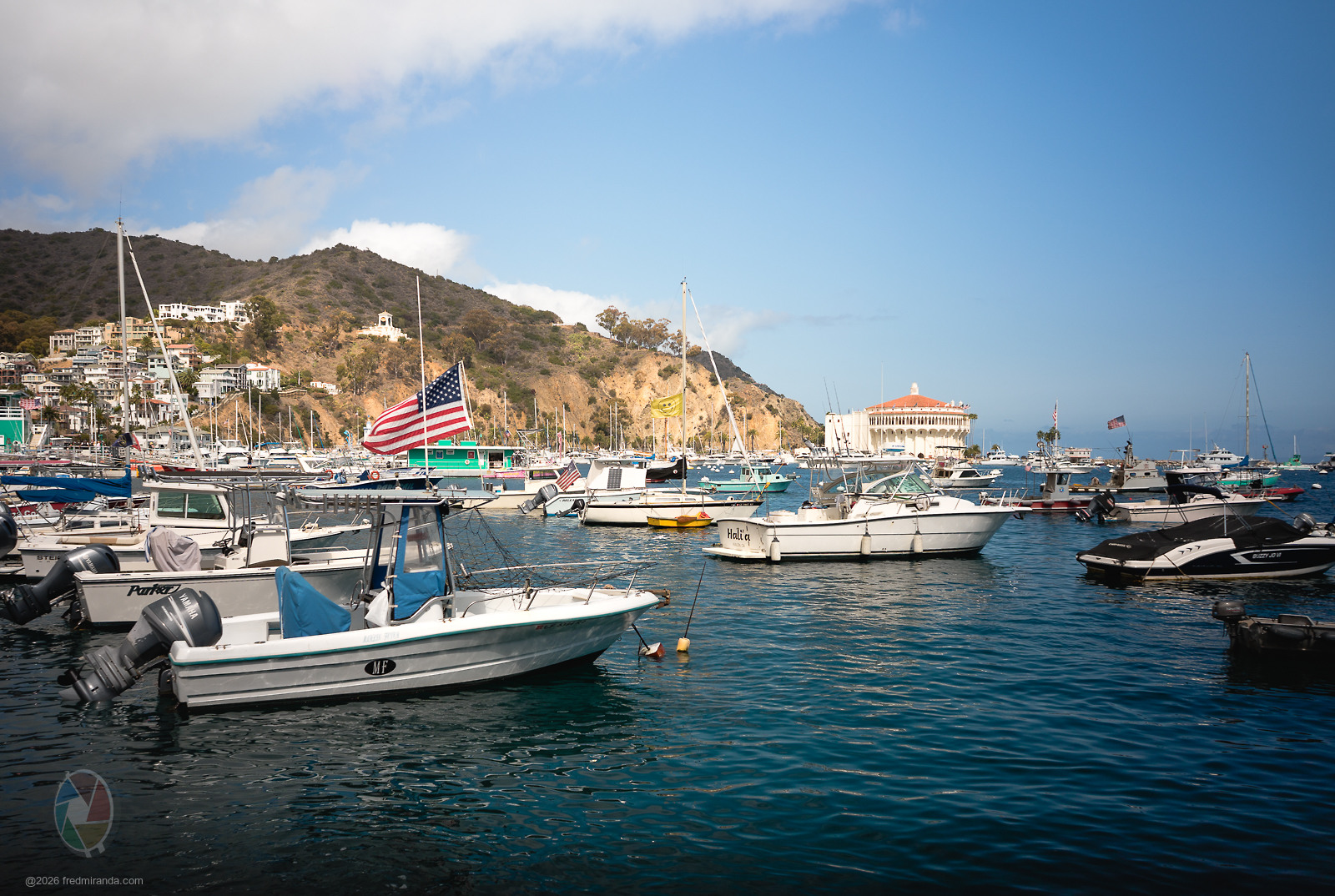
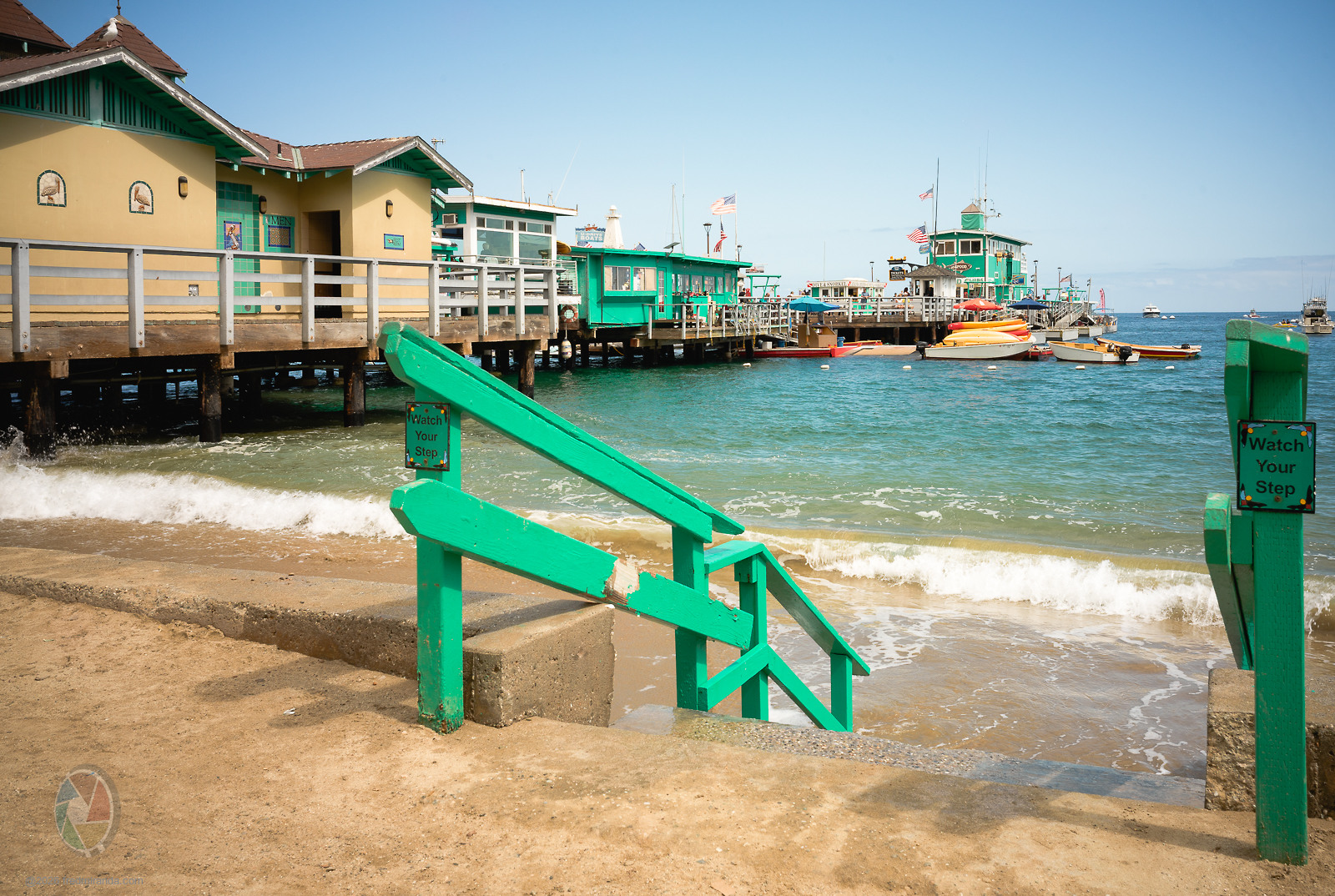
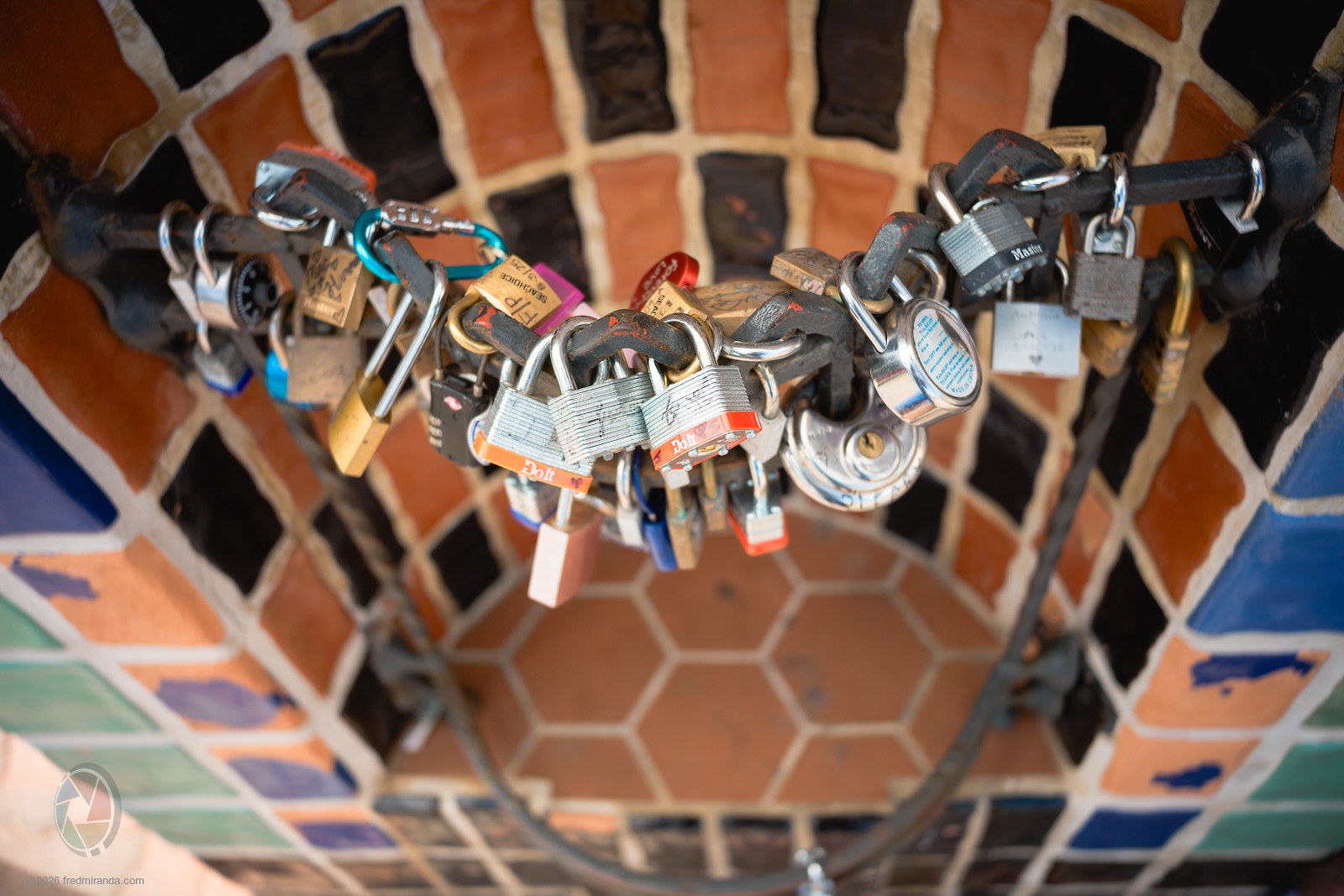
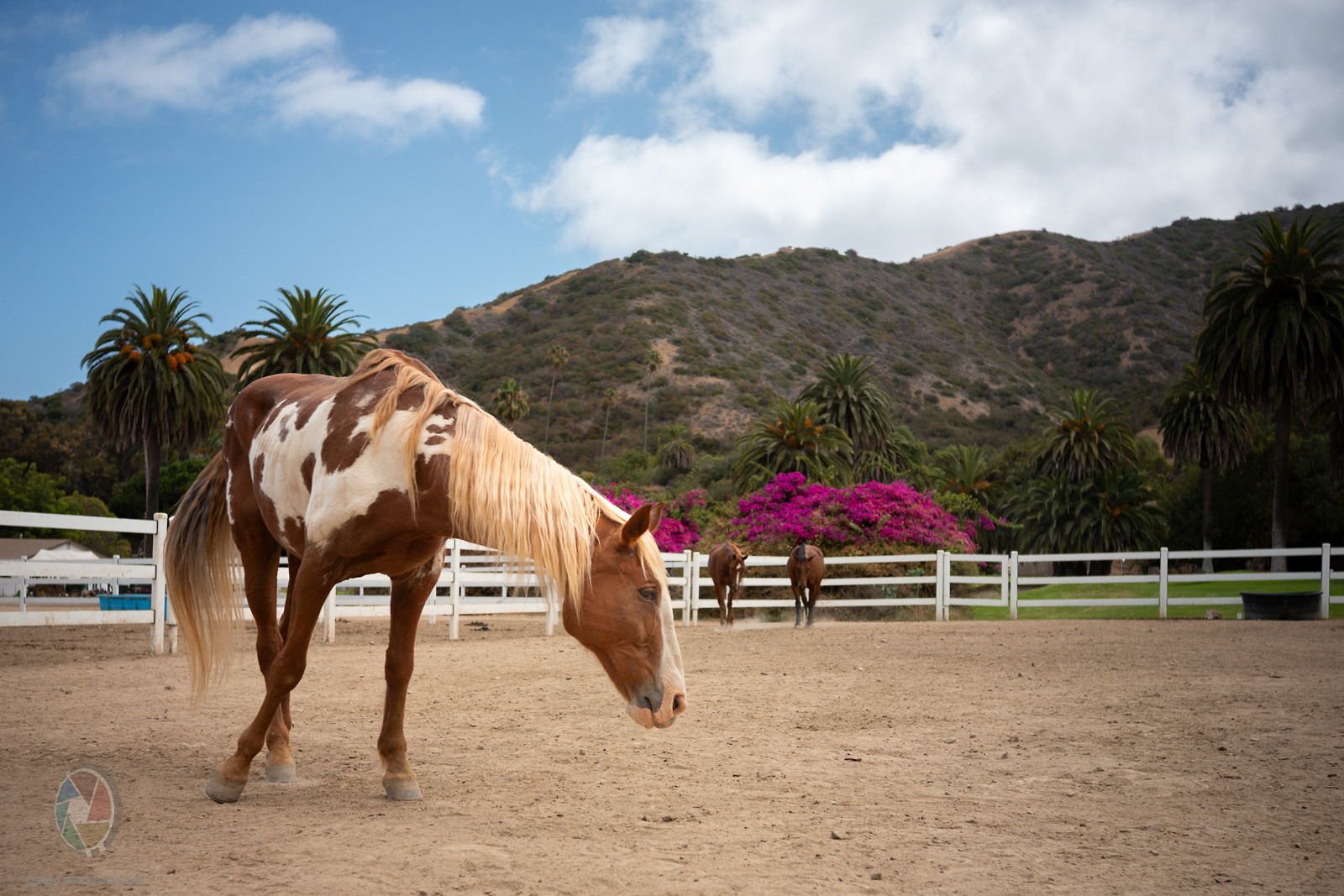
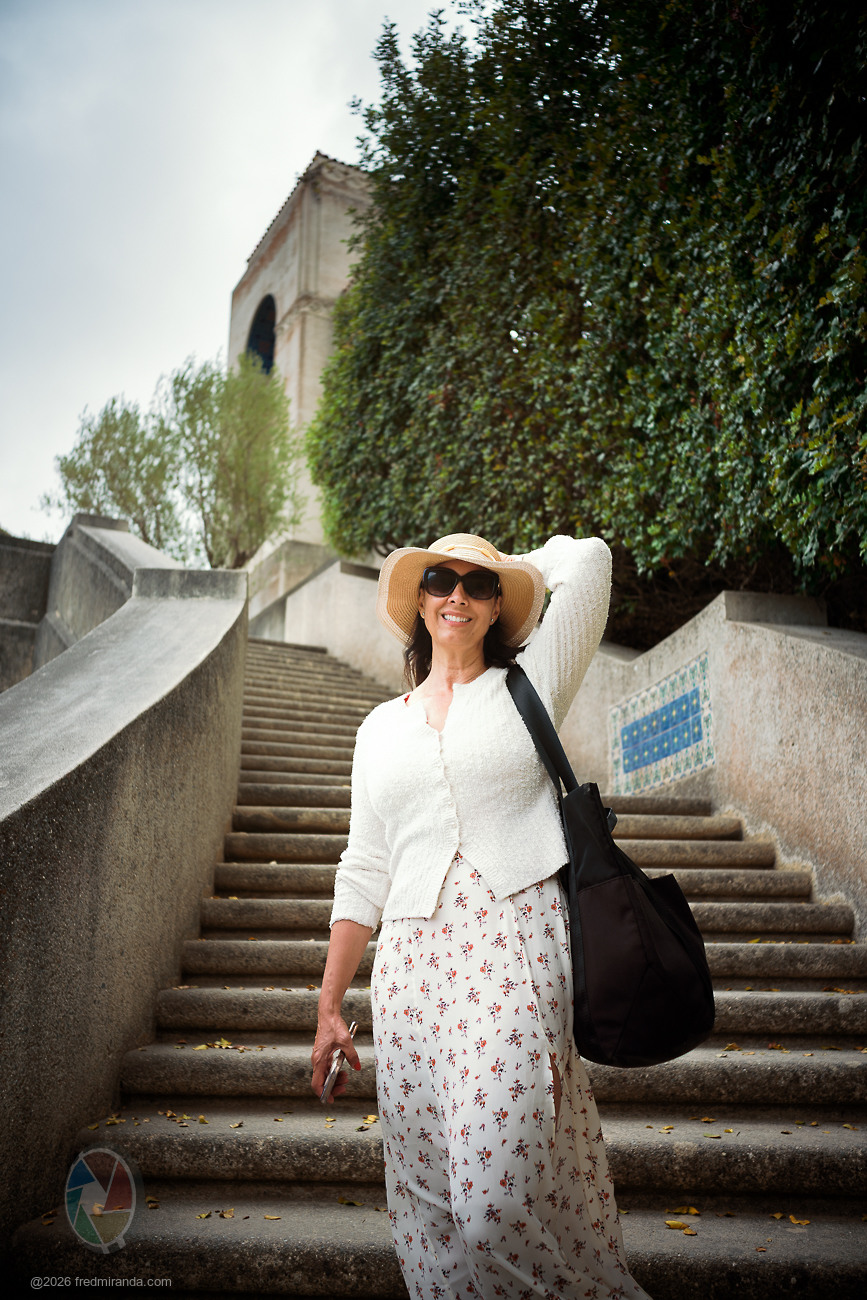
Samples 1: Mini-vacation: At various distances and lighting
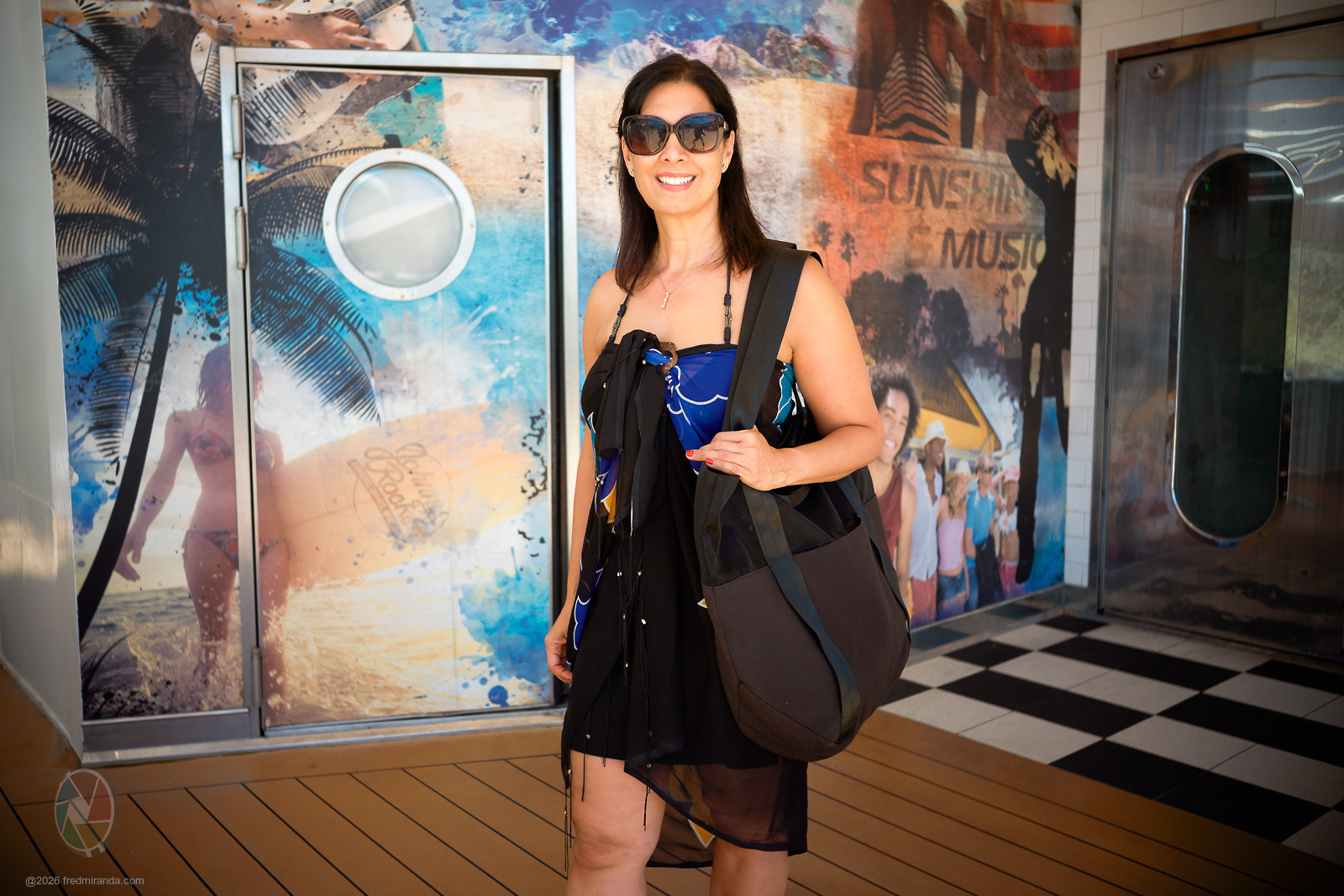
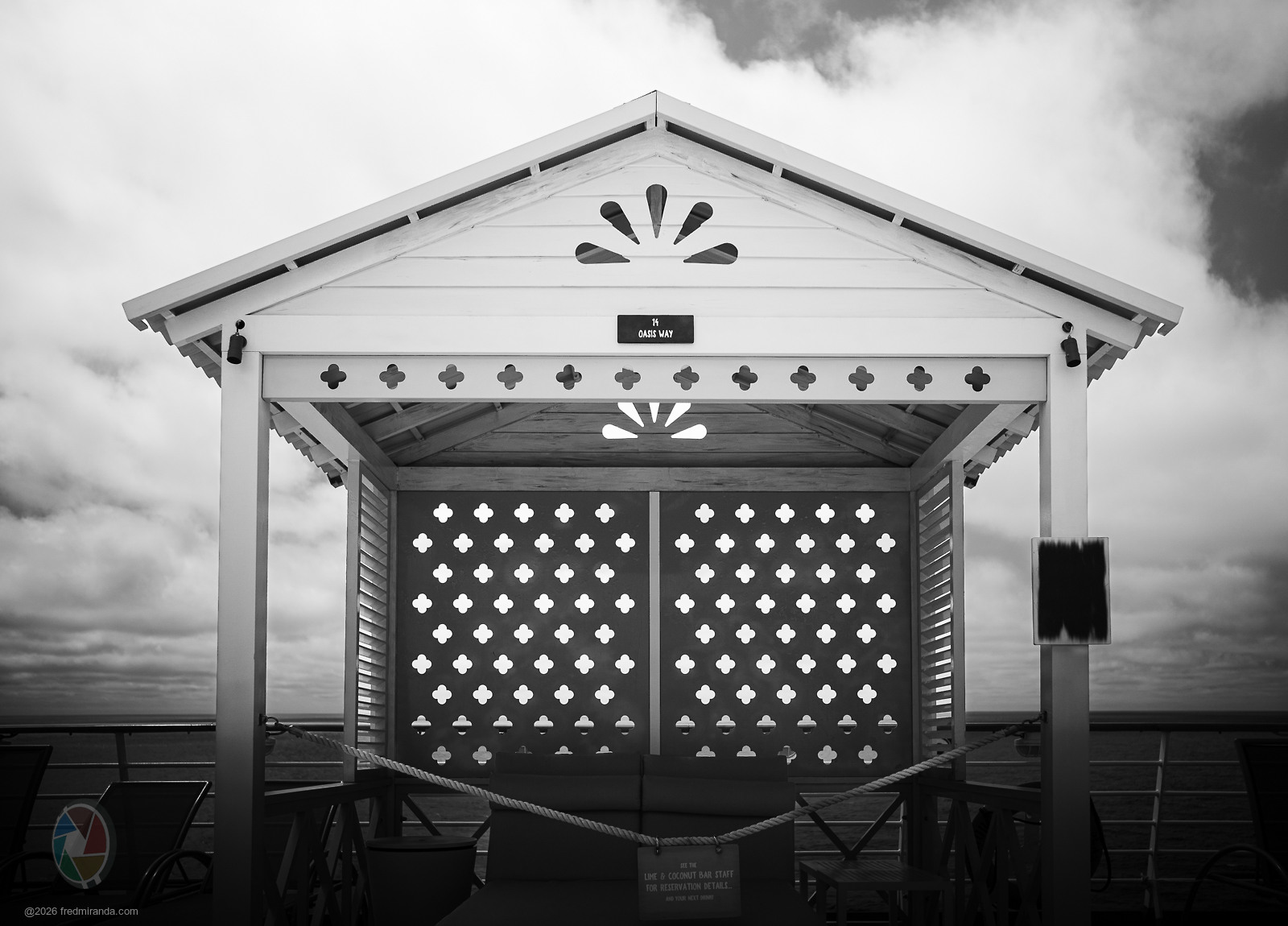
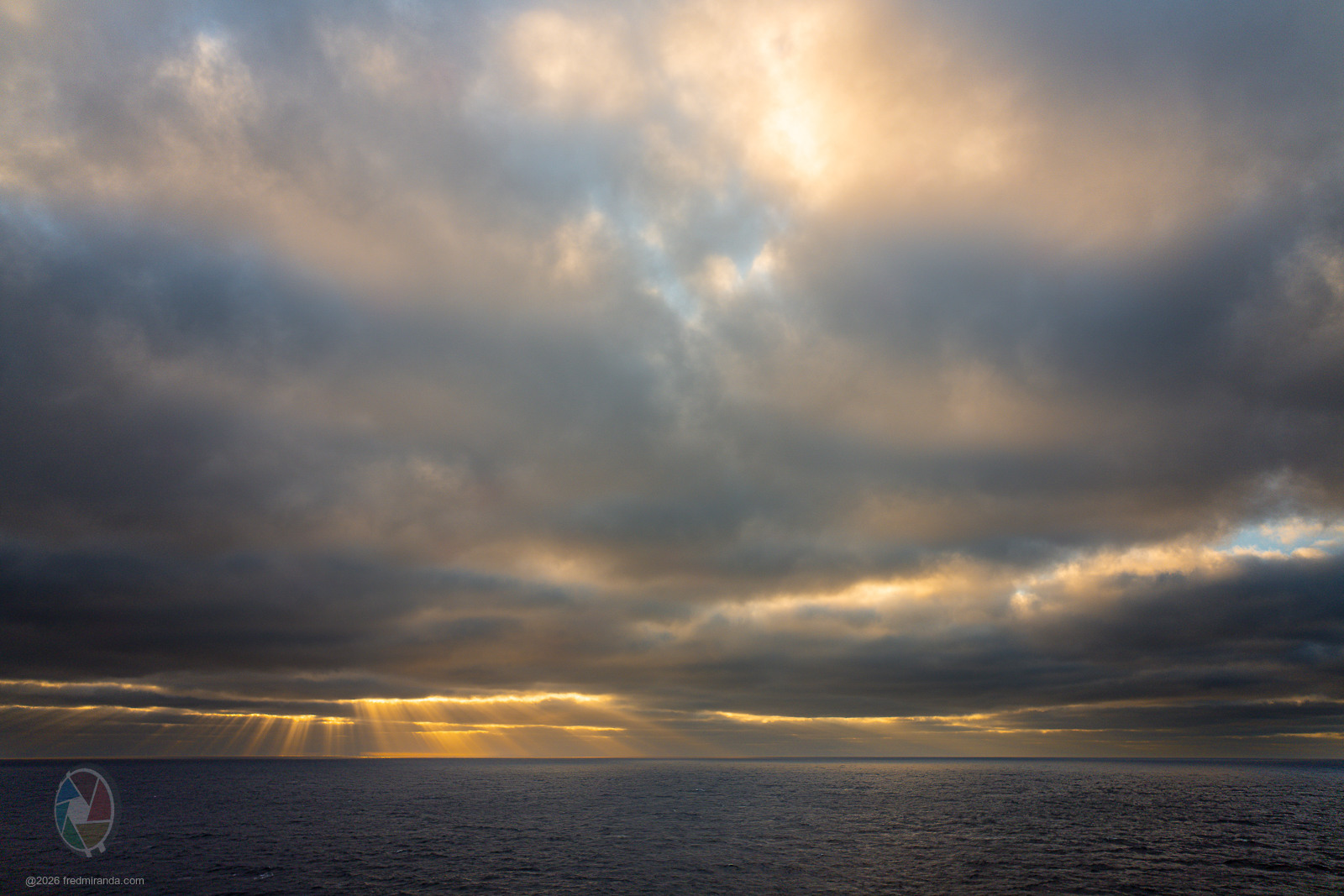
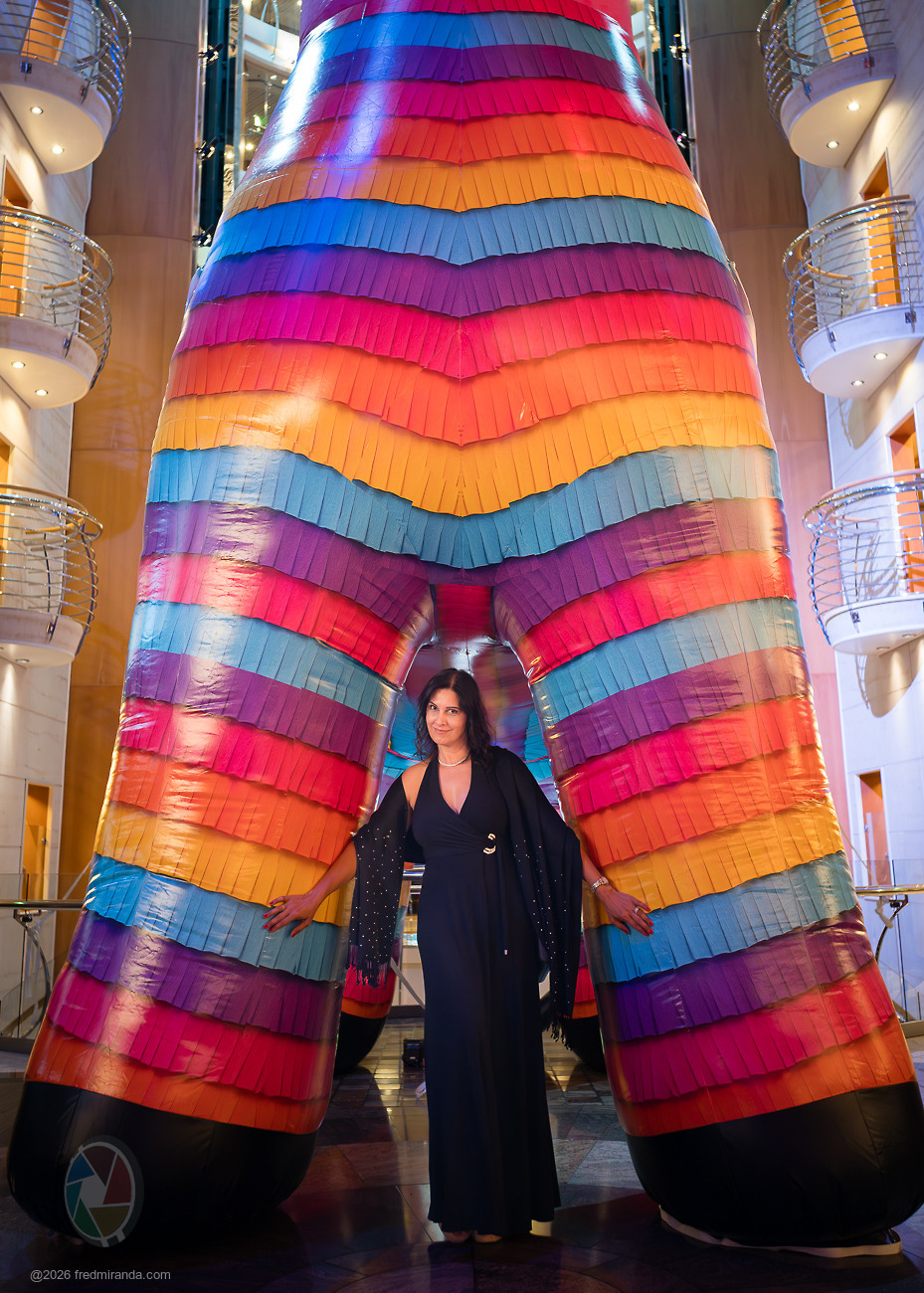
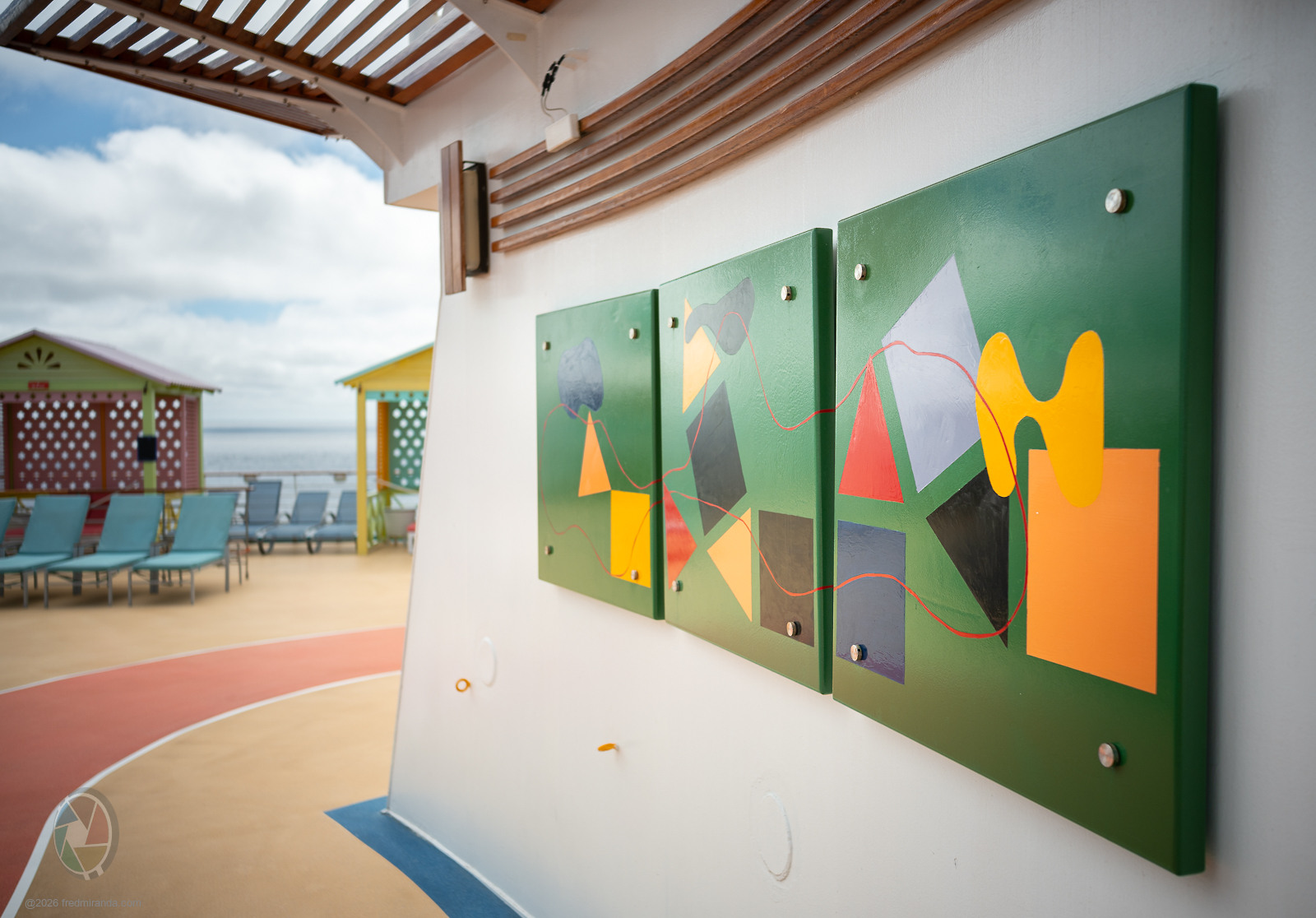
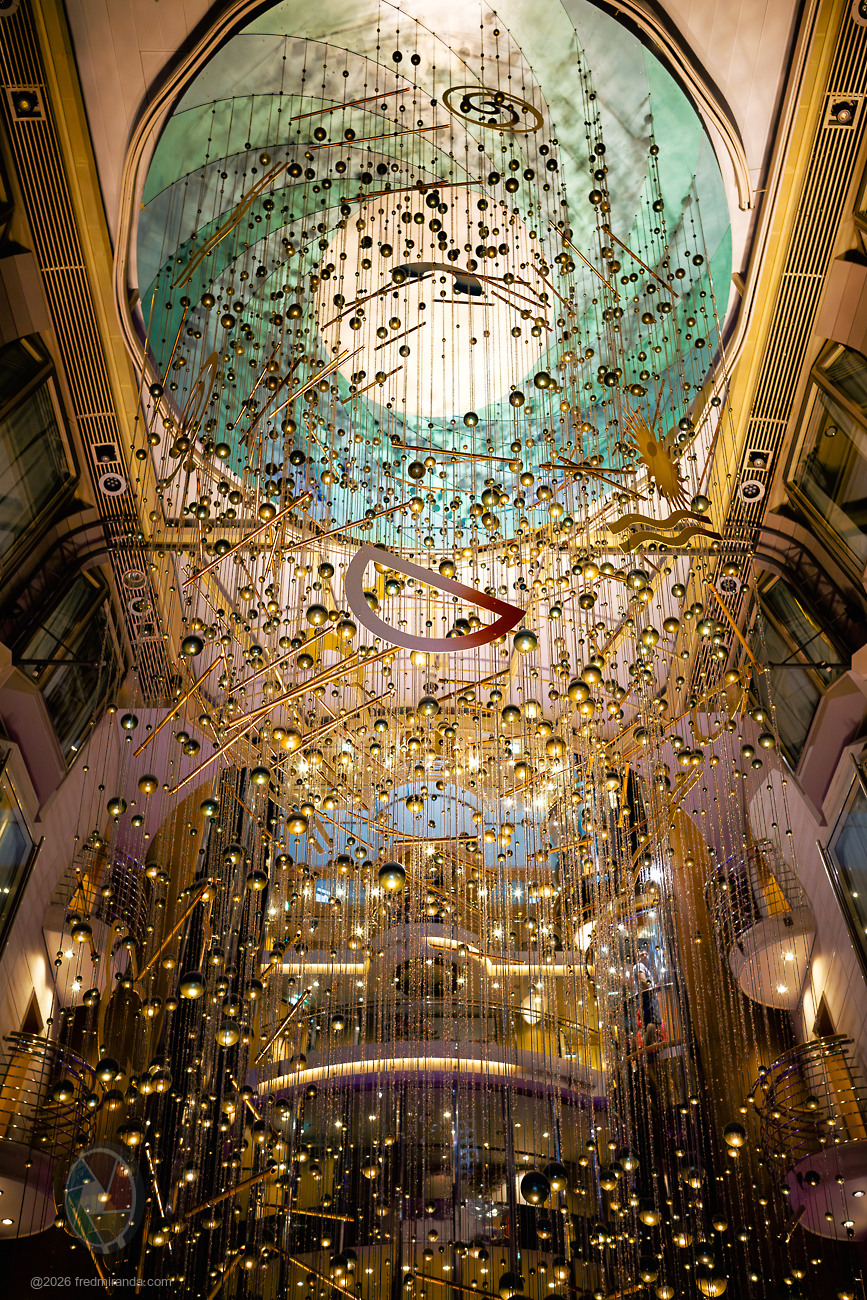
Most of the images were taken wide open at f/2.8 under a variety of lighting conditions and subject distances.
Post processing was kept minimal, with only light sharpening and slight exposure adjustments applied. I used the Adobe Color profile to a bit more contrast and to better showcase the lens’s natural color rendering.
No corrections were applied for distortion or chromatic aberration, allowing the lens's native rendering characteristics to be seen more clearly.
The Thypoch Eureka 28mm f/2.8 focuses down to 0.4m, which is quite impressive for such a small lens. It focuses closer than the larger Voigtlander 28mm f/2.8 Color Skopar compared in this review. The real question is whether it can maintain strong resolution and contrast at that minimum focus distance.
At MFD and wide open at f/2.8, I found the Eureka delivers very usable performance given both its size and the 0.4m close focus capability. Resolution and contrast barely improve at f/4, and there is essentially no gain by f/5.6. In practice, I would call f/2.8 the sweet spot for close range work, offering excellent flexibility when shooting at 0.4m, especially in low light.
The good news for rangefinder shooters is that I did not observe any meaningful focus shift with this lens. I confirmed this using a ruler test, along with side by side comparisons between f/2.8 and f/4 without refocusing, as well as direct focusing at f/4. The results remained consistent, with no noticeable change in focus accuracy or image quality.
The sequence below shows the lens performance progression from wide open at f/2.8 through to f/5.6. The lens was initially focused at f/2.8, and then the aperture was stepped down to f/4 and f/5.6 while maintaining the same focus point.
Samples 1: Mini-vacation 2: At various distances and lighting
Most of the images were taken wide open at f/2.8 under a variety of lighting conditions and subject distances.
Post processing was kept minimal, with only light sharpening and slight exposure adjustments applied. I used the Adobe Color profile to a bit more contrast and to better showcase the lens’s natural color rendering.
No corrections were applied for distortion or chromatic aberration, allowing the lens's native rendering characteristics to be seen more clearly.