Nice to see that even with a new, larger battery, there’s been a slight decrease in weight from the A7RV. There was a trend where every generation increased in size and weight.
RoamingScott wrote:
It's funny that this sensor is being scrutinized so hard simply because it's stacked and thusly compared to the A1 II (a stupid game to play).
If this was a run of the mill non-stacked BSI sensor that was a simple iteration of the formula and had all of the same specs, it would be universally lauded. If it was marketed accurately as the landscape camera that can do a bunch more, it would be better understood.
You'd be hard pressed to find a Nikon shooter that wouldn't want this in a Z7 III, too.
Don't agree with this at all.
The stacked sensor in this camera will allow massive improvements for every type of outdoor shooting with the e-shutter except for the fastest of movement scenarios. A jump from 100ms to 19 is very significant, and will prove useful to many.
It also makes the camera outstanding for video, which more and more users need these days. I think the exact same specs with an 80mp non-stacked sensor with a 100ms readout again would be considered a much less important upgrade.
johnvanr wrote:
Am I the only one who hardly cares about new camera releases?
I’ve been on an upgrade path for a long time, but nowadays I don’t see the point of most new cameras compared to what I have.
Like phones, computers, tvs and lot of other electronics it's all pretty minimal upgrades from single generations to the next. The smaller incremental changes and high prices are keeping me from upgrading and that's ok.
Steve Spencer wrote:
Well, that is interesting. I was wrong and it is a fully stacked sensor, but the sensor scan speed will still leave lots of room for the A1 II and the A9 III when people want to shoot fast action. This looks like a great camera, but I don't think it will be an A1 II killer.
But you had the right idea, that the sensor would be slovenly, despite the hype from some posters. It just shows that the stackable sensors aren't necessarily very good. If the shutter were not also so archaic at only 10FPS it would not be so bad. I suspect that many users will have a button mapped to switch MS to ES rapidly depending on the level of action.
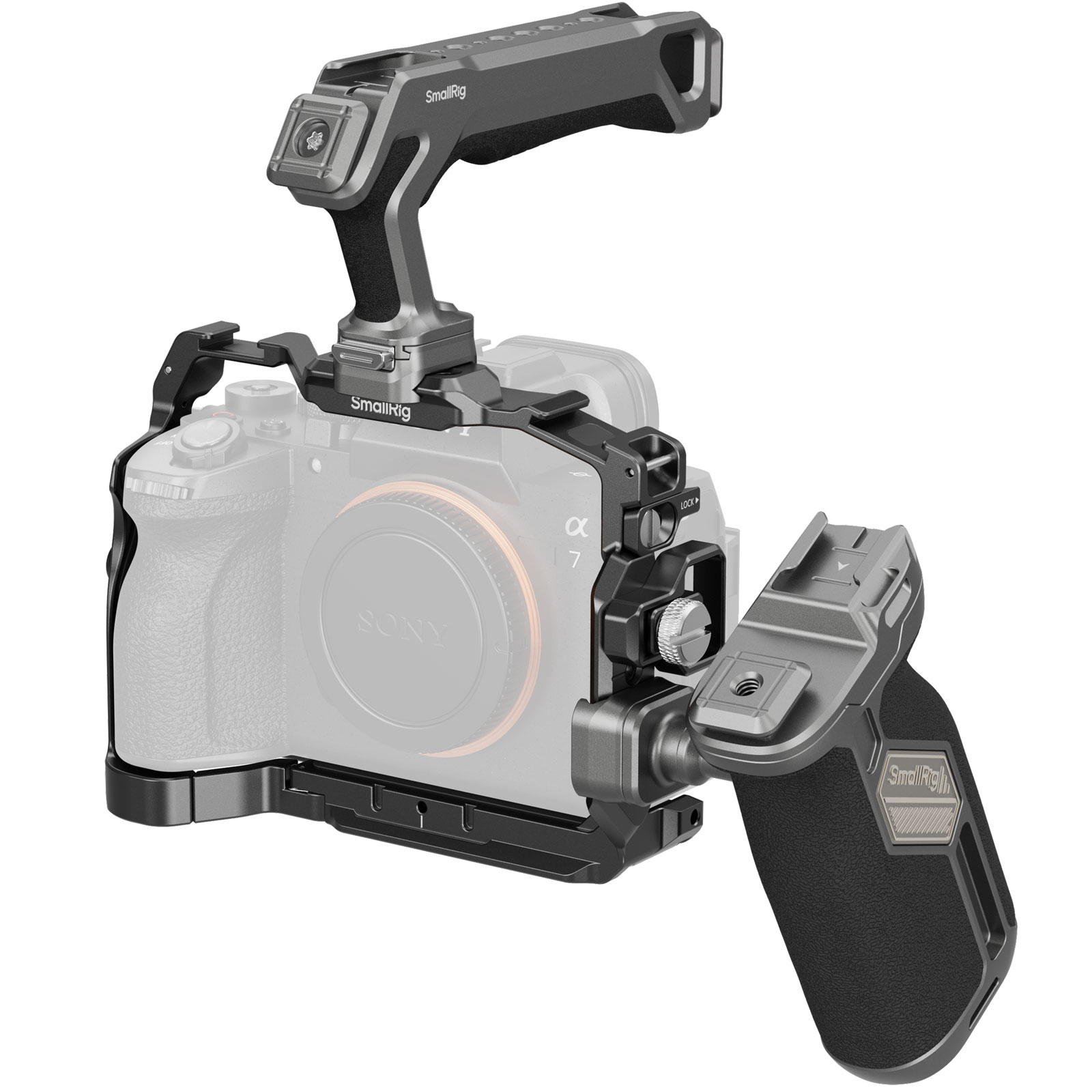
SmallRig teases the a7R VI cage. Glad to see they gave back the front edge stopper to the left-hand-side cold shoe. The 2025 Hawklock was otherwise good but sorely missing that:
LBJ2 wrote:
From a bird photographer and camera reviewer perspective, Jan Wegener:
@about 4:00 marker Rolling Shutter Experience."Quite usable"
@about 8:40 Image Quality & High ISO Results
For those who know the comparison, the sensor scan speed is pretty close to the Canon R5 (just a tiny bit slower), and that camera was useful in many people's eyes for quite a bit of action photography even for birds, but it also showed artifacts at times too. So the electronic shutter will be quite usable for many things, but I wouldn't include birds in flight as one of those things. As many have noted you can switch to the manual shutter and at 10 fps it will perform just fine. Does anyone know yet whether the EVF stays blackout free with the manual shutter? I assume it doesn't, which would be a further impediment to shooting fast action, but maybe they worked out a way to keep it blackout free even with the manual shutter.
On paper, the A7R VI sounds cool: new sensor with more megapixels, new processor, higher burst rate, and body refinements. But once you look past the marketing language, it becomes difficult to identify what has actually changed in a meaningful way for the photographers this camera is supposedly built for.
The increase from 61MP to 67MP is only about a 10% increase in linear resolution, which translates to a relatively negligible real-world gain for landscape work.
High ISO performance also appears to remain broadly similar. It stills excel at low ISO, but once you move into ISO 1600+ territory, IQ starts to fall apart. There doesn’t seem to be a meaningful leap forward. I myself was hoping for improvements in read noise, shadow cleanliness, or downstream processing flexibility rather than simply more pixels.
Despited being a fully stacked sensor, the readout speed is still behind cameras like the Canon R5 II and Nikon Z8, both of which are years old already.
The only upgrade that actually feels meaningful is the higher-capacity battery.
The issue isn’t that the A7R VI is a bad camera. It’s that this release doesn’t push the envelope far enough to make Nikon, Canon, or even Sony’s own previous-generation offerings any less compelling.
This release feels like a sign that Sony understands the market has matured. Canon and Nikon users are no longer switching systems purely because of body specifications.
That may make business sense for Sony. But for photographers hoping to see the company aggressively innovate again the way it once did, the A7R VI feels surprisingly underwhelming.
All that matters is a flood of discounted A7RVs about to flood the market . I can see that already in our Gear Sales forum. Great time to pick one up. The VI is a great camera no doubt but A7RV or even IV hold just fine.
old-gregg wrote:
Fredmiranda users are incredibly wildlife/sports oriented. I honestly don't know why, probably historical reasons. IRL all my photo contacts are weddings, events, real estate and landscape. They care about resolution, noise, dynamic range, weight, power management, AF dependability, glass selection, ergonomics. But then I come here and it's nothing but pre-capture or sensor speed in most conversations. Bizzarre. It's like going to BMW forums only to see endless debates about air pressure in a spare.
You make a good point. I've been in a few photo clubs and I was one of the few people interested in wildlife photography. A little bit more in Florida, but that's likely because it's an ideal place for bird photography.
Steve Spencer wrote:
For those who know the comparison, the sensor scan speed is pretty close to the Canon R5 (just a tiny bit slower), and that camera was useful in many people's eyes for quite a bit of action photography even for birds, but it also showed artifacts at times too. So the electronic shutter will be quite usable for many things, but I wouldn't include birds in flight as one of those things. As many have noted you can switch to the manual shutter and at 10 fps it will perform just fine. Does anyone know yet whether the EVF stays blackout free with the manual shutter? I assume it doesn't, which would be a further impediment to shooting fast action, but maybe they worked out a way to keep it blackout free even with the manual shutter....Show more →
Can’t answer your question, but autofocus isn’t as accurate in 10fps manual shutter, for obvious reasons.
Sundial wrote:
The increase from 61MP to 67MP is only about a 10% increase in linear resolution, which translates to a relatively negligible real-world gain for landscape work.
The sample images at DPR show pixel size increased from 9504 to 9984 (66.5 actual mp), so only 5% linear print width. I agree this is negligible, at least in my own printing workflow. Using original pixels fed at 300dpi to my Canon printer, print width went from 31.68” to 33.28”.
johnvanr wrote:
You may have missed that I asked if others don’t care either. If people increasingly opt out of the upgrade path, manufacturers have to care.
You cannot stop redesiging tech products. At a certain point it costs more to keep making an older model of something and eventually you cannot even get all the parts. Maybe Sony has a stockpile of a7rV sensors, but there could be difficulty making them in the 2030s.
The product category is so mature now I fear we're going to see marginal improvements and manufacturers chasing margin, not share gains. Need a hungry, ambitious new entrant. Wish Samsung had been successful, or some other pressure point on Sony and others. Sony is acting like the lazy incumbent Canon of old, these are the analogous complaints I had before I bailed and switched to Sony. Sure it makes sense for them as a business to do what they do... but I'd like to see something else as a consumer.
ZeeMike wrote:
All that matters is a flood of discounted A7RVs about to flood the market . I can see that already in our Gear Sales forum. Great time to pick one up. The VI is a great camera no doubt but A7RV or even IV hold just fine.
Hmmm.... In terms of nomenclature VI is sure a successor to A7rV. It is also priced accordingly. In terms of capabilities VI might be tempting to A1 users.
A7RV is a very landscape oriented (and non video) camera. In that kind of slow paced photography VI is not a game changer despite being quite an investment for someone having a well used A7rV.
However, maybe I will upgrade after a few years when A7rVI price will come down, it is a really tempting camera but the improvements are still incremental when put into a large scheme


 . I can see that already in our Gear Sales forum. Great time to pick one up. The VI is a great camera no doubt but A7RV or even IV hold just fine.